
TreasuryView compared with Atlar
Atlar vs. TreasuryView
Debt management for external facilities, intercompany loans, cash pools and derivatives
Atlar and TreasuryView both offer debt management, from different starting points. Atlar starts with cash, payments and bank connections. TreasuryView starts with the debt itself: external facilities, intercompany loans, cash pool interest and interest rate derivatives with risk analytics. This page compares both side by side, using the public information we reviewed on 5 November 2026.
Atlar and TreasuryView: where each one starts
Atlar describes itself as a cash and payments platform built on live bank connections. According to its public pages, it covers bank connectivity, payments with approval workflows, cash forecasting, reconciliation and debt management for intercompany loans, external term loans and revolving credit facilities. Atlar's debt management runs on its cash and payments platform and is not offered on its own. Atlar does not publish prices; plans are quoted individually.
TreasuryView is a debt management platform for finance teams, covering external facilities, intercompany loans, cash pools, derivatives and interest rate risk. Its calculation engine calculates interest, schedules and valuations from loan terms and market rates, and it has been in production use since 2009. Pricing is published from €250 per month (net), with a 30-day free trial and a REST API in every plan. TreasuryView does not connect to banks or execute payments, so your bank connections can stay where they are today.
The fit question: if your first need is connecting bank accounts, paying and seeing cash in one place, Atlar's scope is broader on the cash side. If your first need is the debt book, meaning external facilities, intercompany loans, cash pool interest and interest rate risk, TreasuryView is built around those tasks.
Take the interactive tour of intercompany loan management
Read the demo as text: how to add an intercompany loan and see it in the Interest cost report
This demo adds one intercompany loan in TreasuryView and shows it in the Interest cost report.
- Add an intercompany loan. An intercompany loan is entered in the loan form under its own label. You set the rate, day count and compounding, and TreasuryView previews the schedule before saving.
- Intercompany loan is its own loan type. Select it to open the loan form.
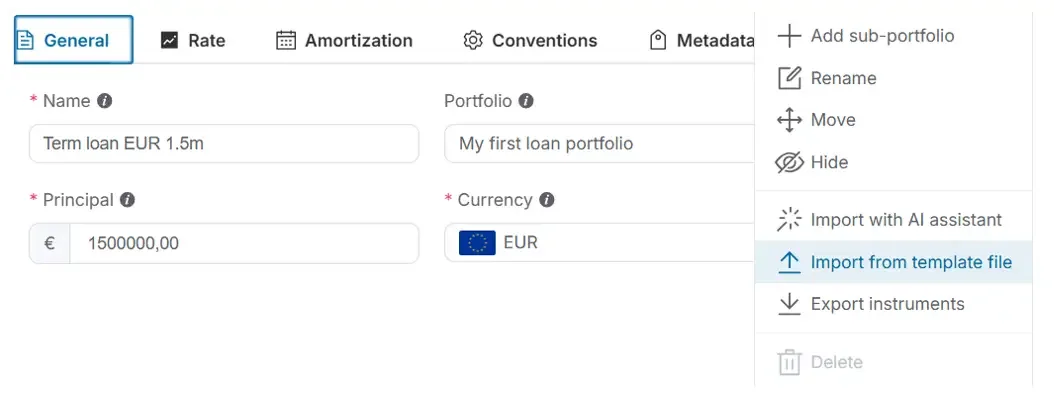
- Enter the loan terms. Name the loan and choose its portfolio. The other tabs hold principal and schedule, rate, amortization and conventions, and TreasuryView previews the schedule below the form.
- Set the payment logic of the agreement. Principal and schedule hold the amount, currency, dates, holiday calendar and payment frequency. The interest payment frequency is set separately, so the schedule follows your loan agreement.
- Check the schedule, then save. With interest paid annually, the schedule accrues interest month by month and pays it once a year. Select Save to add the loan.
- See the loan in the Interest cost report as of any reporting date. The new loan appears in the Interest cost report with its own interest for the selected period, calculated with market data as of the report date. The report exports to Excel, and the REST API sends the same results to accounting software.
Atlar or TreasuryView: which one should you choose?
Atlar and TreasuryView solve different first problems. Atlar starts with bank connections, cash movement and payments, and adds debt management on the same connections. TreasuryView starts with the debt book: intercompany loans, cash pool interest, external facilities, and the derivatives and interest rate risk analytics that go with them. Atlar's debt management comes with its cash and payments platform and is not offered on its own. TreasuryView does not connect to banks, import bank statements or make payments, so it runs next to the cash platform or bank portals a finance team already uses.
Choose Atlar if:
- Your intercompany loans should sit next to the live bank balances they are drawn from and repaid into, with interest and principal paid through your payment approval chains
- Your cash pools run as sweeps between bank accounts, set by rules on live bank connections
- Your external facilities need tracking next to cash and forecast, and you do not need interest rate swaps or interest rate risk analytics
- You plan to connect banks and your accounting system first, with a quote based on your banks, entities and usage, and an Atlar-led implementation on the Professional and Enterprise plans
- Cash position, payments with approval chains and bank reconciliation should live in one platform
Choose TreasuryView if:
- Your intercompany loans need the full agreement terms, with facilities, limits and commitment fees, drawdowns, fixed or floating rates, custom benchmark rates, tranches and repayment profiles
- Your cash pools need debit and credit interest calculated and reported, from balances or movements you enter or upload instead of automated matching through bank connections
- Your external facilities fund projects across the group and are planned as a portfolio, and you need interest rate swaps valued next to the loans they hedge, with stress tests and scenarios for interest cost and value, on GROW and above
- You are moving loans and cash pool balances out of spreadsheets and want to start self-service, without an integration project, with a 30-day free trial without a payment method, a published monthly price and cancellation at any time
- Your cash and payments workflows stay where they are, and the REST API in every plan sends loan data, schedules and report results to your accounting or treasury systems when you are ready to automate
Strengths and limits of each
TreasuryView
- Strength: external facilities, calculation accuracy since 2009
- External facilities with broad coverage of non-standard terms: fixed and floating rate loans, revolving credit facilities, refinancings and multi-leg loans, with bullet, linear or annuity repayment, commitment limits and fees, and tranches, available from the START plan. Interest, schedules and accruals come from a calculation engine in production use since 2009. In the rare case a figure differs from your bank's confirmation, any row can be corrected.
- Strength: intercompany loans and cash pools
- Intercompany loans with facilities, limits and commitment fees, drawdowns, tranches and custom benchmark rates. Cash pool accounts with debit and credit interest, calculated and reported from the balances or movements you enter or upload.
- Strength: derivatives and interest rate risk analytics
- Interest rate swaps with mark-to-market valuation, linked to the external facilities they hedge, plus interest rate stress tests (+/-100 bps, steepening, flattening), scenario analysis, BPV and duration sensitivities and comparison of hedging conditions with bank offers, on GROW and above. Cross-currency swaps, swaptions and hedge effectiveness testing are on ENTERPRISE. Caps and floors are modelled as loan terms on every plan.
- Strength: self-service start
- A 30-day free trial without a payment method. Move your loans and cash pool balances out of spreadsheets through the loan form or a spreadsheet upload, with no integration project.
- Strength: published pricing
- Monthly plans from €250 (net), cancel anytime, no setup or onboarding fees.
- Strength: API in every plan, from first call to full integration
- Generate a key in the app and send your first request from the interactive documentation, with no project and no extra fee. Automate at your own pace with report exports in XLSX or CSV, and bring in an integration project on ENTERPRISE when your systems need one.
- Strength: schedules you can correct to what happened
- Record what actually happened on a loan, cash pool or swap schedule, such as a moved payment date, an extra repayment or a new drawdown, and adjust upcoming rows to an agreed change. Later rows recalculate where a change carries forward. Available on every plan; swaps on GROW and above.
- Limit: no bank connectivity
- TreasuryView does not connect to banks, import bank statements or execute payments. Bank connections and payments stay in the systems you already use, and balances and movements are entered or uploaded.
- Limit: no cash management
- TreasuryView calculates interest on cash pool balances but does not run sweeps or netting, and does not provide daily cash positioning, payment approval chains or bank reconciliation.
Atlar
- Strength: cash and payments in one platform
- Bank connections, payments with approval chains, cash forecasting and reconciliation in one product, according to Atlar's public pages.
- Strength: bank connectivity
- Live bank connections, which Atlar describes as available in more than 100 countries.
- Strength: sweeping rules and AI agents
- Sweeping rules move funds between accounts, and ready-made AI agents cover cash positioning, reconciliation, sweeps, FX exposure and debt monitoring, including facility headroom and limits from a treasury policy, according to Atlar's public pages.
- Strength: debt connected to bank data and payments
- Loans and facilities sit next to the live bank balances they are drawn from and repaid into. Repayments, interest and drawdowns flow into the cash position and forecast, each payment or bank transaction is linked to the schedule it settles, and an agent can draft loan activity for repayments it spots in bank transactions, according to Atlar's public materials.
- Strength: guided implementation
- A dedicated account and delivery manager, a Slack channel and ongoing monitoring on the Professional plan, according to Atlar's pricing page.
- Consideration: quoted pricing and setup
- Plans are quoted individually, based on your banks, entities and usage. Atlar does not advertise a free trial and says customers go live in under 90 days on average.
- Consideration: cash pool interest
- Sweeps move cash between accounts. Interest calculation on cash pool balances between group entities is not described on Atlar's public pages as of 5 November 2026.
- Consideration: derivatives and risk analytics
- Interest rate swaps and bonds are on Atlar's roadmap (announced 3 November 2026). Its public pages list no swap valuation, interest rate stress testing or hedge reporting as of 5 November 2026.
Looking for an Atlar alternative for debt management?
If your main task is managing the debt book, meaning external facilities, intercompany loans, cash pools and interest rate derivatives, and your bank connections are already handled, TreasuryView is built for that job. It offers published pricing from €250 per month, cancellation at any time and a REST API in every plan. If you need payments and cash forecasting on the same bank connections, Atlar covers more of the cash operation.
Atlar vs. TreasuryView: debt management compared
| Feature | TreasuryView | Atlar |
|---|---|---|
| Core job | External facilities, intercompany loans, cash pools, derivatives and interest rate risk management | Cash, payments, forecasting, reconciliation and debt on live bank connections |
| External facilities | External facilities with broad coverage of non-standard terms: fixed and floating rate loans, revolving credit facilities, refinancings and multi-leg loans, with bullet, linear or annuity repayment, commitment limits and fees, and tranches, from the START plan. Calculation engine in production use since 2009; any row can be corrected to match a bank confirmation | Debt module for external term loans and revolving credit facilities, including loans to outside borrowers, with payments and bank transactions linked to the schedule they settle |
| Intercompany loans | Intercompany loans shared with subsidiaries (borrower or lender view) on every plan, plus bilateral facilities with limits and commitment fees, drawdowns, fixed or floating rates, custom benchmark rates, bullet, linear, annuity or fixed repayment and tranches | Debt module for intercompany loans, with fixed or floating rates, custom benchmark rates and bullet, linear or fixed repayment, set up in the app |
| Cash pool interest | Cash pool accounts with debit and credit interest on every plan, calculated and reported from the balances or movements you enter or upload. TreasuryView does not import bank statements, run sweeps or net positions | Sweeping rules and a cash sweep agent move funds between bank accounts. Interest calculation on cash pool balances between group entities is not described on its public pages (reviewed 5 Nov 2026), and sweeps that register as loan drawdowns are announced as upcoming |
| Pricing | Published: START €250 per month, GROW €500 per month, ENTERPRISE on request. Net of VAT. Priced per team, not per user | Not published; every plan is quoted individually |
| Free trial and contract | 30-day free trial with full access and no payment method. Monthly invoicing with no long-term contract, cancel any time, no cancellation fees, paid by bank transfer | No free trial advertised; you start with a quote and a guided setup. Contract terms not published |
| Setup and time to start | Sign up in under a minute and add loans through the loan form, a spreadsheet upload or AI-assisted import. No setup or onboarding fees | Debt management runs on the Atlar platform and is not sold on its own. Atlar says new customers go live in under 90 days on average, with guided setup on Professional and Enterprise and self-managed setup on Connect and Essential. Existing Atlar customers can add loans right away with their current balances |
| API access | REST API with interactive documentation (OpenAPI) and developer portal access on every plan | Listed on the Professional and Enterprise plans; public API documentation is open to all |
| Loan capture | Loan form or spreadsheet upload, plus AI-assisted import below; the REST API sends results out | Debt module set up in the app; no loan or debt endpoints in the API specification reviewed on 5 November 2026 (82 paths) |
| Get debt data out (downstream) | Loan and cash pool lists, payment schedules, derivative data on GROW and above and report runs with XLSX or CSV export, via the API | Not listed in the API specification reviewed on 5 November 2026 |
| Reference rates | Automated EUR reference rate fixings and pre-integrated curves on every plan; automated fixings in other currencies on ENTERPRISE; fixings and curves available via the API; custom benchmark rates are part of every loan's data model | Daily EURIBOR, SOFR, €STR and SONIA updates, according to Atlar (3 November 2026); custom benchmark rates with a missing-fixings review workflow |
| Derivatives and valuation | Interest rate swaps with mark-to-market valuation, linked to the loans they hedge, on GROW; cross-currency swaps, swaptions, basis and amortising swaps and hedge effectiveness testing on ENTERPRISE; caps and floors as loan terms on every plan | Interest rate swaps and bonds on the roadmap (announced 3 November 2026); FX risk listed as coming soon; no swap valuation listed |
| Interest rate risk analytics | Interest rate stress tests (+/-100 bps, steepening, flattening), scenario analysis, sensitivities (BPV and duration) and comparison of hedging conditions with bank offers on GROW and above | Not listed |
| Loan import with AI | AI-assisted import from term sheets, PDFs and spreadsheets (beta on START and GROW; included in ENTERPRISE) | An agent reads a loan agreement and drafts the loan; a person approves it |
| Bank connection | Not included. Bank data stays in your bank portal, accounting or treasury system, or connectivity provider | Yes, the foundation of the product, and bank statements can also be uploaded |
| Payments | Not included | Yes, through approval chains |
| Actual movements on the schedule | Recorded as schedule overrides on loans, cash pools and, on GROW and above, swaps, such as a moved payment date, an extra repayment or a new drawdown | Payments and bank transactions are linked to the schedule they settle |
| Debt interest posting to accounting | No direct posting of debt interest to the ledger; interest, accruals and schedules go to your accounting system through the API. Integration projects with accounting systems are available on ENTERPRISE | Posting of debt interest to accounting systems is announced as upcoming. Bank reconciliation already posts matches and journal entries to accounting systems such as NetSuite and Dynamics 365 |
| Audit trail | Unalterable audit trail of users and deals on GROW and ENTERPRISE; user activity log on START | Audit trail kept for 12, 36 or unlimited months, depending on plan |
| Single sign-on | Microsoft Entra ID on ENTERPRISE; passkey, e-mail code or federated sign-in on every plan | SAML SSO on Professional; Google SSO on Connect and Essential |
| Support and implementation | Support by e-mail, chat, phone and video call on every plan, priority support on GROW and ENTERPRISE, integration projects on ENTERPRISE | Atlar-led implementation with a dedicated account and delivery manager on Professional, according to its pricing page |
| Track record in debt management | Debt management in production use since 2009 | Debt module launched in 2026, according to Atlar's public materials |
Core job
TreasuryView
External facilities, intercompany loans, cash pools, derivatives and interest rate risk management
Atlar
Cash, payments, forecasting, reconciliation and debt on live bank connections
External facilities
TreasuryView
External facilities with broad coverage of non-standard terms: fixed and floating rate loans, revolving credit facilities, refinancings and multi-leg loans, with bullet, linear or annuity repayment, commitment limits and fees, and tranches, from the START plan. Calculation engine in production use since 2009; any row can be corrected to match a bank confirmation
Atlar
Debt module for external term loans and revolving credit facilities, including loans to outside borrowers, with payments and bank transactions linked to the schedule they settle
Intercompany loans
TreasuryView
Intercompany loans shared with subsidiaries (borrower or lender view) on every plan, plus bilateral facilities with limits and commitment fees, drawdowns, fixed or floating rates, custom benchmark rates, bullet, linear, annuity or fixed repayment and tranches
Atlar
Debt module for intercompany loans, with fixed or floating rates, custom benchmark rates and bullet, linear or fixed repayment, set up in the app
Cash pool interest
TreasuryView
Cash pool accounts with debit and credit interest on every plan, calculated and reported from the balances or movements you enter or upload. TreasuryView does not import bank statements, run sweeps or net positions
Atlar
Sweeping rules and a cash sweep agent move funds between bank accounts. Interest calculation on cash pool balances between group entities is not described on its public pages (reviewed 5 Nov 2026), and sweeps that register as loan drawdowns are announced as upcoming
Pricing
TreasuryView
Published: START €250 per month, GROW €500 per month, ENTERPRISE on request. Net of VAT. Priced per team, not per user
Atlar
Not published; every plan is quoted individually
Free trial and contract
TreasuryView
30-day free trial with full access and no payment method. Monthly invoicing with no long-term contract, cancel any time, no cancellation fees, paid by bank transfer
Atlar
No free trial advertised; you start with a quote and a guided setup. Contract terms not published
Setup and time to start
TreasuryView
Sign up in under a minute and add loans through the loan form, a spreadsheet upload or AI-assisted import. No setup or onboarding fees
Atlar
Debt management runs on the Atlar platform and is not sold on its own. Atlar says new customers go live in under 90 days on average, with guided setup on Professional and Enterprise and self-managed setup on Connect and Essential. Existing Atlar customers can add loans right away with their current balances
API access
TreasuryView
REST API with interactive documentation (OpenAPI) and developer portal access on every plan
Atlar
Listed on the Professional and Enterprise plans; public API documentation is open to all
Loan capture
TreasuryView
Loan form or spreadsheet upload, plus AI-assisted import below; the REST API sends results out
Atlar
Debt module set up in the app; no loan or debt endpoints in the API specification reviewed on 5 November 2026 (82 paths)
Get debt data out (downstream)
TreasuryView
Loan and cash pool lists, payment schedules, derivative data on GROW and above and report runs with XLSX or CSV export, via the API
Atlar
Not listed in the API specification reviewed on 5 November 2026
Reference rates
TreasuryView
Automated EUR reference rate fixings and pre-integrated curves on every plan; automated fixings in other currencies on ENTERPRISE; fixings and curves available via the API; custom benchmark rates are part of every loan's data model
Atlar
Daily EURIBOR, SOFR, €STR and SONIA updates, according to Atlar (3 November 2026); custom benchmark rates with a missing-fixings review workflow
Derivatives and valuation
TreasuryView
Interest rate swaps with mark-to-market valuation, linked to the loans they hedge, on GROW; cross-currency swaps, swaptions, basis and amortising swaps and hedge effectiveness testing on ENTERPRISE; caps and floors as loan terms on every plan
Atlar
Interest rate swaps and bonds on the roadmap (announced 3 November 2026); FX risk listed as coming soon; no swap valuation listed
Interest rate risk analytics
TreasuryView
Interest rate stress tests (+/-100 bps, steepening, flattening), scenario analysis, sensitivities (BPV and duration) and comparison of hedging conditions with bank offers on GROW and above
Atlar
Not listed
Loan import with AI
TreasuryView
AI-assisted import from term sheets, PDFs and spreadsheets (beta on START and GROW; included in ENTERPRISE)
Atlar
An agent reads a loan agreement and drafts the loan; a person approves it
Bank connection
TreasuryView
Not included. Bank data stays in your bank portal, accounting or treasury system, or connectivity provider
Atlar
Yes, the foundation of the product, and bank statements can also be uploaded
Payments
TreasuryView
Not included
Atlar
Yes, through approval chains
Actual movements on the schedule
TreasuryView
Recorded as schedule overrides on loans, cash pools and, on GROW and above, swaps, such as a moved payment date, an extra repayment or a new drawdown
Atlar
Payments and bank transactions are linked to the schedule they settle
Debt interest posting to accounting
TreasuryView
No direct posting of debt interest to the ledger; interest, accruals and schedules go to your accounting system through the API. Integration projects with accounting systems are available on ENTERPRISE
Atlar
Posting of debt interest to accounting systems is announced as upcoming. Bank reconciliation already posts matches and journal entries to accounting systems such as NetSuite and Dynamics 365
Audit trail
TreasuryView
Unalterable audit trail of users and deals on GROW and ENTERPRISE; user activity log on START
Atlar
Audit trail kept for 12, 36 or unlimited months, depending on plan
Single sign-on
TreasuryView
Microsoft Entra ID on ENTERPRISE; passkey, e-mail code or federated sign-in on every plan
Atlar
SAML SSO on Professional; Google SSO on Connect and Essential
Support and implementation
TreasuryView
Support by e-mail, chat, phone and video call on every plan, priority support on GROW and ENTERPRISE, integration projects on ENTERPRISE
Atlar
Atlar-led implementation with a dedicated account and delivery manager on Professional, according to its pricing page
Track record in debt management
TreasuryView
Debt management in production use since 2009
Atlar
Debt module launched in 2026, according to Atlar's public materials
Statements about Atlar are based on its public website, pricing page, documentation and changelog, reviewed on 5 November 2026. 'Not listed' means Atlar's public pages describe no such feature on that date; it does not rule out future releases. Additional currencies, or licensable reference rate or swap data, may require a separate market data licence, priced separately. Atlar is a trademark of its owner, and this page is not affiliated with or endorsed by Atlar. If you spot something outdated or inaccurate, please contact us and we will correct it.
Information about third-party products is based on publicly available sources and was last reviewed on 2026-11-05. TreasuryView is not affiliated with the vendors named. All product names and trademarks belong to their respective owners.
Derivatives and interest rate risk: what each platform covers today
Knowing where every loan and derivative stands is the first step. A treasurer also needs to know what happens when markets move. TreasuryView covers external facilities, intercompany loans, derivatives and interest rate risk in one platform, so positions and market impact sit together:
- Position: every external facility, intercompany loan and swap in one place, with schedules, accruals and valuations from the calculation engine.
- Impact: what a move of 100 basis points does to interest cost and cash flows, to the value of swaps and loans, and to the average cost of funds. Rate impact analysis is available on GROW.
- Growth: when the business adds a facility, a swap or a foreign-currency loan, it goes into the same platform instead of a new spreadsheet.
Derivatives and interest rate risk start with the GROW plan (€500 per month). START covers loans, intercompany loans and cash pools. FX rates, FX forward curves and FX history are available through the API. The FX risk management module (spot, forwards and options) is an ENTERPRISE add-on, available on request.
Atlar lists interest rate swaps and bonds as announced for later (3 November 2026). As of 5 November 2026 its public pages list no swap valuation or interest rate stress testing.
If your debt is only intercompany loans today, you may not need interest rate risk analytics yet. If external facilities or swaps are coming, starting on a platform that covers them avoids a second migration.
API and integration: link your debt data with the systems around it
Debt data is only useful if it reaches the systems that need it. TreasuryView's REST API is included in every plan, with API documentation and developer portal access, so you can build the workflow that fits your stack. Typical workflows:
- Upstream: loans enter through the loan form, a spreadsheet upload or AI-assisted import (beta), so you can start without an integration project.
- Downstream to accounting: pull accruals, schedules and reports into your accounting or treasury system, so figures are not retyped.
- Downstream to cash forecasting and BI: send interest and principal schedules to your forecasting tool or dashboards.
- Market data: pull curves, reference rate fixings and FX rates into your own models.
These are examples. The API documentation lists the endpoints available on your plan.
Bank connectivity: keep it where it is
TreasuryView does not connect to your banks, by design. It sits beside whatever you already use: your bank portal, your accounting or treasury system's bank module or a bank connectivity provider. You keep that choice and that contract. Bank transactions and repayments stay where they are; loan terms, schedules and interest live in TreasuryView, and the API links the two.
If bank connectivity and payments are your biggest pain today, a platform that bundles them with debt management may suit you better. Some teams will weigh connectivity heavily, and that is a reasonable reason to choose differently.
What each TreasuryView plan covers
- START (€250 per month): up to 50 loans, 1 company including subsidiaries, 5 internal users, multi-currency (EUR, USD, GBP, CHF and 20+ others), cash pools, intercompany loans, manual schedule overrides, integrated end-of-day market data and the REST API.
- GROW (€500 per month): up to 300 loans and interest rate derivatives, 15 internal users plus 10 guests, valuation and interest rate risk analytics, interest rate swaps, hedge coverage and priority support.
- ENTERPRISE (on request): cross-currency swaps, swaptions, hedge effectiveness testing, the FX risk management module (spot, forwards and options), automated fixings in other currencies, extended transaction volume and reports, single sign-on (Microsoft Entra ID), and integration projects with accounting systems, built for you.
Full functionality free for 30 days
Sign up in under a minute, no credit card. The trial ends automatically. Monthly plans from €250 (net), cancel anytime. Plan details are on the pricing page.
How to choose debt management software for loans and derivatives
If you answer "yes" to these questions, TreasuryView might be a good fit.
-
Still tracking external facilities, intercompany loans and cash pools in spreadsheets?
TreasuryView keeps external facilities, intercompany loans, cash pools and derivatives in one dashboard, with schedules and accruals calculated for you.
-
Do you need swaps valued and interest rate risk analysed next to your loans?
TreasuryView values interest rate swaps alongside your loans on GROW and above, with mark-to-market valuation, stress tests and interest rate scenarios. Caps and floors are modelled as loan terms.
-
Do you need a platform you can start with yourself, without an implementation project?
Sign up, add your loans through the loan form or a spreadsheet upload, and run reports. There are no setup fees.
-
Do you want published pricing before you commit budget?
Monthly plans are published from €250 (net), with a 30-day free trial.
-
Is bank connectivity already handled in your bank portal, your accounting or treasury system or by a provider?
TreasuryView works next to it and links through the API, so you keep that contract.
-
Do you need to send debt data to accounting, forecasting or BI tools?
The REST API, included in every plan, supports upstream and downstream data flows.
-
Do you need payments and daily cash positioning from the same tool?
Then Atlar's cash and payments scope may fit better. TreasuryView does not provide payments or daily cash management.
What the first 30 days look like
-
Start in under a minute
Immediate access
Create a free accountSign up for free and explore the full functionality.
-
Day 1
Import your data
Data migrationUpload your loans with the Excel template or enter them directly, and preview each schedule before you save.
-
Week 1
Automate your work
Customise views and automate reporting.
“It [TreasuryView] is a very intuitive tool to use, with enough capabilities to get a clear understanding of your company's treasury status. I also really value the support I get from their team setting it up for my company.”
Other comparisons
- Agicap Alternative for Loan & Debt Management
- Chatham Onyx Alternative for Mid-Sized Companies
- ION Treasury Alternative for Mid-Sized Companies
- Kyriba Alternative for Mid-Sized Companies
- Nomentia Alternative for SMBs & Mid-Sized Companies
- Ripple Treasury (GTreasury) Alternative
- Salmon Treasurer Alternative for Mid-Sized Companies
- Spreadsheet Alternative for Loan & Debt Management
- Enterprise TMS Alternative for Mid-Sized Companies
- ZenTreasury Alternative for SMBs & Mid-Sized Companies
FAQ: choosing between TreasuryView and Atlar
What is an Atlar alternative for debt management?
TreasuryView is one option if managing the debt book is your main task. It manages external facilities, intercompany loans, cash pools and interest rate derivatives, calculates interest, schedules and valuations, and publishes its monthly pricing. Atlar covers cash, payments and debt on live bank connections, so the better fit depends on whether cash and payments or debt and derivatives come first.
How much does Atlar cost compared with TreasuryView?
Atlar does not publish prices; plans are quoted individually, based on your banks, entities and usage. TreasuryView publishes its prices: START is €250 per month and GROW is €500 per month, both net of VAT, with ENTERPRISE on request. To compare total cost, compare the scope each one covers.
Is there a monthly plan, and can I cancel at any time?
Yes. TreasuryView plans are billed monthly, there is no long-term contract, and you can cancel any time in your account with no cancellation fee. Payment is by bank transfer. Atlar does not publish its contract terms on its pricing page.
Is there a free trial, and do I need a credit card?
TreasuryView offers a 30-day free trial with full access and no payment method. Atlar does not advertise a free trial on its public pages; you start with a quote and a guided setup.
Does TreasuryView have an API, and is it included in every plan?
Yes. TreasuryView's REST API, with interactive documentation, is included in START, GROW and ENTERPRISE, and so is developer portal access. Atlar lists its API on its Professional and Enterprise plans.
How do I get my loans into TreasuryView?
Through the loan form, a spreadsheet upload or AI-assisted import (beta). The REST API then sends calculation results out to your accounting or treasury systems.
Can I send TreasuryView data to my accounting system, cash forecast or BI tool?
Yes. Instruments, exposure portfolio data and report content can be exported through the API. TreasuryView does not post directly to your ledger; your accounting system receives the data.
Do I need bank connections to use TreasuryView?
No. TreasuryView does not connect to banks. Bank transactions and repayments stay in your bank portal, accounting or treasury system or connectivity provider, while loan terms, schedules and interest live in TreasuryView.
Can I keep my current bank connectivity provider?
Yes. TreasuryView sits beside your existing bank connectivity, whether that is your bank portal, your accounting or treasury system or a provider, and you keep that contract.
Can I get Atlar's debt data out through an API?
The public Atlar API specification we reviewed on 5 November 2026 (82 paths) does not list debt or loan endpoints. Atlar documents its debt module as an in-app workflow. Check Atlar's current documentation or ask Atlar directly, because its product may change.
How long has each vendor offered debt management?
TreasuryView's calculation engine has been in production use since 2009. According to Atlar's public materials, its debt module was launched in 2026.
How long does setup take compared with Atlar?
You can sign up in under a minute and upload loans from a spreadsheet on the first day. Atlar says new customers go live in under 90 days on average, with a guided setup.
Can I buy Atlar's debt management on its own?
According to Atlar, new customers go live on the full platform, with the same bank connections running cash management, payments, forecasting and reconciliation, not debt management on its own. Existing Atlar customers can add debt management right away. TreasuryView is a standalone debt management platform with a 30-day free trial.
Can I use TreasuryView next to Atlar?
Yes. TreasuryView does not replace a cash platform. Finance teams keep bank connections and payments where they are and use TreasuryView for external facilities, intercompany loans, cash pool interest and derivatives. The REST API sends schedules and report results to the systems around it.
Does Atlar support interest rate swaps and interest rate risk management?
Atlar's public pages list interest rate swaps and bonds as planned, announced on 3 November 2026. As of 5 November 2026 they list no swap valuation, interest rate stress testing or hedge reporting.
Which TreasuryView plan do I need for derivatives and interest rate risk?
Derivatives and interest rate risk analytics start with GROW at €500 per month. START covers loans, intercompany loans and cash pools. Cross-currency swaps, swaptions, basis and amortising swaps and hedge effectiveness testing are on ENTERPRISE.
What happens to my loans and derivatives when rates move?
TreasuryView shows the impact of rate moves on interest cost, cash flows and the value of swaps and loans, with rate impact analysis on GROW.
Does TreasuryView manage external facilities as well as intercompany loans?
Yes. External facilities, meaning bank loans and credit facilities, are available from the START plan, with broad coverage of non-standard terms: fixed and floating rate loans, revolving credit facilities, refinancings and multi-leg loans, with bullet, linear or annuity repayment, commitment limits and fees, and tranches. Interest, schedules and accruals come from a calculation engine in production use since 2009, and any row can be corrected to match a bank confirmation.
Can TreasuryView calculate interest on cash pool balances, and does it import bank statements?
TreasuryView calculates and reports debit and credit interest on cash pool accounts on every plan, from balances or movements you enter or upload. It does not import bank statements, run sweeps or net positions.
Does TreasuryView support custom benchmark rates, such as an internal group funding rate?
Yes. Custom benchmark rates are part of every loan's data model and are always on, so a loan can reset on an internal rate as well as on market indices.
Where is my data hosted?
Client data is stored in Germany, and TreasuryView is designed to meet EU GDPR requirements.
How we reviewed this page
Statements about Atlar are based on its public website, pricing page, documentation and changelog, read on 5 November 2026. Atlar facts are vendor-stated, including when its debt module launched. TreasuryView facts are taken from its pricing page on the same date. "Not listed" means Atlar's pages describe no such feature today. "Not published" means the pages we read are silent, not that something does not exist. Atlar may have changed since. If you spot something out of date, please contact us and we will correct it.
Compare with your own loan data, free for 30 days
Import your own loan portfolio, check the results against your existing model and then decide.