
TreasuryView compared with enterprise TMS
TreasuryView vs. enterprise TMS
Broad treasury suite or a focused debt book?
Enterprise treasury management systems (TMS) and TreasuryView both help finance teams manage debt, from different starting points. An enterprise TMS starts with a broad treasury operating model: cash, payments, bank connectivity, FX and risk, usually set up through a vendor-led implementation and sold on individually quoted contracts. TreasuryView starts with the debt itself: external facilities, intercompany loans, cash pool interest and interest rate derivatives with risk analytics. This page compares both approaches side by side, describing typical characteristics of the category rather than one vendor.
Enterprise TMS and TreasuryView: where each one starts
Enterprise TMS platforms are typically built for large corporates with dedicated treasury and IT teams. They usually cover a broad scope (cash and liquidity, payments, bank connectivity, FX, risk and more), are configured in an implementation project and are sold on individually quoted contracts. Scope, pricing and implementation vary by vendor, and this page describes the category, not a single product.
TreasuryView is a debt management platform for finance teams, covering external facilities, intercompany loans, cash pools, derivatives and interest rate risk. Its calculation engine calculates interest, schedules and valuations from loan terms and market rates, and it has been in production use since 2009. Pricing is published from €250 per month (net), with a 30-day free trial and a REST API in every plan. TreasuryView does not connect to banks or execute payments, so your bank connections can stay where they are today. It is designed to replace spreadsheets for debt, without the scope of an enterprise suite.
The fit question: an enterprise TMS is the broader choice if you need global cash positioning, payment execution and bank connectivity in one platform, and you can plan an implementation project. TreasuryView is the focused choice if your task is the debt book and its derivatives, meaning external facilities, intercompany loans, cash pool interest, swaps and interest rate risk, and your cash and payment workflows stay where they are. The difference is the starting point (treasury operating model or debt first), setup effort and how pricing works.
Take the interactive product tour
Read the demo as text: how to add loans and generate one loan report
Loan data often starts in spreadsheets: loan terms are retyped from PDFs, reference rates are looked up by hand and the same report is rebuilt every month. This interactive demo shows how TreasuryView replaces those steps.
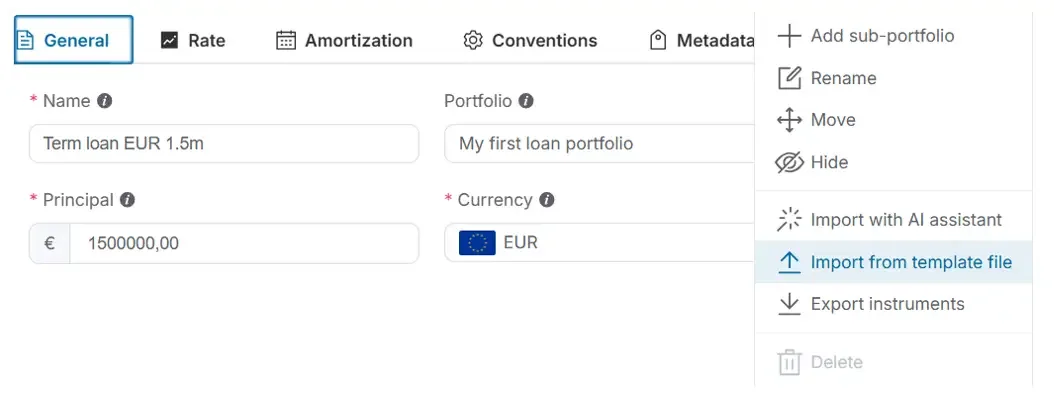
- TreasuryView offers three routes for adding a loan: the loan form, the Excel template and AI-assisted import (beta), which reads a spreadsheet you already have.
- The loan form is the route for a single loan. You enter the key terms, such as principal, dates, rate, payment frequency and conventions, and TreasuryView calculates the schedule. For a bespoke repayment schedule, the cash flows can be copied from Excel into the schedule.
- The Excel template is the route for many loans at once. You download the TreasuryView template, enter one row per loan and upload it.
- AI-assisted import (beta) is the route for a spreadsheet you already have. TreasuryView analyses the file and extracts the loan terms. Results depend on how structured the file is.
- The report is one view of bank loans and intercompany loans, calculated from the loan terms with market data as of the reporting date.
- The demo ends with an invitation to start with your own loans instead of rebuilding the report by hand.
Enterprise TMS or TreasuryView: which one should you choose?
An enterprise TMS and TreasuryView answer different questions. An enterprise TMS is a broad platform for a treasury operating model: cash, payments, bank connectivity, FX and risk, set up through a vendor-led implementation. TreasuryView is built around debt and derivatives tasks: external facilities, intercompany loans, cash pool interest, swaps and the interest rate risk analytics that go with them. It does not connect to banks, import bank statements or make payments, so it runs next to the bank and accounting systems a finance team already uses.
Choose an enterprise TMS if:
- You need global cash management, payment execution and bank connectivity in one platform
- You have a dedicated treasury team and IT resources for an implementation project
- Your treasury spans many entities, banks and countries, with formal front, middle and back office processes
- You need a broad range of instruments and treasury workflows beyond debt, such as FX trading, investments or payment factories
- You can agree an individually quoted licence and plan implementation, training and integrations as a project
Choose TreasuryView if:
- Your task is the debt book and its derivatives rather than a treasury operating model, and your intercompany loans need the full agreement terms, with facilities, limits and commitment fees, drawdowns, fixed or floating rates, custom benchmark rates, tranches and repayment profiles
- Your cash pools need debit and credit interest calculated and reported, from balances or movements you enter or upload instead of an in-house bank set-up
- Your external facilities fund projects across the group and are planned as a portfolio, and you need interest rate swaps valued next to the loans they hedge, with stress tests and scenarios for interest cost and value, on GROW and above
- You are moving loans and cash pool balances out of spreadsheets and want to start self-service, without an integration project, with a 30-day free trial without a payment method, a published monthly price and cancellation at any time
- Your cash and payments workflows stay where they are, and the REST API in every plan sends loan data, schedules and report results to your accounting or treasury systems when you are ready to automate
Strengths and limits of each
TreasuryView
- Strength: external facilities, calculation accuracy since 2009
- External facilities with broad coverage of non-standard terms: fixed and floating rate loans, revolving credit facilities, refinancings and multi-leg loans, with bullet, linear or annuity repayment, commitment limits and fees, and tranches, available from the START plan. Interest, schedules and accruals come from a calculation engine in production use since 2009. In the rare case a figure differs from your bank's confirmation, any row can be corrected.
- Strength: intercompany loans and cash pools
- Intercompany loans with facilities, limits and commitment fees, drawdowns, tranches and custom benchmark rates. Cash pool accounts with debit and credit interest, calculated and reported from the balances or movements you enter or upload.
- Strength: derivatives and interest rate risk analytics since 2009
- Derivatives valued next to the debt book since 2009: interest rate swaps with mark-to-market valuation, linked to the external facilities they hedge, plus interest rate stress tests (+/-100 bps, steepening, flattening), scenario analysis, BPV and duration sensitivities and comparison of hedging conditions with bank offers, on GROW and above. Cross-currency swaps, swaptions and hedge effectiveness testing are on ENTERPRISE. Caps and floors are modelled as loan terms on every plan.
- Strength: self-service start
- A 30-day free trial without a payment method. Move your loans and cash pool balances out of spreadsheets through the loan form or a spreadsheet upload, with no integration project.
- Strength: published pricing
- Monthly plans from €250 (net), cancel anytime, no setup or onboarding fees.
- Strength: API in every plan, from first call to full integration
- Generate a key in the app and send your first request from the interactive documentation, with no project and no extra fee. Automate at your own pace with report exports in XLSX or CSV, and bring in an integration project on ENTERPRISE when your systems need one.
- Strength: schedules you can correct to what happened
- Record what actually happened on a loan, cash pool or swap schedule, such as a moved payment date, an extra repayment or a new drawdown, and adjust upcoming rows to an agreed change. Later rows recalculate where a change carries forward. Available on every plan; swaps on GROW and above.
- Limit: no bank connectivity
- TreasuryView does not connect to banks, import bank statements or execute payments. Bank connections and payments stay in the systems you already use, and balances and movements are entered or uploaded.
- Limit: no cash management
- TreasuryView calculates interest on cash pool balances but does not run sweeps or netting, and does not provide daily cash positioning, payment approval chains or bank reconciliation.
- Limit: no lease accounting
- TreasuryView does not provide IFRS 16 lease accounting, lease schedules or lease journals. If leases are your main task, a platform built for them, such as ZenTreasury, is the better fit, and TreasuryView can manage the debt book next to it.
Enterprise TMS (typical)
- Strength: breadth
- Cash, payments, bank connectivity, FX and risk in one platform for complex, global treasury operations.
- Strength: bank connectivity and payments
- Bank statements, balances and payment workflows are usually part of the suite, with approval chains and bank reconciliation.
- Strength: specialist teams and formal processes
- Built for dedicated treasury departments, with roles, approvals and segregation of duties.
- Strength: wide instrument and module coverage
- Typically a wide range of instruments and treasury workflows, depending on the modules licensed.
- Consideration: implementation and cost
- Implementation, training and licensing usually need more budget, time and IT resources, and prices are individually quoted.
- Consideration: scope beyond debt
- A team whose work is mainly debt may license and configure modules it does not use. Coverage of non-standard debt terms varies by vendor.
- Consideration: terms differ by vendor
- Scope, deployment model, pricing and contract terms vary by vendor, so request current documentation and check it against your requirements.
Looking for an enterprise TMS alternative for debt management?
If your main task is managing the debt book, meaning external facilities, intercompany loans, cash pools and interest rate derivatives, and your cash and payment workflows are handled elsewhere, TreasuryView is built for that job. It offers published pricing from €250 per month, cancellation at any time and a REST API in every plan. If you need global cash positioning, payment execution and bank connectivity on one platform, an enterprise TMS covers more of that.
Enterprise TMS vs. TreasuryView: debt management compared
| Feature | TreasuryView | Enterprise TMS (typical) |
|---|---|---|
| Core job | External facilities, intercompany loans, cash pools, derivatives and interest rate risk management | A broad treasury operating model: cash and liquidity, payments, bank connectivity, FX and risk, with debt as one area among several |
| External facilities | External facilities with broad coverage of non-standard terms: fixed and floating rate loans, revolving credit facilities, refinancings and multi-leg loans, with bullet, linear or annuity repayment, commitment limits and fees, and tranches, from the START plan. Calculation engine in production use since 2009; any row can be corrected to match a bank confirmation | Debt is usually one module of a wider suite and is configured during implementation. Coverage of non-standard terms varies by vendor |
| Other instruments | Focused on external facilities, intercompany loans, cash pools and interest rate derivatives; FX risk management is an ENTERPRISE add-on | Typically a wide range, such as cash, payments, FX, investments and guarantees, depending on the modules licensed |
| Intercompany loans | Intercompany loans shared with subsidiaries (borrower or lender view) on every plan, plus bilateral facilities with limits and commitment fees, drawdowns, fixed or floating rates, custom benchmark rates, bullet, linear, annuity or fixed repayment and tranches | Usually supported, often together with in-house banking. Depth varies by vendor and module |
| Cash pool interest | Cash pool accounts with debit and credit interest on every plan, calculated and reported from the balances or movements you enter or upload. TreasuryView does not import bank statements, run sweeps or net positions | Often covered through cash pooling or in-house banking modules, where licensed |
| In-house banking and netting | Not included. TreasuryView calculates and reports cash pool interest and does not run sweeps, netting or internal accounts | Often available as a module in larger suites. Scope and licensing vary by vendor |
| Pricing | Published: START €250 per month, GROW €500 per month, ENTERPRISE on request. Net of VAT. Priced per team, not per user | Typically individually quoted. The licence is often based on modules, users, entities or bank accounts, with implementation fees quoted separately |
| Free trial and contract | 30-day free trial with full access and no payment method. Monthly invoicing with no long-term contract, cancel any time, no cancellation fees, paid by bank transfer | Varies by vendor. Evaluation usually runs through a sales conversation and a demo, and contract length and notice periods are agreed individually |
| Setup and time to start | Sign up in under a minute and add loans through the loan form, a spreadsheet upload or AI-assisted import. No setup or onboarding fees | Usually a vendor-led implementation project. Duration depends on scope, integrations and the number of bank connections |
| API access | REST API with interactive documentation (OpenAPI) and developer portal access on every plan | Varies by vendor. APIs and integration layers are usually offered, sometimes as part of the implementation or at extra cost |
| Debt-related API | Loan and cash pool lists, payment schedules, interest and accrual reports via the API; derivative data on GROW and above | Varies by vendor and licensed module |
| Derivatives-related API | Interest rate swaps with payment cash flows, valuation and hedge reports, plus curves and scenario calculations via the API; swaps on GROW and above | Varies by vendor and licensed module |
| Cash and bank data API | Not covered | Typically covered, because bank connectivity is a core part of most suites |
| Payments API | Not covered | Typically covered where a payment module is licensed |
| Loan capture | Loan form or spreadsheet upload, plus AI-assisted import below; the REST API sends results out | Manual entry, import templates and system integrations. Varies by vendor |
| Get debt data out (downstream) | Loan and cash pool lists, payment schedules, derivative data on GROW and above and report runs with XLSX or CSV export, via the API | Through reports, exports and integrations with ERP and accounting systems. Varies by vendor |
| Reference rates | Automated EUR reference rate fixings and pre-integrated curves on every plan; automated fixings in other currencies on ENTERPRISE; fixings and curves available via the API; custom benchmark rates are part of every loan's data model | Usually integrated through market data providers. Market data is often a separate licence or service |
| Derivatives and valuation | Derivatives in production use since 2009: interest rate swaps with mark-to-market valuation, linked to the loans they hedge, on GROW; cross-currency swaps, swaptions, basis and amortising swaps and hedge effectiveness testing on ENTERPRISE; caps and floors as loan terms on every plan | Typically broad coverage of derivatives, valuation and hedge accounting across asset classes, depending on the modules licensed |
| Interest rate risk analytics | Interest rate stress tests (+/-100 bps, steepening, flattening), scenario analysis, sensitivities (BPV and duration) and comparison of hedging conditions with bank offers on GROW and above | Typically available as a risk module. Scope and licensing vary by vendor |
| Loan import with AI | AI-assisted import from term sheets, PDFs and spreadsheets (beta on START and GROW; included in ENTERPRISE) | Varies by vendor |
| Bank connection | Not included. Bank data stays in your bank portal, accounting or treasury system, or connectivity provider | Typically a core capability: connectivity to banks through standards such as SWIFT or host-to-host, set up during implementation |
| Payments | Not included | Typically included as a module, with approval workflows |
| Actual movements on the schedule | Recorded as schedule overrides on loans, cash pools and, on GROW and above, swaps, such as a moved payment date, an extra repayment or a new drawdown | Varies by vendor. Usually handled through transaction processing and settlement workflows |
| Debt interest posting to accounting | Interest, accruals and schedules go to your accounting system through the API. Integration projects with accounting systems are available on ENTERPRISE | Usually through ERP and accounting integrations built in the implementation project |
| Audit trail | Unalterable audit trail of users and deals on GROW and ENTERPRISE; user activity log on START | Typically available, with role-based approvals and segregation of duties |
| Single sign-on | Microsoft Entra ID on ENTERPRISE; passkey, e-mail code or federated sign-in on every plan | Typically supported. Varies by vendor and deployment model |
| Security and hosting | Client data hosted in Germany in an ISO 27001-certified data centre, designed to meet GDPR requirements; audit trail of user activity and deals | Deployment varies: cloud, hosted or on-premises. Certifications vary by vendor |
| Support and implementation | Support by e-mail, chat, phone and video call on every plan, priority support on GROW and ENTERPRISE, integration projects on ENTERPRISE | Vendor-led implementation with named contacts and training. Support tiers vary and may carry extra fees |
| Track record in debt management | Debt management and derivatives in production use since 2009 | Many vendors have long track records in enterprise treasury. This varies by vendor |
Core job
TreasuryView
External facilities, intercompany loans, cash pools, derivatives and interest rate risk management
Enterprise TMS (typical)
A broad treasury operating model: cash and liquidity, payments, bank connectivity, FX and risk, with debt as one area among several
External facilities
TreasuryView
External facilities with broad coverage of non-standard terms: fixed and floating rate loans, revolving credit facilities, refinancings and multi-leg loans, with bullet, linear or annuity repayment, commitment limits and fees, and tranches, from the START plan. Calculation engine in production use since 2009; any row can be corrected to match a bank confirmation
Enterprise TMS (typical)
Debt is usually one module of a wider suite and is configured during implementation. Coverage of non-standard terms varies by vendor
Other instruments
TreasuryView
Focused on external facilities, intercompany loans, cash pools and interest rate derivatives; FX risk management is an ENTERPRISE add-on
Enterprise TMS (typical)
Typically a wide range, such as cash, payments, FX, investments and guarantees, depending on the modules licensed
Intercompany loans
TreasuryView
Intercompany loans shared with subsidiaries (borrower or lender view) on every plan, plus bilateral facilities with limits and commitment fees, drawdowns, fixed or floating rates, custom benchmark rates, bullet, linear, annuity or fixed repayment and tranches
Enterprise TMS (typical)
Usually supported, often together with in-house banking. Depth varies by vendor and module
Cash pool interest
TreasuryView
Cash pool accounts with debit and credit interest on every plan, calculated and reported from the balances or movements you enter or upload. TreasuryView does not import bank statements, run sweeps or net positions
Enterprise TMS (typical)
Often covered through cash pooling or in-house banking modules, where licensed
In-house banking and netting
TreasuryView
Not included. TreasuryView calculates and reports cash pool interest and does not run sweeps, netting or internal accounts
Enterprise TMS (typical)
Often available as a module in larger suites. Scope and licensing vary by vendor
Pricing
TreasuryView
Published: START €250 per month, GROW €500 per month, ENTERPRISE on request. Net of VAT. Priced per team, not per user
Enterprise TMS (typical)
Typically individually quoted. The licence is often based on modules, users, entities or bank accounts, with implementation fees quoted separately
Free trial and contract
TreasuryView
30-day free trial with full access and no payment method. Monthly invoicing with no long-term contract, cancel any time, no cancellation fees, paid by bank transfer
Enterprise TMS (typical)
Varies by vendor. Evaluation usually runs through a sales conversation and a demo, and contract length and notice periods are agreed individually
Setup and time to start
TreasuryView
Sign up in under a minute and add loans through the loan form, a spreadsheet upload or AI-assisted import. No setup or onboarding fees
Enterprise TMS (typical)
Usually a vendor-led implementation project. Duration depends on scope, integrations and the number of bank connections
API access
TreasuryView
REST API with interactive documentation (OpenAPI) and developer portal access on every plan
Enterprise TMS (typical)
Varies by vendor. APIs and integration layers are usually offered, sometimes as part of the implementation or at extra cost
Debt-related API
TreasuryView
Loan and cash pool lists, payment schedules, interest and accrual reports via the API; derivative data on GROW and above
Enterprise TMS (typical)
Varies by vendor and licensed module
Derivatives-related API
TreasuryView
Interest rate swaps with payment cash flows, valuation and hedge reports, plus curves and scenario calculations via the API; swaps on GROW and above
Enterprise TMS (typical)
Varies by vendor and licensed module
Cash and bank data API
TreasuryView
Not covered
Enterprise TMS (typical)
Typically covered, because bank connectivity is a core part of most suites
Payments API
TreasuryView
Not covered
Enterprise TMS (typical)
Typically covered where a payment module is licensed
Loan capture
TreasuryView
Loan form or spreadsheet upload, plus AI-assisted import below; the REST API sends results out
Enterprise TMS (typical)
Manual entry, import templates and system integrations. Varies by vendor
Get debt data out (downstream)
TreasuryView
Loan and cash pool lists, payment schedules, derivative data on GROW and above and report runs with XLSX or CSV export, via the API
Enterprise TMS (typical)
Through reports, exports and integrations with ERP and accounting systems. Varies by vendor
Reference rates
TreasuryView
Automated EUR reference rate fixings and pre-integrated curves on every plan; automated fixings in other currencies on ENTERPRISE; fixings and curves available via the API; custom benchmark rates are part of every loan's data model
Enterprise TMS (typical)
Usually integrated through market data providers. Market data is often a separate licence or service
Derivatives and valuation
TreasuryView
Derivatives in production use since 2009: interest rate swaps with mark-to-market valuation, linked to the loans they hedge, on GROW; cross-currency swaps, swaptions, basis and amortising swaps and hedge effectiveness testing on ENTERPRISE; caps and floors as loan terms on every plan
Enterprise TMS (typical)
Typically broad coverage of derivatives, valuation and hedge accounting across asset classes, depending on the modules licensed
Interest rate risk analytics
TreasuryView
Interest rate stress tests (+/-100 bps, steepening, flattening), scenario analysis, sensitivities (BPV and duration) and comparison of hedging conditions with bank offers on GROW and above
Enterprise TMS (typical)
Typically available as a risk module. Scope and licensing vary by vendor
Loan import with AI
TreasuryView
AI-assisted import from term sheets, PDFs and spreadsheets (beta on START and GROW; included in ENTERPRISE)
Enterprise TMS (typical)
Varies by vendor
Bank connection
TreasuryView
Not included. Bank data stays in your bank portal, accounting or treasury system, or connectivity provider
Enterprise TMS (typical)
Typically a core capability: connectivity to banks through standards such as SWIFT or host-to-host, set up during implementation
Payments
TreasuryView
Not included
Enterprise TMS (typical)
Typically included as a module, with approval workflows
Actual movements on the schedule
TreasuryView
Recorded as schedule overrides on loans, cash pools and, on GROW and above, swaps, such as a moved payment date, an extra repayment or a new drawdown
Enterprise TMS (typical)
Varies by vendor. Usually handled through transaction processing and settlement workflows
Debt interest posting to accounting
TreasuryView
Interest, accruals and schedules go to your accounting system through the API. Integration projects with accounting systems are available on ENTERPRISE
Enterprise TMS (typical)
Usually through ERP and accounting integrations built in the implementation project
Audit trail
TreasuryView
Unalterable audit trail of users and deals on GROW and ENTERPRISE; user activity log on START
Enterprise TMS (typical)
Typically available, with role-based approvals and segregation of duties
Single sign-on
TreasuryView
Microsoft Entra ID on ENTERPRISE; passkey, e-mail code or federated sign-in on every plan
Enterprise TMS (typical)
Typically supported. Varies by vendor and deployment model
Security and hosting
TreasuryView
Client data hosted in Germany in an ISO 27001-certified data centre, designed to meet GDPR requirements; audit trail of user activity and deals
Enterprise TMS (typical)
Deployment varies: cloud, hosted or on-premises. Certifications vary by vendor
Support and implementation
TreasuryView
Support by e-mail, chat, phone and video call on every plan, priority support on GROW and ENTERPRISE, integration projects on ENTERPRISE
Enterprise TMS (typical)
Vendor-led implementation with named contacts and training. Support tiers vary and may carry extra fees
Track record in debt management
TreasuryView
Debt management and derivatives in production use since 2009
Enterprise TMS (typical)
Many vendors have long track records in enterprise treasury. This varies by vendor
The right-hand column describes typical characteristics of enterprise treasury management systems as a category. Scope, pricing, deployment and implementation vary by vendor, module and contract, so it is not a statement about any one vendor. Additional currencies, or licensable reference rate or swap data, may require a separate market data licence, priced separately. If you spot something inaccurate, please contact us and we will correct it.
Information about third-party products is based on publicly available sources and was last reviewed on 2026-11-08. TreasuryView is not affiliated with the vendors named. All product names and trademarks belong to their respective owners.
Derivatives and interest rate risk: what each approach covers today
Knowing where every loan and derivative stands is the first step. A treasurer also needs to know what happens when markets move. TreasuryView covers external facilities, intercompany loans, derivatives and interest rate risk in one platform, so positions and market impact sit together:
- Position: every external facility, intercompany loan and swap in one place, with schedules, accruals and valuations from the calculation engine.
- Impact: what a move of 100 basis points does to interest cost and cash flows, to the value of swaps and loans, and to the average cost of funds. Rate impact analysis is available on GROW.
- Growth: when the business adds a facility, a swap or a foreign-currency loan, it goes into the same platform instead of a new spreadsheet.
Derivatives and interest rate risk start with the GROW plan (€500 per month). START covers loans, intercompany loans and cash pools. FX rates, FX forward curves and FX history are available through the API. The FX risk management module (spot, forwards and options) is an ENTERPRISE add-on, available on request.
Enterprise TMS platforms typically cover derivatives, valuation and hedge accounting across a wide range of instruments, often as separate risk or trade modules that are licensed and configured individually. Scope and licensing vary by vendor. TreasuryView's focus is interest rate derivatives valued next to the debt they hedge, in production use since 2009.
If your debt is only intercompany loans today, you may not need interest rate risk analytics yet. If external facilities or swaps are coming, starting on a platform that covers them avoids a second migration.
API and integration: link your debt data with the systems around it
Debt data is only useful if it reaches the systems that need it. TreasuryView's REST API is included in every plan, with API documentation and developer portal access, so you can build the workflow that fits your stack. Typical workflows:
- Upstream: loans enter through the loan form, a spreadsheet upload or AI-assisted import (beta), so you can start without an integration project.
- Downstream to accounting: pull accruals, schedules and reports into your accounting or treasury system, so figures are not retyped.
- Downstream to cash forecasting and BI: send interest and principal schedules to your forecasting tool or dashboards.
- Market data: pull curves, reference rate fixings and FX rates into your own models.
These are examples. The API documentation lists the endpoints available on your plan.
Enterprise TMS platforms typically offer integration layers and bank connectivity as part of the implementation, with ERP, accounting and bank integrations built for each customer. APIs, standard connectors and their pricing vary by vendor, so ask for current documentation.
What each TreasuryView plan covers
- START (€250 per month): up to 50 loans, 1 company including subsidiaries, 5 internal users, multi-currency (EUR, USD, GBP, CHF and 20+ others), cash pools, intercompany loans, manual schedule overrides, integrated end-of-day market data and the REST API.
- GROW (€500 per month): up to 300 loans and interest rate derivatives, 15 internal users plus 10 guests, valuation and interest rate risk analytics, interest rate swaps, hedge coverage and priority support.
- ENTERPRISE (on request): cross-currency swaps, swaptions, hedge effectiveness testing, the FX risk management module (spot, forwards and options), automated fixings in other currencies, extended transaction volume and reports, single sign-on (Microsoft Entra ID), and integration projects with accounting systems, built for you.
Full functionality free for 30 days
Sign up in under a minute, no credit card. The trial ends automatically. Monthly plans from €250 (net), cancel anytime. Plan details are on the pricing page.
How to choose debt management software next to or instead of an enterprise TMS
If you answer "yes" to these questions, TreasuryView might be a good fit.
-
Still tracking external facilities, intercompany loans and cash pools in spreadsheets?
TreasuryView keeps external facilities, intercompany loans, cash pools and derivatives in one dashboard, with schedules and accruals calculated for you.
-
Do you need swaps valued and interest rate risk analysed next to your loans?
TreasuryView values interest rate swaps alongside your loans on GROW and above, with mark-to-market valuation, stress tests and interest rate scenarios. Caps and floors are modelled as loan terms.
-
Do you need a platform you can start with yourself, without an implementation project?
Sign up, add your loans through the loan form or a spreadsheet upload, and run reports. There are no setup fees.
-
Do you want published pricing before you commit budget?
Monthly plans are published from €250 (net), with a 30-day free trial.
-
Is bank connectivity already handled in your bank portal, your accounting or treasury system or by a provider?
TreasuryView works next to it and links through the API, so you keep that contract.
-
Do you need to send debt data to accounting, forecasting or BI tools?
The REST API, included in every plan, sends results out to the systems around TreasuryView.
-
Do you need global cash positioning, payment execution and bank connectivity on the same platform?
Then an enterprise TMS may fit better. TreasuryView does not connect to banks or execute payments.
What the first 30 days look like
Within the 30-day free trial you can have your external facilities, intercompany loans and cash pools in one place, with reports and market data included.
-
Start in under a minute
Immediate access
Create a free accountSign up for free and explore the full functionality.
-
Day 1
Import your data
Data migrationUpload your loans with the Excel template or enter them directly, and preview each schedule before you save.
-
Week 1
Automate your work
Customise views and automate reporting.
-
Week 2
Make data-driven decisions
Evaluate interest rate risk and, on GROW, value swaps next to the loans they hedge.
Common assumptions about enterprise TMS
Four questions that finance teams often ask when they compare a focused platform with a full suite.
-
Do you need a full enterprise suite to manage debt?
Not necessarily. If your need is one clear view of loans, intercompany facilities and hedges, a focused platform may cover it. Modules for cash pooling or FX trading matter if you use them. See why mid-market finance teams may not need a full TMS.
-
How long do implementation and training take?
It depends on scope. A broad suite with bank and accounting connectivity usually takes a project. TreasuryView starts self-service: you sign up in under a minute and upload loans from a spreadsheet on the first day, with no IT project.
-
Is a broader product automatically more professional?
A broader product helps when you need the breadth. For a team that mainly tracks debt, a focused tool keeps reporting on a single data basis and the team aligned.
-
Do treasury systems lock you in for years?
Contract terms vary by vendor. TreasuryView monthly plans can be cancelled at any time. Learn more about next-generation SaaS treasury platforms.
Group treasury software for 10 to 30 entities
At 10 to 30 entities, a group usually holds more loans than Excel can track safely, but has fewer people than an enterprise TMS assumes. Treasury is typically two or three people working next to accounting and reporting, with no separate front, middle or back office. One of them can set TreasuryView up and run it.
“It [TreasuryView] is a very intuitive tool to use, with enough capabilities to get a clear understanding of your company's treasury status. I also really value the support I get from their team setting it up for my company.”
Other comparisons
- Agicap Alternative for Loan & Debt Management
- Atlar Alternative for Debt Management
- Chatham Onyx Alternative for Mid-Sized Companies
- ION Treasury Alternative for Mid-Sized Companies
- Kyriba Alternative for Mid-Sized Companies
- Nomentia Alternative for SMBs & Mid-Sized Companies
- Ripple Treasury (GTreasury) Alternative
- Salmon Treasury Alternative for Mid-Sized Companies
- Spreadsheet Alternative for Loan & Debt Management
- ZenTreasury Alternative for Mid-Sized Companies
FAQ: choosing between TreasuryView and an enterprise TMS
What is an alternative to a full enterprise treasury management system?
TreasuryView is one option if managing the debt book is your main task. It manages external facilities, intercompany loans, cash pools and interest rate derivatives, calculates interest, schedules and valuations, and publishes its monthly pricing. An enterprise TMS is a broad platform that starts with cash, payments and bank connectivity, so the better fit depends on whether a treasury operating model or the debt book comes first.
How does TreasuryView differ from enterprise treasury management system (TMS) solutions?
TreasuryView is a cloud-based subscription for finance teams, focused on external facilities, intercompany loans, cash pools and interest rate derivatives. Enterprise TMS platforms usually cover a broader scope, with larger implementation projects and individually quoted licences.
Key differences:
- Implementation: self-service start vs. a vendor-led project
- Cost model: published subscription vs. individually quoted licences
- Focus: debt and interest rate risk vs. broad treasury coverage
- User base: finance teams focused on debt vs. dedicated treasury departments
Why might an enterprise TMS be more than a finance team needs?
Enterprise TMS solutions are built for large corporates with complex global operations. They often include modules, such as payment hubs or bank connectivity, that a team focused on debt may not use. If your scope is mainly debt, a focused platform can mean a shorter start and a simpler cost model.
Points to compare:
- Implementation: a project with IT involvement vs. a self-service start after sign-up
- Cost: licences and implementation vs. published subscription prices
- Staffing: dedicated treasury staff vs. finance teams that run treasury next to accounting and reporting
- Relevance: global cash and FX networks vs. tracking loans and hedges
- Support: ticket and training models vary; TreasuryView offers human support by e-mail, chat, phone and video calls (Teams, Google Meet, Zoom)
Read more: Do mid-market finance teams need an enterprise TMS?
Does TreasuryView cover all the same features as an enterprise TMS?
No, and that is intentional. Enterprise TMS platforms offer broad coverage, including liquidity, payments and global bank connectivity. TreasuryView focuses on debt management with external facilities, intercompany loans, cash pools and interest rate derivatives. FX risk management is an ENTERPRISE add-on.
Key focus areas of TreasuryView for debt portfolio management:
- Centralised debt and hedge management
- Automated interest, amortisation and reporting
- Scenario analysis and interest rate risk analytics from GROW
- FX risk management as an ENTERPRISE add-on
TreasuryView does not offer:
- On-site software installation
- Liquidity management
- Cash management
- Bank connectivity
- Payment management
- Accounting software
For a clear overview, see TreasuryView functionality.
Which companies are best suited for TreasuryView instead of an enterprise TMS?
TreasuryView is built for finance teams in companies and public sector entities that manage debt and need clarity and automation without heavy IT. It is designed for finance teams who want to move beyond Excel but do not need the full scope of an enterprise TMS.
Typical users come from areas such as:
- Commercial real estate with many property companies and financings
- Municipalities and the public sector needing audit-ready reporting
- Industrial companies and groups managing loans and interest rate risk
- Growing finance teams moving from spreadsheets to automation
How much does an enterprise TMS cost compared with TreasuryView?
Enterprise TMS pricing is typically individually quoted: the licence is often based on modules, users, entities or bank accounts, and implementation is quoted separately, so a price follows a sales conversation. TreasuryView publishes its prices: START is €250 per month and GROW is €500 per month, both net of VAT, with ENTERPRISE on request. To compare total cost, compare the scope each one covers.
Is there a monthly plan, and can I cancel at any time?
Yes. TreasuryView plans are billed monthly, there is no long-term contract, and you can cancel any time in your account with no cancellation fee. Payment is by bank transfer. Enterprise TMS contract length and notice periods are agreed individually and vary by vendor.
Is there a free trial, and do I need a credit card?
TreasuryView offers a 30-day free trial with full access and no payment method, and you can upload your own loans to see real reports. Enterprise TMS vendors usually run evaluation through a sales conversation and a demo; check each vendor's current terms.
What happens if my requirements go beyond TreasuryView?
TreasuryView is built for debt structures and hedges across several currencies and entities. The plans differ by number of loans: START up to 50, GROW up to 300, ENTERPRISE on request. If your needs move toward global liquidity management, payment factories or other specialised treasury functions, talk to our team about options or consider a larger TMS.
Plans at a glance:
- Monthly plans, cancel anytime: START with 5 internal users, GROW with 15 internal users plus 10 guests
- REST API in every plan for integration with accounting and treasury systems
- Support for multi-currency, multi-entity portfolios
- Risk analytics and scenario analysis from GROW
- ENTERPRISE add-ons: contact us for details, timeline and conditions
Is TreasuryView easy to use?
TreasuryView is designed for finance professionals who are comfortable with Excel. It offers an intuitive interface, onboarding without IT and automation of routine tasks such as interest calculations and reporting.
- Spreadsheet-like input form and reports, approachable for non-treasury experts
- Sign up in under a minute and upload loans on the first day
- No accounting software integration or consultant support required to start
- Human support available
What is the right group treasury software for a company with 10 to 30 entities?
It depends where the complexity sits. If it is cash, with many bank accounts, payments and daily positions, a cash management tool such as Agicap, Trovata or Embat may fit. If it is debt, with external facilities, intercompany loans and hedges across entities and currencies, TreasuryView is built for that case. TreasuryView keeps external facilities and intercompany loans across multiple entities in one register. You sign up in under a minute and upload loans on the first day. The GROW plan costs €500 per month (net) and covers EUR, USD, GBP, CHF and 20+ other currencies, so a group with non-core currencies can still fit GROW rather than ENTERPRISE.
Can I replace or combine a legacy treasury platform with a browser-based solution?
Yes, if your main need is debt and hedge management. TreasuryView runs entirely in the browser with nothing to install. It imports existing loan data from an Excel template and hosts all data in an ISO 27001-certified data centre in Germany. The REST API is included in every plan. Single sign-on with Microsoft Entra ID is available on ENTERPRISE.
Can I use TreasuryView next to an enterprise TMS?
Yes. TreasuryView does not replace a broad treasury suite. Finance teams keep their cash, payments and bank connections where they are and use TreasuryView for external facilities, intercompany loans, cash pool interest and derivatives. If your enterprise TMS also holds loans, decide which system holds the debt data first, so that loans are not maintained twice. The REST API sends schedules and report results to the systems around TreasuryView.
Which debt instruments does TreasuryView cover?
TreasuryView covers external facilities, including revolving credit facilities, intercompany loans, cash pools and interest rate derivatives. FX risk management is an ENTERPRISE add-on. An enterprise TMS typically covers a wider range of instruments, depending on the modules licensed.
Does TreasuryView manage external facilities as well as intercompany loans?
Yes. External facilities, meaning bank loans and credit facilities, are available from the START plan, with broad coverage of non-standard terms: fixed and floating rate loans, revolving credit facilities, refinancings and multi-leg loans, with bullet, linear or annuity repayment, commitment limits and fees, and tranches. Interest, schedules and accruals come from a calculation engine in production use since 2009, and any row can be corrected to match a bank confirmation.
Can TreasuryView calculate interest on cash pool balances, and does it import bank statements?
TreasuryView calculates and reports debit and credit interest on cash pool accounts on every plan, from balances or movements you enter or upload. It does not import bank statements, run sweeps or net positions.
Which TreasuryView plan do I need for derivatives and interest rate risk?
Derivatives and interest rate risk analytics start with GROW at €500 per month. START covers loans, intercompany loans and cash pools. Cross-currency swaps, swaptions, basis and amortising swaps and hedge effectiveness testing are on ENTERPRISE.
What happens to my loans and derivatives when rates move?
TreasuryView shows the impact of rate moves on interest cost, cash flows and the value of swaps and loans, with rate impact analysis on GROW.
Does TreasuryView have an API, and is it included in every plan?
Yes. TreasuryView's REST API, with interactive documentation, is included in START, GROW and ENTERPRISE, and so is developer portal access. Enterprise TMS platforms typically offer integration layers and APIs as part of the implementation, and availability and pricing vary by vendor.
How do I get my loans into TreasuryView?
Through the loan form, a spreadsheet upload or AI-assisted import (beta). The REST API then sends calculation results out to your accounting or treasury systems.
Can I send TreasuryView data to my accounting system, cash forecast or BI tool?
Yes. Instruments, exposure portfolio data and report content can be exported through the API.
Do I need bank connections to use TreasuryView?
No. TreasuryView does not connect to banks. Bank transactions and repayments stay in your bank portal, accounting or treasury system or connectivity provider, while loan terms, schedules and interest live in TreasuryView.
Can I keep my current bank connectivity provider?
Yes. TreasuryView sits beside your existing bank connectivity, whether that is your bank portal, your accounting or treasury system or a provider, and you keep that contract.
How long does setup take compared with an enterprise TMS?
You can sign up in under a minute and upload loans from a spreadsheet on the first day, without involving your IT team. An enterprise TMS usually involves a vendor-led implementation project whose duration depends on scope, integrations and the number of bank connections.
Will I talk to a human if I get stuck during the trial?
Yes. If you get stuck or want a tour of the software, you can talk to one of our professionals. Full support is available during the trial, and you can book a demo call.
What if TreasuryView is not for me and I want to leave?
The free trial ends automatically and its data will be deleted. Monthly plans can be cancelled at any time.
Does TreasuryView support custom benchmark rates, such as an internal group funding rate?
Yes. Custom benchmark rates are part of every loan's data model and are always on, so a loan can reset on an internal rate as well as on market indices.
Is my data secured?
Client data is hosted in an ISO 27001-certified data centre in Germany and handled according to German and EU regulations. TreasuryView also appoints an external data security officer. Learn more about data security.
Is TreasuryView a cash management tool like Agicap, Trovata or Embat?
No. TreasuryView manages debt: external facilities, intercompany loans, cash pool interest, interest rate derivatives and their accruals, maturities and valuations. It does not connect to bank accounts, import bank statements or execute payments. Many groups run a cash tool and TreasuryView side by side.
Which alternatives to an enterprise TMS exist?
That depends on your company's size, priorities and budget. Four examples, by focus:
- TreasuryView: for finance teams focused on debt management. It automates reporting, reduces Excel risks and improves visibility across external facilities, intercompany loans, cash pools and derivatives, for teams without internal IT support.
- Nomentia: a treasury suite covering bank connectivity, payments, cash and debt, with a vendor-led implementation. See TreasuryView vs. Nomentia.
- Kyriba: a full treasury management system for large-scale implementations. See TreasuryView vs. Kyriba.
- Spreadsheets: familiar and flexible, but error-prone as the number of loans grows. See spreadsheet vs. TreasuryView.
Where can I find more answers?
See the general FAQ or contact us.
How we reviewed this page
This page compares TreasuryView with enterprise treasury management systems as a category, not with one vendor. Statements about enterprise TMS describe typical characteristics and vary by vendor, module and contract; they are not statements about any named product. TreasuryView facts are taken from its pricing page and product documentation, reviewed on 8 November 2026. "Varies by vendor" means the answer depends on the vendor and the contract. If you spot something out of date, please contact us and we will correct it.
Compare with your own loan data, free for 30 days
Know your data is accurate and up to date. Try TreasuryView with your own loan data and compare for yourself.