
TreasuryView compared with Salmon Treasury
Salmon Treasury vs. TreasuryView
Debt management for external facilities, intercompany loans, cash pools and derivatives
Salmon Treasury and TreasuryView both manage debt, from different starting points. Salmon Treasury is a modular treasury management system (TMS) that covers cash, payments, trading and deal management, reporting, risk and integration, and is set up through an implementation project with a dedicated project manager. TreasuryView starts with the debt itself: external facilities, intercompany loans, cash pool interest and interest rate derivatives with risk analytics. This page compares both side by side, using the public information each vendor provides.
Salmon Treasury and TreasuryView: where each one starts
Salmon Treasury is a modular treasury management system from Salmon Software, based in Dublin, Ireland, which states more than 40 years in the market. Its customer stories and its Capterra listing call the product Salmon Treasurer. According to its public pages, the platform covers cash management, payments, trading and deal management for facilities, debt, investments, FX and intercompany transactions, reporting, risk management with limits and exposure analysis, and integration with banks and with accounting and business systems such as SAP and Oracle NetSuite. Salmon recommends rolling modules out in phases rather than all at once, offers a dedicated project manager and training, and can be deployed on your own servers or in Salmon's Azure cloud. Salmon does not publish prices and contact starts with a conversation.
TreasuryView is a debt management platform for finance teams, covering external facilities, intercompany loans, cash pools, derivatives and interest rate risk. Its calculation engine calculates interest, schedules and valuations from loan terms and market rates, and it has been in production use since 2009. Pricing is published from €250 per month (net), with a 30-day free trial and a REST API in every plan. TreasuryView does not connect to banks or execute payments, so your bank connections can stay where they are today.
The fit question: Salmon Treasury is the broader choice if you are planning a phased TMS implementation around cash, payments, bank connectivity and deal management, with debt, FX and intercompany transactions in the same system. TreasuryView is the focused choice if your task is the debt book and its derivatives, meaning external facilities, intercompany loans, cash pool interest, swaps and interest rate risk, and the rest of your treasury stays where it is. Both manage debt, so the difference is scope, setup effort and how pricing works.
Take the interactive product tour
Read the demo as text: how to add loans and generate one loan report
Loan data often starts in spreadsheets: loan terms are retyped from PDFs, reference rates are looked up by hand and the same report is rebuilt every month. This interactive demo shows how TreasuryView replaces those steps.
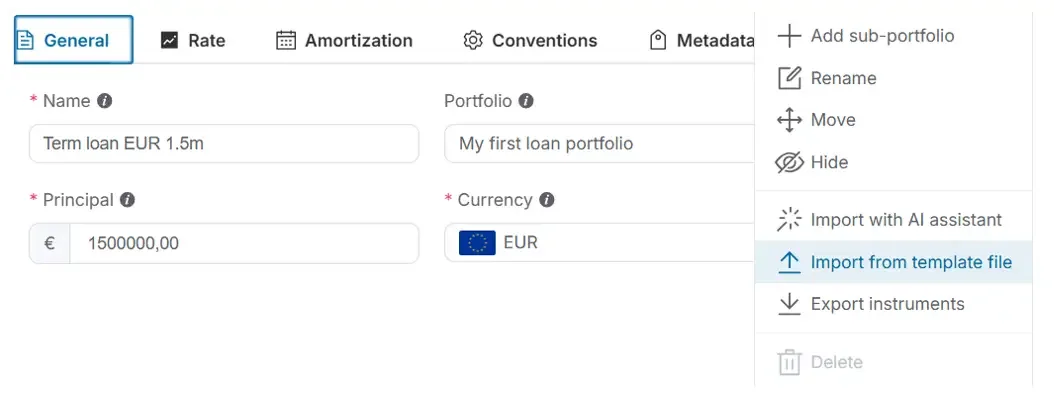
- TreasuryView offers three routes for adding a loan: the loan form, the Excel template and AI-assisted import (beta), which reads a spreadsheet you already have.
- The loan form is the route for a single loan. You enter the key terms, such as principal, dates, rate, payment frequency and conventions, and TreasuryView calculates the schedule. For a bespoke repayment schedule, the cash flows can be copied from Excel into the schedule.
- The Excel template is the route for many loans at once. You download the TreasuryView template, enter one row per loan and upload it.
- AI-assisted import (beta) is the route for a spreadsheet you already have. TreasuryView analyses the file and extracts the loan terms. Results depend on how structured the file is.
- The report is one view of bank loans and intercompany loans, calculated from the loan terms with market data as of the reporting date.
- The demo ends with an invitation to start with your own loans instead of rebuilding the report by hand.
Salmon Treasury or TreasuryView: which one should you choose?
Salmon Treasury and TreasuryView answer different questions. Salmon Treasury is a modular TMS set up through an implementation project: cash, payments, bank connectivity, deal management, risk and integration, rolled out module by module. TreasuryView is built around debt and derivatives tasks: external facilities, intercompany loans, cash pool interest, swaps and the interest rate risk analytics that go with them. It does not connect to banks, import bank statements or make payments, so it runs next to the cash platform or bank portals a finance team already uses.
Choose Salmon Treasury if:
- You are planning a phased TMS implementation around cash management, payments and bank connectivity, with deal management, risk and integration on the same platform
- You want facilities, debt, investments, FX and intercompany transactions captured in one deal lifecycle, from capture and matching to settlement
- You need limit management, exposure analysis across currencies, counterparties and instruments, and policy compliance in the same system as your cash
- You need in-house banking and netting alongside your debt, as described in Salmon's customer stories
- You want a dedicated project manager, training and support included in the licence fee, with the choice of deploying on your own servers or in Salmon's Azure cloud
- You can plan an implementation project and agree a quoted contract, since Salmon does not publish prices
Choose TreasuryView if:
- Your task is the debt book and its derivatives rather than a treasury operating model, and your intercompany loans need the full agreement terms, with facilities, limits and commitment fees, drawdowns, fixed or floating rates, custom benchmark rates, tranches and repayment profiles
- Your cash pools need debit and credit interest calculated and reported, from balances or movements you enter or upload instead of an in-house bank set-up
- Your external facilities fund projects across the group and are planned as a portfolio, and you need interest rate swaps valued next to the loans they hedge, on a derivatives engine in production since 2009, with stress tests and scenarios for interest cost and value, on GROW and above
- You are moving loans and cash pool balances out of spreadsheets and want to start self-service, without an integration project, with a 30-day free trial without a payment method, a published monthly price and cancellation at any time
- Your cash and payments workflows stay where they are, and the REST API in every plan sends loan data, schedules and report results to your accounting or treasury systems when you are ready to automate
Strengths and limits of each
TreasuryView
- Strength: external facilities, calculation accuracy since 2009
- External facilities with broad coverage of non-standard terms: fixed and floating rate loans, revolving credit facilities, refinancings and multi-leg loans, with bullet, linear or annuity repayment, commitment limits and fees, and tranches, available from the START plan. Interest, schedules and accruals come from a calculation engine in production use since 2009. In the rare case a figure differs from your bank's confirmation, any row can be corrected.
- Strength: intercompany loans and cash pools
- Intercompany loans with facilities, limits and commitment fees, drawdowns, tranches and custom benchmark rates. Cash pool accounts with debit and credit interest, calculated and reported from the balances or movements you enter or upload.
- Strength: derivatives and interest rate risk analytics since 2009
- Derivatives valued next to the debt book since 2009: interest rate swaps with mark-to-market valuation, linked to the external facilities they hedge, plus interest rate stress tests (+/-100 bps, steepening, flattening), scenario analysis, BPV and duration sensitivities and comparison of hedging conditions with bank offers, on GROW and above. Cross-currency swaps, swaptions and hedge effectiveness testing are on ENTERPRISE. Caps and floors are modelled as loan terms on every plan.
- Strength: self-service start
- A 30-day free trial without a payment method. Move your loans and cash pool balances out of spreadsheets through the loan form or a spreadsheet upload, with no integration project.
- Strength: published pricing
- Monthly plans from €250 (net), cancel anytime, no setup or onboarding fees.
- Strength: API in every plan, from first call to full integration
- Generate a key in the app and send your first request from the interactive documentation, with no project and no extra fee. Automate at your own pace with report exports in XLSX or CSV, and bring in an integration project on ENTERPRISE when your systems need one.
- Strength: schedules you can correct to what happened
- Record what actually happened on a loan, cash pool or swap schedule, such as a moved payment date, an extra repayment or a new drawdown, and adjust upcoming rows to an agreed change. Later rows recalculate where a change carries forward. Available on every plan; swaps on GROW and above.
- Limit: no bank connectivity
- TreasuryView does not connect to banks, import bank statements or execute payments. Bank connections and payments stay in the systems you already use, and balances and movements are entered or uploaded.
- Limit: no cash management
- TreasuryView calculates interest on cash pool balances but does not run sweeps or netting, and does not provide daily cash positioning, payment approval chains or bank reconciliation.
Salmon Treasury
- Strength: modular platform and phased rollout
- Cash management, payments, trading and deal management, reporting, risk management and integration as separate modules, with a recommended phased rollout instead of a single go-live, according to Salmon's platform page and white paper.
- Strength: deal management and risk
- Facilities, debt, investments, FX and intercompany transactions captured in one deal lifecycle from capture and matching to settlement, with limit management, exposure analysis across currencies, counterparties and instruments, and policy compliance, according to Salmon's platform page.
- Strength: custom loan scheduler
- A Schedule Wizard for the standard bullet schedule and a Custom Schedule function for stub periods, several drawdowns and stepped repayments, built from scratch, copied from another deal or uploaded from CSV, with bulk interest rate fixing across deals, capitalisation of accrued interest and separate fee types, according to Salmon's white paper.
- Strength: bank connectivity and payments
- Straight-through connectivity with any bank for statements and payments, payment processing with custom approval workflows, and daily and intraday bank statement support with automated reconciliation, according to Salmon's platform page and customer stories.
- Strength: in-house banking and netting
- In-house banking and netting modules that give a view of cash balances and positions across subsidiaries and banks; Kingspan reports cutting a monthly netting cycle from up to three days to three hours, according to Salmon's customer stories.
- Strength: deployment, support and security
- Deployment on your own servers or in Salmon's Azure cloud, a dedicated project manager, onboarding with training, support included in the licence fees, ISO 27001 accreditation, role-based access and a complete audit trail, according to Salmon's About and platform pages.
- Strength: experience
- More than 40 years in the market, according to Salmon, with customers such as Airbus, Ryanair, Zurich, Dechra, Associated British Ports, Kingspan, Aergo and SEGRO.
- Consideration: implementation effort
- Salmon Treasury is set up through an implementation project. Its customer stories describe a parallel run of almost six months for Zurich and about nine months to build an intercompany module for Dechra; these are individual projects and not typical timelines.
- Consideration: pricing and terms
- Pricing is not published; Salmon states that support is included in the licence fees. No free trial is advertised on the pages read, and contact starts with a conversation.
- Consideration: planned features
- Advanced scenario modelling, machine learning forecasting, integrated API connectivity and a payment factory appear on Salmon's What's next page as planned or voted ideas, not as available features. Public API documentation was not found, and the instrument list and valuation methods for derivatives are not described on the platform pages.
Looking for a Salmon Treasury alternative for debt management?
If your main task is managing the debt book, meaning external facilities, intercompany loans, cash pools and interest rate derivatives, and your bank connections, payments and cash operation are already handled elsewhere, TreasuryView is built for that job. It offers published pricing from €250 per month, cancellation at any time and a REST API in every plan. If you are planning a phased TMS implementation for your whole treasury, from cash and payments to deal management, risk and in-house banking, Salmon Treasury covers more of it.
Salmon Treasury vs. TreasuryView: debt management compared
| Feature | TreasuryView | Salmon Treasury |
|---|---|---|
| Core job | External facilities, intercompany loans, cash pools, derivatives and interest rate risk management | Modular treasury management system: cash management, payments, trading and deal management, reporting, risk management and integration, according to Salmon's platform page |
| External facilities | External facilities with broad coverage of non-standard terms: fixed and floating rate loans, revolving credit facilities, refinancings and multi-leg loans, with bullet, linear or annuity repayment, commitment limits and fees, and tranches, from the START plan. Calculation engine in production use since 2009; any row can be corrected to match a bank confirmation | Facilities and debt are captured in trading and deal management. A Schedule Wizard builds the standard bullet schedule, and a Custom Schedule function adds stub periods, several drawdowns and stepped repayments, built from scratch, copied from another deal or uploaded from CSV, with bulk interest rate fixing, capitalisation of accrued interest and separate fee types, according to Salmon's white paper. Revolving facilities and commitment limits are not described on the pages read |
| Other instruments | Focused on external facilities, intercompany loans, cash pools and interest rate derivatives; FX risk management is an ENTERPRISE add-on | Facilities, debt, investments, FX and intercompany transactions are captured in trading and deal management, with a deal lifecycle from capture and matching to settlement, according to Salmon's platform page; the instrument list is not itemised on the pages read |
| Intercompany loans | Intercompany loans shared with subsidiaries (borrower or lender view) on every plan, plus bilateral facilities with limits and commitment fees, drawdowns, fixed or floating rates, custom benchmark rates, bullet, linear, annuity or fixed repayment and tranches | Intercompany transactions are captured with the other instruments in deal management; an intercompany module appears in Dechra's customer story, and in-house banking and netting modules in the stories of SEGRO and Kingspan |
| Cash pool interest | Cash pool accounts with debit and credit interest on every plan, calculated and reported from the balances or movements you enter or upload. TreasuryView does not import bank statements, run sweeps or net positions | A zero-balancing cash pool appears in Dechra's customer story; how interest on cash pool balances is calculated is not described on the pages read |
| In-house banking and netting | Not included. TreasuryView calculates and reports cash pool interest and does not run sweeps, netting or internal accounts | In-house banking and netting modules, according to SEGRO's customer story; Kingspan moved intercompany netting into its Salmon TMS and cut a monthly cycle from up to three days to three hours, according to Salmon |
| Pricing | Published: START €250 per month, GROW €500 per month, ENTERPRISE on request. Net of VAT. Priced per team, not per user | Not published; support is included in the licence fees, according to Salmon's About page |
| Free trial and contract | 30-day free trial with full access and no payment method. Monthly invoicing with no long-term contract, cancel any time, no cancellation fees, paid by bank transfer | No free trial advertised on the pages read; contact starts with "Let's chat" |
| Setup and time to start | Sign up in under a minute and add loans through the loan form, a spreadsheet upload or AI-assisted import. No setup or onboarding fees | A dedicated project manager, onboarding with training, deployment on in-house servers or Salmon's Azure cloud; Salmon recommends phased module rollouts; customer stories describe a parallel run of almost six months (Zurich) and about nine months for an intercompany module (Dechra) |
| API access | REST API with interactive documentation (OpenAPI) and developer portal access on every plan | A connectivity hub with prebuilt and low-code integrations to third-party platforms, and data exchange with accounting and business systems such as SAP and Oracle NetSuite; public API documentation not found, and integrated API connectivity appears on the What's next vote list |
| Debt-related API | Loan and cash pool lists, payment schedules, interest and accrual reports via the API; derivative data on GROW and above | Not described; no public API documentation found, and integrated API connectivity appears on the What's next vote list |
| Derivatives-related API | Interest rate swaps with payment cash flows, valuation and hedge reports, plus curves and scenario calculations via the API; swaps on GROW and above | Not described; no public API documentation found |
| Cash and bank data API | Not covered | Not described; no public API documentation found |
| Payments API | Not covered | Not described; no public API documentation found |
| Loan capture | Loan form or spreadsheet upload, plus AI-assisted import below; the REST API sends results out | Deals are captured in trading and deal management, and a repayment schedule can be uploaded from CSV in the Custom Schedule function; spreadsheet upload of whole loans is not described on the pages read |
| Get debt data out (downstream) | Loan and cash pool lists, payment schedules, derivative data on GROW and above and report runs with XLSX or CSV export, via the API | A reporting module and integration with accounting and business systems, according to Salmon's platform page; report formats and export options are not described on the pages read |
| Reference rates | Automated EUR reference rate fixings and pre-integrated curves on every plan; automated fixings in other currencies on ENTERPRISE; fixings and curves available via the API; custom benchmark rates are part of every loan's data model | Market data feeds are described as part of Salmon's connectivity approach in its white paper; which rates and curves are supplied is not described on the pages read |
| Derivatives and valuation | Derivatives in production use since 2009: interest rate swaps with mark-to-market valuation, linked to the loans they hedge, on GROW; cross-currency swaps, swaptions, basis and amortising swaps and hedge effectiveness testing on ENTERPRISE; caps and floors as loan terms on every plan | FX, interest rate and counterparty risk monitoring with limits and policy compliance; interest rate derivatives appear in SEGRO's customer story, which also states real-time revaluation of all deals and positions; the instrument list and valuation methods are not described on the platform pages |
| Interest rate risk analytics | Interest rate stress tests (+/-100 bps, steepening, flattening), scenario analysis, sensitivities (BPV and duration) and comparison of hedging conditions with bank offers on GROW and above | Exposure analysis across currencies, counterparties and instruments, according to Salmon's platform page; advanced scenario modelling is listed on the What's next vote list, not described as available |
| Loan import with AI | AI-assisted import from term sheets, PDFs and spreadsheets (beta on START and GROW; included in ENTERPRISE) | AI import of loan agreements, term sheets or spreadsheets is not described on Salmon's public pages (reviewed 5 November 2026); AI and automation are listed as planned on the What's next page |
| Bank connection | Not included. Bank data stays in your bank portal, accounting or treasury system, or connectivity provider | Yes: straight-through connectivity with any bank for statements and payments, according to Salmon's platform page, with daily and intraday bank statement support, according to SEGRO's customer story |
| Payments | Not included | Yes: payment processing with custom approval workflows, according to Salmon's platform page |
| Actual movements on the schedule | Recorded as schedule overrides on loans, cash pools and, on GROW and above, swaps, such as a moved payment date, an extra repayment or a new drawdown | Bank statements are reconciled automatically in cash management; how actual debt movements update a debt schedule is not described on the pages read |
| Debt interest posting to accounting | Interest, accruals and schedules go to your accounting system through the API. Integration projects with accounting systems are available on ENTERPRISE | The deal lifecycle automates settlement, valuation and accounting, according to Salmon's platform page; posting formats are not described on the pages read |
| Audit trail | Unalterable audit trail of users and deals on GROW and ENTERPRISE; user activity log on START | Complete audit trail and role-based access controls, according to Salmon's platform page |
| Single sign-on | Microsoft Entra ID on ENTERPRISE; passkey, e-mail code or federated sign-in on every plan | Not described on the pages read |
| Security and hosting | Client data hosted in Germany in an ISO 27001-certified data centre, designed to meet GDPR requirements; audit trail of user activity and deals | ISO 27001 (NQA accredited), role-based access and a complete audit trail, according to Salmon; hosting on in-house servers or Salmon's Azure cloud |
| Support and implementation | Support by e-mail, chat, phone and video call on every plan, priority support on GROW and ENTERPRISE, integration projects on ENTERPRISE | Dedicated project manager, onboarding with training and support included in the licence fees, according to Salmon's About page |
| Track record in debt management | Debt management and derivatives in production use since 2009 | Over 40 years in the market, according to Salmon; customers include Airbus, Ryanair, Zurich, Dechra, Associated British Ports, Kingspan, Aergo and SEGRO; no launch date for its debt tooling is stated on its public pages |
Core job
TreasuryView
External facilities, intercompany loans, cash pools, derivatives and interest rate risk management
Salmon Treasury
Modular treasury management system: cash management, payments, trading and deal management, reporting, risk management and integration, according to Salmon's platform page
External facilities
TreasuryView
External facilities with broad coverage of non-standard terms: fixed and floating rate loans, revolving credit facilities, refinancings and multi-leg loans, with bullet, linear or annuity repayment, commitment limits and fees, and tranches, from the START plan. Calculation engine in production use since 2009; any row can be corrected to match a bank confirmation
Salmon Treasury
Facilities and debt are captured in trading and deal management. A Schedule Wizard builds the standard bullet schedule, and a Custom Schedule function adds stub periods, several drawdowns and stepped repayments, built from scratch, copied from another deal or uploaded from CSV, with bulk interest rate fixing, capitalisation of accrued interest and separate fee types, according to Salmon's white paper. Revolving facilities and commitment limits are not described on the pages read
Other instruments
TreasuryView
Focused on external facilities, intercompany loans, cash pools and interest rate derivatives; FX risk management is an ENTERPRISE add-on
Salmon Treasury
Facilities, debt, investments, FX and intercompany transactions are captured in trading and deal management, with a deal lifecycle from capture and matching to settlement, according to Salmon's platform page; the instrument list is not itemised on the pages read
Intercompany loans
TreasuryView
Intercompany loans shared with subsidiaries (borrower or lender view) on every plan, plus bilateral facilities with limits and commitment fees, drawdowns, fixed or floating rates, custom benchmark rates, bullet, linear, annuity or fixed repayment and tranches
Salmon Treasury
Intercompany transactions are captured with the other instruments in deal management; an intercompany module appears in Dechra's customer story, and in-house banking and netting modules in the stories of SEGRO and Kingspan
Cash pool interest
TreasuryView
Cash pool accounts with debit and credit interest on every plan, calculated and reported from the balances or movements you enter or upload. TreasuryView does not import bank statements, run sweeps or net positions
Salmon Treasury
A zero-balancing cash pool appears in Dechra's customer story; how interest on cash pool balances is calculated is not described on the pages read
In-house banking and netting
TreasuryView
Not included. TreasuryView calculates and reports cash pool interest and does not run sweeps, netting or internal accounts
Salmon Treasury
In-house banking and netting modules, according to SEGRO's customer story; Kingspan moved intercompany netting into its Salmon TMS and cut a monthly cycle from up to three days to three hours, according to Salmon
Pricing
TreasuryView
Published: START €250 per month, GROW €500 per month, ENTERPRISE on request. Net of VAT. Priced per team, not per user
Salmon Treasury
Not published; support is included in the licence fees, according to Salmon's About page
Free trial and contract
TreasuryView
30-day free trial with full access and no payment method. Monthly invoicing with no long-term contract, cancel any time, no cancellation fees, paid by bank transfer
Salmon Treasury
No free trial advertised on the pages read; contact starts with "Let's chat"
Setup and time to start
TreasuryView
Sign up in under a minute and add loans through the loan form, a spreadsheet upload or AI-assisted import. No setup or onboarding fees
Salmon Treasury
A dedicated project manager, onboarding with training, deployment on in-house servers or Salmon's Azure cloud; Salmon recommends phased module rollouts; customer stories describe a parallel run of almost six months (Zurich) and about nine months for an intercompany module (Dechra)
API access
TreasuryView
REST API with interactive documentation (OpenAPI) and developer portal access on every plan
Salmon Treasury
A connectivity hub with prebuilt and low-code integrations to third-party platforms, and data exchange with accounting and business systems such as SAP and Oracle NetSuite; public API documentation not found, and integrated API connectivity appears on the What's next vote list
Debt-related API
TreasuryView
Loan and cash pool lists, payment schedules, interest and accrual reports via the API; derivative data on GROW and above
Salmon Treasury
Not described; no public API documentation found, and integrated API connectivity appears on the What's next vote list
Derivatives-related API
TreasuryView
Interest rate swaps with payment cash flows, valuation and hedge reports, plus curves and scenario calculations via the API; swaps on GROW and above
Salmon Treasury
Not described; no public API documentation found
Cash and bank data API
TreasuryView
Not covered
Salmon Treasury
Not described; no public API documentation found
Payments API
TreasuryView
Not covered
Salmon Treasury
Not described; no public API documentation found
Loan capture
TreasuryView
Loan form or spreadsheet upload, plus AI-assisted import below; the REST API sends results out
Salmon Treasury
Deals are captured in trading and deal management, and a repayment schedule can be uploaded from CSV in the Custom Schedule function; spreadsheet upload of whole loans is not described on the pages read
Get debt data out (downstream)
TreasuryView
Loan and cash pool lists, payment schedules, derivative data on GROW and above and report runs with XLSX or CSV export, via the API
Salmon Treasury
A reporting module and integration with accounting and business systems, according to Salmon's platform page; report formats and export options are not described on the pages read
Reference rates
TreasuryView
Automated EUR reference rate fixings and pre-integrated curves on every plan; automated fixings in other currencies on ENTERPRISE; fixings and curves available via the API; custom benchmark rates are part of every loan's data model
Salmon Treasury
Market data feeds are described as part of Salmon's connectivity approach in its white paper; which rates and curves are supplied is not described on the pages read
Derivatives and valuation
TreasuryView
Derivatives in production use since 2009: interest rate swaps with mark-to-market valuation, linked to the loans they hedge, on GROW; cross-currency swaps, swaptions, basis and amortising swaps and hedge effectiveness testing on ENTERPRISE; caps and floors as loan terms on every plan
Salmon Treasury
FX, interest rate and counterparty risk monitoring with limits and policy compliance; interest rate derivatives appear in SEGRO's customer story, which also states real-time revaluation of all deals and positions; the instrument list and valuation methods are not described on the platform pages
Interest rate risk analytics
TreasuryView
Interest rate stress tests (+/-100 bps, steepening, flattening), scenario analysis, sensitivities (BPV and duration) and comparison of hedging conditions with bank offers on GROW and above
Salmon Treasury
Exposure analysis across currencies, counterparties and instruments, according to Salmon's platform page; advanced scenario modelling is listed on the What's next vote list, not described as available
Loan import with AI
TreasuryView
AI-assisted import from term sheets, PDFs and spreadsheets (beta on START and GROW; included in ENTERPRISE)
Salmon Treasury
AI import of loan agreements, term sheets or spreadsheets is not described on Salmon's public pages (reviewed 5 November 2026); AI and automation are listed as planned on the What's next page
Bank connection
TreasuryView
Not included. Bank data stays in your bank portal, accounting or treasury system, or connectivity provider
Salmon Treasury
Yes: straight-through connectivity with any bank for statements and payments, according to Salmon's platform page, with daily and intraday bank statement support, according to SEGRO's customer story
Payments
TreasuryView
Not included
Salmon Treasury
Yes: payment processing with custom approval workflows, according to Salmon's platform page
Actual movements on the schedule
TreasuryView
Recorded as schedule overrides on loans, cash pools and, on GROW and above, swaps, such as a moved payment date, an extra repayment or a new drawdown
Salmon Treasury
Bank statements are reconciled automatically in cash management; how actual debt movements update a debt schedule is not described on the pages read
Debt interest posting to accounting
TreasuryView
Interest, accruals and schedules go to your accounting system through the API. Integration projects with accounting systems are available on ENTERPRISE
Salmon Treasury
The deal lifecycle automates settlement, valuation and accounting, according to Salmon's platform page; posting formats are not described on the pages read
Audit trail
TreasuryView
Unalterable audit trail of users and deals on GROW and ENTERPRISE; user activity log on START
Salmon Treasury
Complete audit trail and role-based access controls, according to Salmon's platform page
Single sign-on
TreasuryView
Microsoft Entra ID on ENTERPRISE; passkey, e-mail code or federated sign-in on every plan
Salmon Treasury
Not described on the pages read
Security and hosting
TreasuryView
Client data hosted in Germany in an ISO 27001-certified data centre, designed to meet GDPR requirements; audit trail of user activity and deals
Salmon Treasury
ISO 27001 (NQA accredited), role-based access and a complete audit trail, according to Salmon; hosting on in-house servers or Salmon's Azure cloud
Support and implementation
TreasuryView
Support by e-mail, chat, phone and video call on every plan, priority support on GROW and ENTERPRISE, integration projects on ENTERPRISE
Salmon Treasury
Dedicated project manager, onboarding with training and support included in the licence fees, according to Salmon's About page
Track record in debt management
TreasuryView
Debt management and derivatives in production use since 2009
Salmon Treasury
Over 40 years in the market, according to Salmon; customers include Airbus, Ryanair, Zurich, Dechra, Associated British Ports, Kingspan, Aergo and SEGRO; no launch date for its debt tooling is stated on its public pages
Statements about Salmon Treasury are based on its public website, platform pages, customer stories, white papers and What's next page, reviewed on 5 November 2026. 'Not described' means Salmon's public pages describe no such feature on that date; it does not rule out features that exist but are not published. Items on its What's next page are planned or voted ideas, not available features. Additional currencies, or licensable reference rate or swap data, may require a separate market data licence, priced separately. Salmon Treasury and Salmon Treasurer are names used by Salmon Software, and this page is not affiliated with or endorsed by Salmon Software. A feature-by-feature comparison is also available on Capterra. If you spot something outdated or inaccurate, please contact us and we will correct it.
Information about third-party products is based on publicly available sources and was last reviewed on 2026-11-05. TreasuryView is not affiliated with the vendors named. All product names and trademarks belong to their respective owners.
Derivatives and interest rate risk: what each platform covers today
Knowing where every loan and derivative stands is the first step. A treasurer also needs to know what happens when markets move. TreasuryView covers external facilities, intercompany loans, derivatives and interest rate risk in one platform, so positions and market impact sit together:
- Position: every external facility, intercompany loan and swap in one place, with schedules, accruals and valuations from the calculation engine.
- Impact: what a move of 100 basis points does to interest cost and cash flows, to the value of swaps and loans, and to the average cost of funds. Rate impact analysis is available on GROW.
- Growth: when the business adds a facility, a swap or a foreign-currency loan, it goes into the same platform instead of a new spreadsheet.
Derivatives and interest rate risk start with the GROW plan (€500 per month). START covers loans, intercompany loans and cash pools. FX rates, FX forward curves and FX history are available through the API. The FX risk management module (spot, forwards and options) is an ENTERPRISE add-on, available on request.
Salmon Treasury lists risk management with FX, interest rate and counterparty risk monitoring, limits and policy compliance, and exposure analysis across currencies, counterparties and instruments, according to its platform page (reviewed 5 November 2026). A customer story describes interest rate derivatives and real-time revaluation of all deals and positions at SEGRO. The instrument list and valuation methods are not described on its platform pages, and advanced scenario modelling is listed on its What's next vote list as a future idea. TreasuryView's focus is interest rate derivatives valued next to the debt they hedge, in production use since 2009.
If your debt is only intercompany loans today, you may not need interest rate risk analytics yet. If external facilities or swaps are coming, starting on a platform that covers them avoids a second migration.
API and integration: link your debt data with the systems around it
Debt data is only useful if it reaches the systems that need it. TreasuryView's REST API is included in every plan, with API documentation and developer portal access, so you can build the workflow that fits your stack. Typical workflows:
- Upstream: loans enter through the loan form, a spreadsheet upload or AI-assisted import (beta), so you can start without an integration project.
- Downstream to accounting: pull accruals, schedules and reports into your accounting or treasury system, so figures are not retyped.
- Downstream to cash forecasting and BI: send interest and principal schedules to your forecasting tool or dashboards.
- Market data: pull curves, reference rate fixings and FX rates into your own models.
These are examples. The API documentation lists the endpoints available on your plan.
What each TreasuryView plan covers
- START (€250 per month): up to 50 loans, 1 company including subsidiaries, 5 internal users, multi-currency (EUR, USD, GBP, CHF and 20+ others), cash pools, intercompany loans, manual schedule overrides, integrated end-of-day market data and the REST API.
- GROW (€500 per month): up to 300 loans and interest rate derivatives, 15 internal users plus 10 guests, valuation and interest rate risk analytics, interest rate swaps, hedge coverage and priority support.
- ENTERPRISE (on request): cross-currency swaps, swaptions, hedge effectiveness testing, the FX risk management module (spot, forwards and options), automated fixings in other currencies, extended transaction volume and reports, single sign-on (Microsoft Entra ID), and integration projects with accounting systems, built for you.
Full functionality free for 30 days
Sign up in under a minute, no credit card. The trial ends automatically. Monthly plans from €250 (net), cancel anytime. Plan details are on the pricing page.
How to choose debt management software next to or instead of a treasury platform
If you answer "yes" to these questions, TreasuryView might be a good fit.
-
Still tracking external facilities, intercompany loans and cash pools in spreadsheets?
TreasuryView keeps external facilities, intercompany loans, cash pools and derivatives in one dashboard, with schedules and accruals calculated for you.
-
Do you need swaps valued and interest rate risk analysed next to your loans?
TreasuryView values interest rate swaps alongside your loans on GROW and above, with mark-to-market valuation, stress tests and interest rate scenarios. Caps and floors are modelled as loan terms.
-
Do you need a platform you can start with yourself, without an implementation project?
Sign up, add your loans through the loan form or a spreadsheet upload, and run reports. There are no setup fees.
-
Do you want published pricing before you commit budget?
Monthly plans are published from €250 (net), with a 30-day free trial.
-
Is bank connectivity already handled in your bank portal, your accounting or treasury system or by a provider?
TreasuryView works next to it and links through the API, so you keep that contract.
-
Do you need to send debt data to accounting, forecasting or BI tools?
The REST API, included in every plan, sends results out to the systems around TreasuryView.
-
Do you need payments, bank connectivity and daily cash positioning from the same tool?
Then Salmon Treasury's platform may fit better. TreasuryView does not provide payments or daily cash management.
What the first 30 days look like
Within the 30-day free trial you can have your external facilities, intercompany loans and cash pools in one place, with reports and market data included.
-
Start in under a minute
Immediate access
Create a free accountSign up for free and explore the full functionality.
-
Day 1
Import your data
Data migrationUpload your loans with the Excel template or enter them directly, and preview each schedule before you save.
-
Week 1
Automate your work
Customise views and automate reporting.
-
Week 2
Make data-driven decisions
Evaluate interest rate risk and, on GROW, value swaps next to the loans they hedge.
“It [TreasuryView] is a very intuitive tool to use, with enough capabilities to get a clear understanding of your company's treasury status. I also really value the support I get from their team setting it up for my company.”
Other comparisons
- Agicap Alternative for Loan & Debt Management
- Atlar Alternative for Debt Management
- Chatham Onyx Alternative for Mid-Sized Companies
- ION Treasury Alternative for Mid-Sized Companies
- Kyriba Alternative for Mid-Sized Companies
- Nomentia Alternative for SMBs & Mid-Sized Companies
- Ripple Treasury (GTreasury) Alternative
- Spreadsheet Alternative for Loan & Debt Management
- Enterprise TMS Alternative for Mid-Sized Companies
- ZenTreasury Alternative for Mid-Sized Companies
FAQ: choosing between TreasuryView and Salmon Treasury
What is a Salmon Treasury alternative for debt management?
TreasuryView is one option if managing the debt book is your main task. It manages external facilities, intercompany loans, cash pools and interest rate derivatives, calculates interest, schedules and valuations, and publishes its monthly pricing. Salmon Treasury is a modular TMS set up through an implementation project and covers cash, payments, deal management, risk and integration, so the better fit depends on whether you are building a broader treasury platform or focusing on debt and derivatives. For a feature-by-feature view, see the TreasuryView vs Salmon Treasurer comparison on Capterra.
How much does Salmon Treasury cost compared with TreasuryView?
Salmon Treasury does not publish prices on the pages we read. Its About page states that support is included in the licence fees, and contact starts with a conversation. TreasuryView publishes its prices: START is €250 per month and GROW is €500 per month, both net of VAT, with ENTERPRISE on request. To compare total cost, compare the scope each one covers.
Is there a monthly plan, and can I cancel at any time?
Yes. TreasuryView plans are billed monthly, there is no long-term contract, and you can cancel any time in your account with no cancellation fee. Payment is by bank transfer. Salmon Treasury does not publish its contract terms on the pages we read.
Is there a free trial, and do I need a credit card?
TreasuryView offers a 30-day free trial with full access and no payment method, and you can upload your own loans to see real reports. Salmon Treasury does not advertise a free trial on the pages we read; contact starts with a conversation.
Can I buy Salmon Treasury's debt management on its own?
Salmon describes a modular platform and recommends phased rollouts, module by module. Whether its deal management and debt tooling can be bought without other modules is not stated on its public pages. TreasuryView is a standalone debt management platform that you can start yourself.
Can I use TreasuryView next to Salmon Treasury?
Yes. TreasuryView does not replace a cash platform. Finance teams keep bank connections and payments where they are and use TreasuryView for external facilities, intercompany loans, cash pool interest and derivatives. The REST API sends schedules and report results to the systems around it.
Which debt instruments does each platform cover?
Salmon Treasury captures facilities, debt, investments, FX and intercompany transactions in deal management; the instrument list is not itemised on the pages we read. TreasuryView covers external facilities, including revolving credit facilities, intercompany loans, cash pools and interest rate derivatives.
Does Salmon Treasury handle irregular loan schedules?
According to Salmon's white paper on its custom loan scheduler, yes: a Schedule Wizard builds the standard bullet schedule, and a Custom Schedule function handles stub periods, several drawdowns and stepped repayments, built from scratch, copied from another deal or uploaded from CSV. TreasuryView also supports schedule overrides on every plan. The difference is how you start: a vendor-led project with a dedicated project manager, or a self-service trial with your own loans.
Does TreasuryView manage external facilities as well as intercompany loans?
Yes. External facilities, meaning bank loans and credit facilities, are available from the START plan, with broad coverage of non-standard terms: fixed and floating rate loans, revolving credit facilities, refinancings and multi-leg loans, with bullet, linear or annuity repayment, commitment limits and fees, and tranches. Interest, schedules and accruals come from a calculation engine in production use since 2009, and any row can be corrected to match a bank confirmation.
Can TreasuryView calculate interest on cash pool balances, and does it import bank statements?
TreasuryView calculates and reports debit and credit interest on cash pool accounts on every plan, from balances or movements you enter or upload. It does not import bank statements, run sweeps or net positions.
Does Salmon Treasury calculate interest on intercompany loans and cash pools?
Salmon's customer stories describe an intercompany module (Dechra), in-house banking and netting (SEGRO, Kingspan) and a zero-balancing cash pool (Dechra). How interest on intercompany loans and cash pool balances is calculated is not described on the pages we read. TreasuryView calculates and reports debit and credit interest on cash pool accounts on every plan, from balances or movements you enter or upload.
Does Salmon Treasury support interest rate derivatives and risk management?
According to Salmon's public pages, it monitors FX, interest rate and counterparty risk with limits and policy compliance, and a customer story (SEGRO) describes interest rate derivatives with real-time revaluation of deals and positions. The instrument list and valuation methods are not described on its platform pages, and advanced scenario modelling is listed on its What's next vote list as a future idea. TreasuryView values interest rate swaps next to the loans they hedge from GROW, with stress tests and scenarios, and its calculation engine has been in production use since 2009. Check both vendors' current documentation against your requirements and test with your own data.
Which TreasuryView plan do I need for derivatives and interest rate risk?
Derivatives and interest rate risk analytics start with GROW at €500 per month. START covers loans, intercompany loans and cash pools. Cross-currency swaps, swaptions, basis and amortising swaps and hedge effectiveness testing are on ENTERPRISE.
What happens to my loans and derivatives when rates move?
TreasuryView shows the impact of rate moves on interest cost, cash flows and the value of swaps and loans, with rate impact analysis on GROW.
Does Salmon Treasury offer hedge accounting, and what does TreasuryView offer?
Hedge accounting is not described on Salmon's public pages; its platform page states that settlement, valuation and accounting are automated in the deal lifecycle. TreasuryView offers hedge relationships on GROW and above and, on ENTERPRISE, hedge effectiveness testing.
Does TreasuryView have an API, and is it included in every plan?
Yes. TreasuryView's REST API, with interactive documentation, is included in START, GROW and ENTERPRISE, and so is developer portal access. Salmon Treasury describes a connectivity hub with prebuilt, low-code integrations and data exchange with accounting and business systems; public API documentation was not found, and integrated API connectivity is on its What's next vote list.
How do I get my loans into TreasuryView?
Through the loan form, a spreadsheet upload or AI-assisted import (beta). The REST API then sends calculation results out to your accounting or treasury systems.
Can I send TreasuryView data to my accounting system, cash forecast or BI tool?
Yes. Instruments, exposure portfolio data and report content can be exported through the API.
Do I need bank connections to use TreasuryView?
No. TreasuryView does not connect to banks. Bank transactions and repayments stay in your bank portal, accounting or treasury system or connectivity provider, while loan terms, schedules and interest live in TreasuryView.
Can I keep my current bank connectivity provider?
Yes. TreasuryView sits beside your existing bank connectivity, whether that is your bank portal, your accounting or treasury system or a provider, and you keep that contract.
How long does setup take compared with Salmon Treasury?
You can sign up in under a minute and upload loans from a spreadsheet on the first day, without involving your IT team. Salmon Treasury describes a dedicated project manager and training, recommends phased module rollouts, and its customer stories describe a parallel run of almost six months (Zurich) and about nine months for an intercompany module (Dechra). Salmon does not publish a typical go-live time.
Will I talk to a human if I get stuck during the trial?
Yes. If you get stuck or want a tour of the software, you can talk to one of our professionals. Full support is available during the trial, and you can book a demo call.
What if TreasuryView is not for me and I want to leave?
The free trial ends automatically and its data will be deleted. Monthly plans can be cancelled at any time.
Does TreasuryView support custom benchmark rates, such as an internal group funding rate?
Yes. Custom benchmark rates are part of every loan's data model and are always on, so a loan can reset on an internal rate as well as on market indices.
Is my data secured?
Client data is hosted in an ISO 27001-certified data centre in Germany and handled according to German and EU regulations. TreasuryView also appoints an external data security officer. Learn more about data security. Salmon Treasury states ISO 27001 accreditation, role-based access and a complete audit trail, and can be deployed on your own servers or in Salmon's Azure cloud.
Which alternatives to Salmon Treasury exist?
That depends on your company's size, priorities and budget. Four examples, by focus:
- TreasuryView: for finance teams focused on debt management. It automates reporting, reduces Excel risks and improves visibility across external facilities, intercompany loans, cash pools and derivatives, for teams without internal IT support.
- Nomentia: a treasury suite covering bank connectivity, payments, cash and debt, with a vendor-led implementation. See TreasuryView vs. Nomentia.
- Kyriba: a full treasury management system for large-scale implementations. See TreasuryView vs. Kyriba.
- Atlar: cash, payments and debt management on live bank connections. See TreasuryView vs. Atlar.
Choose based on what matters most: debt management, global treasury control or bank and payment visibility.
Where can I find more answers?
See the general FAQ or contact us.
How we reviewed this page
Statements about Salmon Treasury are based on Salmon's public website, read on 5 November 2026: the platform, solutions, About and What's next pages, six customer stories and ten white papers, and on the Treasury Brief vendor profile reviewed on 2 November 2026. Salmon facts are vendor-stated. TreasuryView facts are taken from its pricing page on the same date. "Not described" means the pages we read describe no such feature today; it does not mean something does not exist. Items on Salmon's What's next page are planned or voted ideas, not available features. Salmon may have changed since. If you spot something out of date, please contact us and we will correct it.
Compare with your own loan data, free for 30 days
Import your own loan portfolio, check the results against your existing model and then decide.