
TreasuryView compared with Ripple Treasury
Ripple Treasury vs. TreasuryView
Debt and treasury management software compared for finance teams
Both platforms serve treasury and finance teams, with a different focus. This page compares them side by side so you can judge which one fits your situation.
Two platforms, two different centres of gravity
Choosing between Ripple Treasury (formerly GTreasury, now part of Ripple) and TreasuryView depends on whether you need a comprehensive enterprise TMS covering the full treasury stack, or a specialised debt and derivatives platform with published pricing.
Ripple Treasury is an enterprise treasury management system. According to its public product information, it covers the treasury lifecycle: debt and investment management, cash, payments, netting, FX, in-house banking, hedge accounting and digital assets, for global enterprises across the US, EMEA and APAC. Pricing is not published; engagement is sales-led.
TreasuryView is built for mid-market finance teams that need bank loan, derivative and intercompany funding management. It has published pricing from €250 per month (net), a self-service start and a 30-day free trial. TreasuryView's calculation engine has been in production use since 2009, for derivatives valuation and risk reporting for corporates, public sector entities and financial institutions. TreasuryView now applies that engine to bank and intercompany loans across multiple entities.
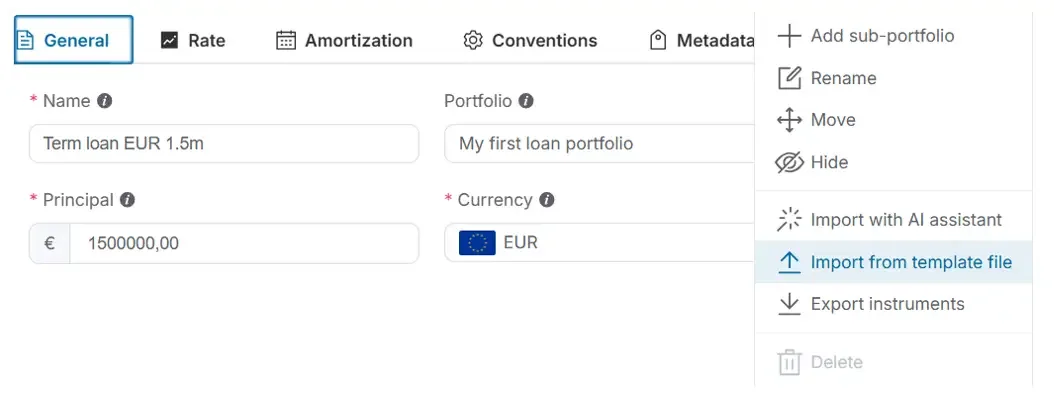
Take the interactive product tour
Decision guide
Ripple Treasury may fit if:
- You need deep debt and investment lifecycle management across front, middle and back office in one platform
- Your portfolio includes complex instruments such as cross-currency swaps, European or Bermudan swaptions, ABS, syndicated facilities or investment securities
- Monte Carlo simulations, Cash Flow-at-Risk analytics and asset and liability management are required for enterprise risk management
- Hedge accounting (IFRS 9, ASC 815) with automated lifecycle reporting is a governance requirement
- SEC 10-K/10-Q disclosure reporting or equivalent regulatory output is required
- You run a global treasury operation (US, EMEA, APAC) with dedicated treasury and IT staff, and a multi-month implementation is resourced
TreasuryView may fit if:
- Your treasury is run by one to five people alongside accounting and reporting
- You need specialised debt and risk management for bank loans, intercompany loans and derivatives
- You want published pricing and a free trial before you commit budget
- You want to get started without IT approval, often within a day
- You are replacing Excel and want to validate results with your own loan data
- You value a calculation engine that has been in production use since 2009
Front-to-back architecture and mid-market teams
Enterprise treasury systems like Ripple Treasury are built around a three-tier operational model: a front office captures and approves deals, a middle office runs analytics and valuations, and a back office processes accounting and settlement. For large corporates with dedicated treasury departments, this architecture delivers control, auditability and scale. Mid-market finance teams often work differently, for three reasons:
Cost. End-to-end front-to-back implementation requires enterprise licensing, IT project resources and ongoing specialist support.
Staff. Front-to-back workflows assume dedicated people at each tier: deal approvers, analysts and accounting processors. Mid-market finance teams are lean by design. The controller who manages intercompany loans is often the same person who produces board reports, works with auditors and closes the books at month-end.
Volume and governance overhead. Enterprise architecture was built for institutions processing many capital markets transactions, where multi-step deal approval and multi-team handoffs prevent errors at scale. A company managing a smaller number of bank loans and interest rate derivatives may not need that overhead.
The question is not whether front-to-back architecture is good. It is a strong fit for the right organisation. The question is whether its cost, staffing and governance overhead fits your team.
The problem with staying in Excel
Avoiding front-to-back architecture does not mean avoiding risk. Finance teams that manage treasury in Excel can face calculation errors that compound across formula chains, lender and borrower balances that drift apart between files, rate resets that are missed when someone is on leave, and audit requests that take days to reconstruct because there is no single timestamped source of truth. With 20 loans, Excel is manageable. With 80 loans across six entities and three currencies, it becomes much harder to control.
TreasuryView is built for the gap between Excel and an enterprise suite. It brings its calculation engine to a single self-service workspace that one treasury or finance manager can operate. There is no deal approval chain and no separate analyst or accounting handoff. The workspace where data is entered also produces board-ready output.
Ripple Treasury vs. TreasuryView: Comparison table
| Feature | TreasuryView | Ripple Treasury |
|---|---|---|
| Target customer | Mid-market treasury and finance teams managing bank loans, intercompany funding and derivatives, often in Excel, who need debt analytics and accurate calculations. Segments include commercial real estate holdings, family offices, PE-backed companies and mid-market corporates with multi-entity and multi-currency structures. Typical decision-maker: a finance manager or controller who manages treasury alongside other responsibilities. | Large enterprises and global corporates with dedicated treasury and IT teams that need a comprehensive TMS across debt, cash, payments, FX and risk. Typical decision-maker: a group treasurer or VP Finance leading an enterprise treasury project. |
| Debt and investment management coverage | Input: loans (fixed, floating, revolving, bullet, amortizing), intercompany facilities with automatic lender and borrower position mirroring, and derivatives (swaps, caps, collars, swaptions). Import via Excel template or API. Calculation: interest accruals, floating rate resets, mark-to-market valuation with integrated market data, amortisation schedules, maturity profiles and derivative scenario simulation (+100/-100 bp curve shifts). Output: pre-built report templates, consolidated debt reports across all entities, monthly accrual statements and an audit trail with timestamped changes. | Front office: working capital instruments (facilities with fees, call accounts, guarantees, discount securities, CDs, repos), capital markets instruments (bonds, term and P&I loans, ABS, FRNs) and derivatives (IR swaps, cross-currency swaps, European and Bermudan swaptions, caps, collars, floors), with facility and tranche management including syndication and multi-currency drawdowns. Middle office: mark-to-market against system-published or user-provided market data, MTM sensitivity, accruals and amortisation reporting, event diary, securities reporting and leverage analysis with what-if hedging scenarios. Back office: configurable three-step workflow, automated rate sets, hedge accounting dashboard with lifecycle reports (IFRS 9, ASC 815), automated journal entries, risk analytics using Monte Carlo simulations and Cash Flow-at-Risk, asset and liability management, and limits management with dashboards and e-mail alerts. |
| Setup and time to start | Self-service. After free sign-up you get immediate access, capture deals in the UI or import loan data via Excel or API, configure a multi-entity structure and generate first reports. Many teams are up and running within a day, without a consultant or IT approval. Cloud-based (Germany), SSO available. | Vendor-led implementation project; bank connectivity and accounting software integration are part of the set-up and involve IT resources. Evaluation begins by contacting sales to scope the project. |
| Time to value | Operational relief by replacing manual Excel work with automated calculations and reports. The 30-day free trial lets you test with your own data before you commit; no credit card required. | A treasury operating model project, from fragmented manual processes to an integrated front-to-back operation. Value is realised once implementation and team onboarding are complete; the duration depends on scope, integrations and modules. |
| Pricing | Published SaaS plans, net of VAT: START €250 per month (up to 50 loans), GROW €500 per month (up to 300 loans, adds interest rate derivatives) and ENTERPRISE on request. Monthly contracts, cancel anytime. 30-day free trial, no credit card required. | No public pricing. Licensing, implementation and support are individually quoted by sales. |
| Support and security | Human support by e-mail, chat and phone, plus video calls (Teams, Google Meet, Zoom), with a typical response time of 24 to 48 hours, plus documentation, video guides and in-app help. The START plan has no dedicated account manager. Cloud-hosted in Germany (EU data residency), designed to meet GDPR requirements. SSO/SAML available, audit trail and version control. | Dedicated implementation analysts, account management and a structured onboarding programme. A dedicated Audit and Compliance module covers covenant compliance, regulatory reporting automation and audit-ready documentation. Managed services are available for ongoing operations support. Global service with offices in EMEA and APAC; EU data sovereignty adaptations for European deployments, according to its public information. |
| Integrations | Excel import and export on all plans, SSO/SAML, and a REST API on all plans for automated loan and derivatives data updates (see integrations). Designed for data portability rather than workflow coupling, without IT dependency. | Extensive accounting and bank connectivity, including SWIFT, multi-bank connectivity in the US, EMEA and APAC, and SAP and Oracle accounting integrations. The integration project is a core part of the implementation and needs IT resources. |
| User experience | Designed for finance and treasury managers who work in Excel today: import debt data, the dashboard builds itself, drill into any report. No treasury specialist background required. Available in English and German. | Interface designed for dedicated treasury professionals, with dashboards for facilities, limits, FX and basis point sensitivity, plus interactive risk dashboards for scenario exploration. Assumes treasury operations expertise; structured onboarding and training are included. |
| Scalability | Scales debt and derivatives depth: add entities, currencies and instruments without a system overhaul. Pricing tiers follow portfolio size (START up to 50 loans, GROW up to 300, ENTERPRISE beyond). When multi-bank payment processing, cash management or full TMS breadth becomes the primary need, evaluating a broader platform makes sense. | Scales treasury breadth across the full lifecycle: debt, cash, payments, FX, investments, ALM, netting and digital assets, with analytics for complex multi-entity global portfolios. Designed to scale with dedicated treasury and IT teams. |
| Key strengths |
|
|
| Limitations and considerations | These are scope decisions, not product gaps: TreasuryView is built for debt and derivatives.
|
|
| Trial and evaluation | 30-day free trial with full functionality and no credit card. Import your real loan portfolio, see the calculations, validate them against your Excel model and generate board reports before paying. If it does not fit, cancel during the trial. No sales call is needed to start. | Evaluation typically runs through a demo request, a call with the sales team, a proposal and pricing discussion, and procurement approval, followed by implementation. |
Target customer
TreasuryView
Mid-market treasury and finance teams managing bank loans, intercompany funding and derivatives, often in Excel, who need debt analytics and accurate calculations. Segments include commercial real estate holdings, family offices, PE-backed companies and mid-market corporates with multi-entity and multi-currency structures. Typical decision-maker: a finance manager or controller who manages treasury alongside other responsibilities.
Ripple Treasury
Large enterprises and global corporates with dedicated treasury and IT teams that need a comprehensive TMS across debt, cash, payments, FX and risk. Typical decision-maker: a group treasurer or VP Finance leading an enterprise treasury project.
Debt and investment management coverage
TreasuryView
Input: loans (fixed, floating, revolving, bullet, amortizing), intercompany facilities with automatic lender and borrower position mirroring, and derivatives (swaps, caps, collars, swaptions). Import via Excel template or API.
Calculation: interest accruals, floating rate resets, mark-to-market valuation with integrated market data, amortisation schedules, maturity profiles and derivative scenario simulation (+100/-100 bp curve shifts).
Output: pre-built report templates, consolidated debt reports across all entities, monthly accrual statements and an audit trail with timestamped changes.
Ripple Treasury
Front office: working capital instruments (facilities with fees, call accounts, guarantees, discount securities, CDs, repos), capital markets instruments (bonds, term and P&I loans, ABS, FRNs) and derivatives (IR swaps, cross-currency swaps, European and Bermudan swaptions, caps, collars, floors), with facility and tranche management including syndication and multi-currency drawdowns.
Middle office: mark-to-market against system-published or user-provided market data, MTM sensitivity, accruals and amortisation reporting, event diary, securities reporting and leverage analysis with what-if hedging scenarios.
Back office: configurable three-step workflow, automated rate sets, hedge accounting dashboard with lifecycle reports (IFRS 9, ASC 815), automated journal entries, risk analytics using Monte Carlo simulations and Cash Flow-at-Risk, asset and liability management, and limits management with dashboards and e-mail alerts.
Setup and time to start
TreasuryView
Self-service. After free sign-up you get immediate access, capture deals in the UI or import loan data via Excel or API, configure a multi-entity structure and generate first reports. Many teams are up and running within a day, without a consultant or IT approval. Cloud-based (Germany), SSO available.
Ripple Treasury
Vendor-led implementation project; bank connectivity and accounting software integration are part of the set-up and involve IT resources. Evaluation begins by contacting sales to scope the project.
Time to value
TreasuryView
Operational relief by replacing manual Excel work with automated calculations and reports. The 30-day free trial lets you test with your own data before you commit; no credit card required.
Ripple Treasury
A treasury operating model project, from fragmented manual processes to an integrated front-to-back operation. Value is realised once implementation and team onboarding are complete; the duration depends on scope, integrations and modules.
Pricing
TreasuryView
Published SaaS plans, net of VAT: START €250 per month (up to 50 loans), GROW €500 per month (up to 300 loans, adds interest rate derivatives) and ENTERPRISE on request. Monthly contracts, cancel anytime. 30-day free trial, no credit card required.
Ripple Treasury
No public pricing. Licensing, implementation and support are individually quoted by sales.
Support and security
TreasuryView
Human support by e-mail, chat and phone, plus video calls (Teams, Google Meet, Zoom), with a typical response time of 24 to 48 hours, plus documentation, video guides and in-app help. The START plan has no dedicated account manager.
Cloud-hosted in Germany (EU data residency), designed to meet GDPR requirements. SSO/SAML available, audit trail and version control.
Ripple Treasury
Dedicated implementation analysts, account management and a structured onboarding programme. A dedicated Audit and Compliance module covers covenant compliance, regulatory reporting automation and audit-ready documentation. Managed services are available for ongoing operations support.
Global service with offices in EMEA and APAC; EU data sovereignty adaptations for European deployments, according to its public information.
Integrations
TreasuryView
Excel import and export on all plans, SSO/SAML, and a REST API on all plans for automated loan and derivatives data updates (see integrations). Designed for data portability rather than workflow coupling, without IT dependency.
Ripple Treasury
Extensive accounting and bank connectivity, including SWIFT, multi-bank connectivity in the US, EMEA and APAC, and SAP and Oracle accounting integrations. The integration project is a core part of the implementation and needs IT resources.
User experience
TreasuryView
Designed for finance and treasury managers who work in Excel today: import debt data, the dashboard builds itself, drill into any report. No treasury specialist background required. Available in English and German.
Ripple Treasury
Interface designed for dedicated treasury professionals, with dashboards for facilities, limits, FX and basis point sensitivity, plus interactive risk dashboards for scenario exploration. Assumes treasury operations expertise; structured onboarding and training are included.
Scalability
TreasuryView
Scales debt and derivatives depth: add entities, currencies and instruments without a system overhaul. Pricing tiers follow portfolio size (START up to 50 loans, GROW up to 300, ENTERPRISE beyond). When multi-bank payment processing, cash management or full TMS breadth becomes the primary need, evaluating a broader platform makes sense.
Ripple Treasury
Scales treasury breadth across the full lifecycle: debt, cash, payments, FX, investments, ALM, netting and digital assets, with analytics for complex multi-entity global portfolios. Designed to scale with dedicated treasury and IT teams.
Key strengths
TreasuryView
- Calculation engine in production use since 2009
- Published prices
- Self-service start, no IT project required
- German hosting, designed to meet GDPR requirements
- 30-day free trial with full calculation functionality, no credit card
Ripple Treasury
- Full front-to-back debt and investment lifecycle in one connected system
- Wide instrument coverage, including swaptions, ABS, repos, CDs and syndicated facilities
- Monte Carlo and Cash Flow-at-Risk risk analytics
- Balance sheet management: basis sensitivity, liquidity risk and forecasting
- Configurable three-step deal approval with automated rate sets
- Regulatory reporting and a dedicated Audit and Compliance module
- Managed services for ongoing treasury support
Limitations and considerations
TreasuryView
These are scope decisions, not product gaps: TreasuryView is built for debt and derivatives.
- Governance: no configurable multi-step deal approval chains or segregation-of-duties controls; designed for finance manager self-service
- Cash: no cash forecasting, live bank balance aggregation, multi-bank payment processing, netting or in-house banking
- Investments: limited investment portfolio management (money market funds, bonds, equities)
- Covenants: automated breach alerts are not a native feature
- Bank connectivity: no bank feed integration
Ripple Treasury
- Evaluation is sales-led, starting with a demo and scoping conversation
- Implementation involves IT resources, accounting software integration and bank connectivity set-up
- Pricing is quoted after contact; enterprise pricing may exceed what is needed if your main need is debt and derivatives
Trial and evaluation
TreasuryView
30-day free trial with full functionality and no credit card. Import your real loan portfolio, see the calculations, validate them against your Excel model and generate board reports before paying. If it does not fit, cancel during the trial. No sales call is needed to start.
Ripple Treasury
Evaluation typically runs through a demo request, a call with the sales team, a proposal and pricing discussion, and procurement approval, followed by implementation.
Statements about Ripple Treasury are based on publicly available information and may change. If you spot something outdated or inaccurate, please contact us and we will correct it.
Information about third-party products is based on publicly available sources and was last reviewed on 2026-10-19. TreasuryView is not affiliated with the vendors named. All product names and trademarks belong to their respective owners.
Compare for yourself
Test TreasuryView with your own loan data, or see it in a demo.
How to choose treasury software for debt and derivatives management
If you answer "yes" to these questions, TreasuryView might be a good fit.
-
Still relying on spreadsheets for your loans and hedges tracking?
TreasuryView covers debt types and plain vanilla and structured interest rate derivatives, with FX exposure and FX derivatives as an add-on. All your loans and derivatives in one dashboard instead of scattered tabs and files.
-
Do you manage various debt instruments, such as bank and intercompany loans, private and venture debt, leases or interest rate derivatives?
TreasuryView specialises in the management of loans, hedging instruments, interest rate and FX exposure (via add-on), alongside automated treasury and risk reporting.
-
Still manually updating static spreadsheets for debt, investments and interest rate derivatives data?
TreasuryView automates management reports, instrument cash flow projections and derivative valuations. Latest market data is integrated.
-
Tired of complex, months-long IT projects just to get started with new treasury software?
TreasuryView is ready to use after sign-up. No upfront integrations required.
-
Looking for affordable treasury software without a long-term commitment?
Published monthly plans from €250 (net), cancel anytime. Derivatives are part of the GROW plan; see pricing.
-
Is your finance team seeking an intuitive solution rather than a complex enterprise TMS?
TreasuryView is designed for finance users and teams.
-
Is your priority to get clear insights quickly, in days rather than months?
Run risk and exposure reports within days, without onboarding calls or integrations.
-
Do you need solid security and European-level data protection?
TreasuryView is designed to meet EU GDPR requirements, and all client data is stored in Germany.
-
Do you need clean, shareable reports for investors, auditors or your board?
TreasuryView automates audit-ready reports.
-
Interested in a risk-free trial that lets you test all features with your real data?
Try TreasuryView free for 30 days. No setup, no card. Upload your transaction data, generate management reports and explore the platform yourself, or after a demo call.
What the first 30 days look like
Within the 30-day free trial you have all your debt and hedges in one place, automated reports and market data included.
-
Start in under a minute
Immediate access
Create a free accountSign up for free and explore the full functionality.
-
Day 1
Import your data
Data migrationCapture or import your spreadsheet data into one clear view.
-
Week 1
Automate your work
Customise views and automate reporting.
-
Week 2
Make data-driven decisions
Evaluate risks, explore hedging options and make informed decisions.
In 30 days
- of work freed
- 26h
- of processes automated
- 90%+
“It [TreasuryView] is a very intuitive tool to use, with enough capabilities to get a clear understanding of your company's treasury status. I also really value the support I get from their team setting it up for my company.”
Other comparisons
- Agicap Alternative for Loan & Debt Management
- Atlar Alternative for Debt Management
- Chatham Onyx Alternative for Mid-Sized Companies
- ION Treasury Alternative for Mid-Sized Companies
- Kyriba Alternative for Mid-Sized Companies
- Nomentia Alternative for SMBs & Mid-Sized Companies
- Salmon Treasury Alternative for Mid-Sized Companies
- Spreadsheet Alternative for Loan & Debt Management
- Enterprise TMS Alternative for Mid-Sized Companies
- ZenTreasury Alternative for Mid-Sized Companies
FAQ: choosing between TreasuryView and Ripple Treasury
How does TreasuryView compare to Ripple Treasury for treasury and debt management?
The main difference is scope and how you start. Ripple Treasury is built for larger organisations with complex treasury needs: a wide range of features, deep integrations and enterprise-level scalability, with a longer implementation and an individually quoted cost. TreasuryView concentrates on debt, is easy to start without IT support and is built for finance teams moving away from spreadsheets. Which fits better depends on whether your main need is full treasury breadth or debt and hedging.
Which alternatives to Ripple Treasury exist?
That depends on your company's size, priorities and budget. Three examples, by focus:
- TreasuryView: for mid-sized companies focused on debt management. It automates reporting, reduces Excel risks and improves visibility across loans, hedges and covenants, for finance teams without internal IT support.
- Kyriba: a comprehensive enterprise treasury system covering cash, risk and liquidity, with integration and training effort. See TreasuryView vs. Kyriba.
- TIS (Treasury Intelligence Solutions): specialises in multi-bank payment management and cash visibility. It is not a loan or hedge tracking tool.
Choose based on what matters most: debt management, global treasury control or bank and payment visibility.
What makes TreasuryView suitable for medium-sized company debt management?
- Easy to use, with an intuitive interface
- Clear subscription pricing and no setup fees
- Quick setup: no IT project or integration, ready to use after sign-up
- Automation: reports and calculations are automated, which saves manual work
- Latest market data integrated, including swap data to simulate decisions with a few clicks
- Cloud-based access, so more than one person has a view of the data
- Data stored in Germany
- A 30-day free trial to see whether TreasuryView fits your needs
Do I need any special knowledge to start using TreasuryView?
No special knowledge is needed. TreasuryView is made by treasurers for treasurers. If you get stuck, there are demos of the main features, and we are happy to arrange a quick call. You can also look at use cases, such as interest rate derivatives, to see how visual it can be. Pre-configured transaction templates and market-data-supported reports help you identify opportunities and risks.
How long does it take to implement TreasuryView?
No special implementation is needed. Sign up for the free trial: no credit card and no software to install. There is no need for IT integration or a development team, because TreasuryView is designed for self-service. It operates as a standalone solution for treasurers and CFO office teams.
Is my data secured?
Client data is hosted in an ISO 27001-certified data center in Germany and handled according to German and EU regulations. TreasuryView also appoints an external data security officer. Learn more about data security.
Do I need to involve my IT team to set TreasuryView up?
No. Sign up, upload your data in a few clicks and start. If you get stuck, contact us.
Can I import my data from spreadsheets easily?
Yes. You can upload your data with TreasuryView spreadsheet templates and get actionable transaction overviews, so you can quickly identify exposures. Our support team is happy to help with the import: see the migration guide or contact us.
Does the free trial let me upload my real loans and get real reports, or is it just a demo sandbox?
You get full access to the software during the trial. Test with some of your own data to see the dashboards, filters and reports.
Will I talk to a human if I get stuck during the trial?
Yes. If you get stuck or want a tour of the software, you can talk to one of our professionals. Full support is available during the trial, and you can book a demo call.
What if TreasuryView is not for me and I want to leave?
The free trial ends automatically and its data will be deleted. Monthly plans can be cancelled at any time.
What does Ripple Treasury cover that TreasuryView does not?
According to its public product information, Ripple Treasury extends beyond TreasuryView in several areas relevant to large enterprise treasury. Instrument breadth: European and Bermudan swaptions, cross-currency swaps, ABS, repos, certificates of deposit, discount securities and investment portfolio management. Risk analytics: Monte Carlo simulations and Cash Flow-at-Risk techniques, beyond TreasuryView's scenario simulation. Asset and liability management, covering basis sensitivity, liquidity risk analysis and balance sheet forecasting. Beyond debt: the full TMS stack, including cash management, payments, in-house banking, SWIFT connectivity, netting, FX risk, regulatory reporting and digital assets. Plus a dedicated Audit and Compliance module and managed services.
How quickly can a finance team get started with TreasuryView versus Ripple Treasury?
TreasuryView: many teams are up and running within a day. The finance team imports debt data independently, with no IT involvement. Ripple Treasury: sales-led scoping followed by an enterprise implementation involving IT, bank connectivity and accounting software integration; the duration depends on scope, integrations and modules.
What does TreasuryView cost compared to Ripple Treasury?
TreasuryView prices are published (net of VAT): START €250 per month (up to 50 loans), GROW €500 per month (up to 300 loans) and a custom ENTERPRISE plan, with a 30-day free trial and no credit card. Ripple Treasury does not publish pricing; enterprise licensing, implementation and support are quoted by sales.
Why do some mid-market finance teams choose a focused platform over an enterprise treasury system?
Three factors: cost, staff and volume. Enterprise treasury systems are designed for large corporates with dedicated treasury departments, and their front-to-back architecture assumes specialist staff in the front, middle and back office. Many mid-market teams do not work that way: the controller who manages intercompany loans often also produces board reports and handles auditors. Implementation costs for enterprise systems are an additional consideration, and the transaction volumes of a smaller portfolio may not need multi-step approval chains. TreasuryView offers its calculation engine in a single self-service workspace without the three-tier staffing and cost overhead.
Is there a simpler replacement for GTreasury/Ripple for smaller finance teams?
GTreasury is now Ripple Treasury, an enterprise system covering cash, payments, netting, FX, hedge accounting and debt. Smaller finance teams that mainly track bank loans, intercompany loans and interest rate hedges can use TreasuryView instead. TreasuryView has published pricing from €250 per month, a 30-day free trial with your own data and a setup without an IT project. If you need full hedge accounting under IFRS 9 or ASC 815, or payment execution, Ripple Treasury may be the better fit.
Try TreasuryView for free and make an informed decision
See how it compares to Ripple Treasury with your own loan data. Know your data is accurate and up to date.