
TreasuryView compared with ZenTreasury
ZenTreasury vs. TreasuryView
Financial contract accounting or a focused debt book?
ZenTreasury and TreasuryView both manage loans, from different starting points. ZenTreasury is a financial contract accounting platform for the Office of the CFO: it starts with IFRS 16 lease accounting and extends the same accounting control to loans, deposits, bonds, FX contracts and guarantees, and it is set up through a sales-led implementation. TreasuryView starts with the debt itself: external facilities, intercompany loans, cash pool interest and interest rate derivatives with risk analytics. This page compares both side by side, using the public information each vendor provides.
ZenTreasury and TreasuryView: where each one starts
ZenTreasury is a financial contract accounting software from ZenTreasury Oy, founded in Helsinki, Finland in 2016, with customers in nine countries. It describes its primary product wedge as IFRS 16 lease accounting and its broader category as financial contract accounting. According to its public pages, the platform turns leases, loans, deposits, commercial paper, bonds, swaps, FX contracts and guarantees into schedules, accounting entries, disclosures and an audit trail, with cash forecasting built from the same contract data. Posting rules per module map the entries to your chart of accounts, and the entries are exported to your accounting system. Implementation is sales-led: a dedicated environment is provisioned within one to two days, and ZenTreasury states that most customers are live within four to eight weeks. ZenTreasury does not publish prices; the subscription is priced on the size and activity of the contract portfolio.
TreasuryView is a debt management platform for finance teams, covering external facilities, intercompany loans, cash pools, derivatives and interest rate risk. Its calculation engine calculates interest, schedules and valuations from loan terms and market rates, and it has been in production use since 2009. Pricing is published from €250 per month (net), with a 30-day free trial and a REST API in every plan. TreasuryView does not connect to banks or execute payments, so your bank connections can stay where they are today.
The fit question: ZenTreasury is the broader choice if your priority is accounting for IFRS 16 leases together with loans, FX contracts and guarantees, with journals, disclosures and an audit trail generated from the contract data. TreasuryView is the focused choice if your task is the debt book and its derivatives, meaning external facilities, intercompany loans, cash pool interest, swaps and interest rate risk, and the accounting for your other contracts stays where it is. Both manage loans and swaps, so the difference is the starting point (accounting first or debt first), setup effort and how pricing works.
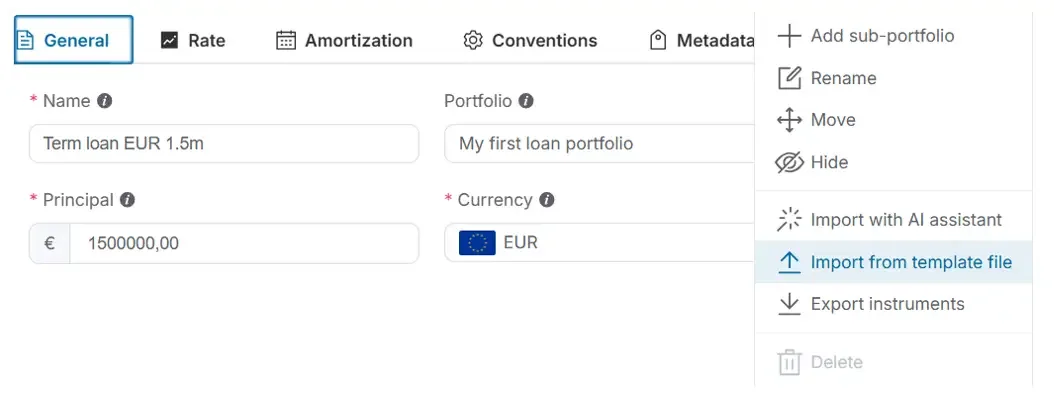
Take the interactive product tour
Read the demo as text: how to add loans and generate one loan report
Loan data often starts in spreadsheets: loan terms are retyped from PDFs, reference rates are looked up by hand and the same report is rebuilt every month. This interactive demo shows how TreasuryView replaces those steps.
- TreasuryView offers three routes for adding a loan: the loan form, the Excel template and AI-assisted import (beta), which reads a spreadsheet you already have.
- The loan form is the route for a single loan. You enter the key terms, such as principal, dates, rate, payment frequency and conventions, and TreasuryView calculates the schedule. For a bespoke repayment schedule, the cash flows can be copied from Excel into the schedule.
- The Excel template is the route for many loans at once. You download the TreasuryView template, enter one row per loan and upload it.
- AI-assisted import (beta) is the route for a spreadsheet you already have. TreasuryView analyses the file and extracts the loan terms. Results depend on how structured the file is.
- The report is one view of bank loans and intercompany loans, calculated from the loan terms with market data as of the reporting date.
- The demo ends with an invitation to start with your own loans instead of rebuilding the report by hand.
ZenTreasury or TreasuryView: which one should you choose?
ZenTreasury and TreasuryView answer different questions. ZenTreasury is a financial contract accounting platform set up through a sales-led implementation: IFRS 16 leases, loans and money market, FX contracts and guarantees, with accounting entries, disclosures and an audit trail generated from the contract data. TreasuryView is built around debt and derivatives tasks: external facilities, intercompany loans, cash pool interest, swaps and the interest rate risk analytics that go with them. It does not connect to banks, import bank statements or make payments, and it does not provide lease accounting, so it runs next to the accounting and bank systems a finance team already uses.
Choose ZenTreasury if:
- IFRS 16 lease accounting is your main need, with modifications, remeasurements and multi-currency, multi-entity lease accounting, and you want loans, FX contracts and guarantees accounted for on the same platform
- You need journals and disclosures generated from contract data, with posting rules per module that map to your chart of accounts and a record-level audit trail your auditor can open
- You want leases, loans, bonds, FX contracts, guarantees and cash forecasting held as structured contracts in one register, across entities and currencies
- You want bank balances, transactions and executed FX trades brought into the platform through APIs, scheduled feeds or structured imports, while payments and trade execution stay elsewhere
- You want four-eye approval on critical treasury transactions, Microsoft Entra ID single sign-on and a separate database per customer hosted in the EU
- You can plan a scoped implementation with a named contact and agree a quoted subscription, since ZenTreasury does not publish prices, and you can work with support in English and Finnish during Finnish business hours
Choose TreasuryView if:
- Your task is the debt book and its derivatives rather than a treasury operating model, and your intercompany loans need the full agreement terms, with facilities, limits and commitment fees, drawdowns, fixed or floating rates, custom benchmark rates, tranches and repayment profiles
- Your cash pools need debit and credit interest calculated and reported, from balances or movements you enter or upload instead of an in-house bank set-up
- Your external facilities fund projects across the group and are planned as a portfolio, and you need interest rate swaps valued next to the loans they hedge, on a derivatives engine in production since 2009, with stress tests and scenarios for interest cost and value, on GROW and above
- You are moving loans and cash pool balances out of spreadsheets and want to start self-service, without an integration project, with a 30-day free trial without a payment method, a published monthly price and cancellation at any time
- Your cash and payments workflows stay where they are, and the REST API in every plan sends loan data, schedules and report results to your accounting or treasury systems when you are ready to automate
Strengths and limits of each
TreasuryView
- Strength: external facilities, calculation accuracy since 2009
- External facilities with broad coverage of non-standard terms: fixed and floating rate loans, revolving credit facilities, refinancings and multi-leg loans, with bullet, linear or annuity repayment, commitment limits and fees, and tranches, available from the START plan. Interest, schedules and accruals come from a calculation engine in production use since 2009. In the rare case a figure differs from your bank's confirmation, any row can be corrected.
- Strength: intercompany loans and cash pools
- Intercompany loans with facilities, limits and commitment fees, drawdowns, tranches and custom benchmark rates. Cash pool accounts with debit and credit interest, calculated and reported from the balances or movements you enter or upload.
- Strength: derivatives and interest rate risk analytics since 2009
- Derivatives valued next to the debt book since 2009: interest rate swaps with mark-to-market valuation, linked to the external facilities they hedge, plus interest rate stress tests (+/-100 bps, steepening, flattening), scenario analysis, BPV and duration sensitivities and comparison of hedging conditions with bank offers, on GROW and above. Cross-currency swaps, swaptions and hedge effectiveness testing are on ENTERPRISE. Caps and floors are modelled as loan terms on every plan.
- Strength: self-service start
- A 30-day free trial without a payment method. Move your loans and cash pool balances out of spreadsheets through the loan form or a spreadsheet upload, with no integration project.
- Strength: published pricing
- Monthly plans from €250 (net), cancel anytime, no setup or onboarding fees.
- Strength: API in every plan, from first call to full integration
- Generate a key in the app and send your first request from the interactive documentation, with no project and no extra fee. Automate at your own pace with report exports in XLSX or CSV, and bring in an integration project on ENTERPRISE when your systems need one.
- Strength: schedules you can correct to what happened
- Record what actually happened on a loan, cash pool or swap schedule, such as a moved payment date, an extra repayment or a new drawdown, and adjust upcoming rows to an agreed change. Later rows recalculate where a change carries forward. Available on every plan; swaps on GROW and above.
- Limit: no bank connectivity
- TreasuryView does not connect to banks, import bank statements or execute payments. Bank connections and payments stay in the systems you already use, and balances and movements are entered or uploaded.
- Limit: no cash management
- TreasuryView calculates interest on cash pool balances but does not run sweeps or netting, and does not provide daily cash positioning, payment approval chains or bank reconciliation.
- Limit: no lease accounting
- TreasuryView does not provide IFRS 16 lease accounting, lease schedules or lease journals. If leases are your main task, a platform built for them, such as ZenTreasury, is the better fit, and TreasuryView can manage the debt book next to it.
ZenTreasury
- Strength: financial contract accounting platform
- IFRS 16 leases, loans and money market, FX contracts and guarantees held as structured contracts, with schedules, accounting entries, disclosures and an audit trail generated from the contract data, according to ZenTreasury's public pages.
- Strength: IFRS 16 lease accounting
- Recognition and schedules generated from contract terms, modifications and remeasurements with an audit trail, and FX retranslation across subsidiaries. ZenTreasury states that an international audit firm reviewed its IFRS 16 calculations and shares the review report during the product walkthrough.
- Strength: loans, bonds and facility register
- Fixed and floating rate loans, external and intercompany, revolving facilities with drawdowns and repayments, deposits, commercial paper, bonds, and interest rate and cross-currency swaps alongside the loans they relate to, with a bank facility register for limits, pricing, covenants and renewal dates, according to ZenTreasury's debt page.
- Strength: floating-rate resets and valuation
- Reset dates tracked per loan, with the new reference rate applied and schedules and accruals recalculated when a fixing falls due, and an alert if a fixing is missed. Loans and money market are valued by discounted cash flow against yield curves, bonds by market price by ISIN or discounted cash flow, with premium and discount amortisation, according to ZenTreasury's debt page.
- Strength: treasury accounting
- Interest accruals, revaluations and premium and discount amortisation for loans, bonds and FX, with posting rules per module that map to your chart of accounts and entries exported to your accounting system, according to ZenTreasury's debt and treasury pages.
- Strength: FX contracts, guarantees and cash forecasting
- Spots, forwards, swaps and cross-currency deals tracked to settlement with forward exposure and hedge ratio against policy, bank, corporate and parent guarantees and letters of credit with fees, exposure and expiry, and short-term, weekly and long-term cash forecasts built from the contracts already in the system.
- Strength: bank data in, controls and security
- Bank balances, transactions and executed FX trades come in through APIs, scheduled feeds or structured imports. Four-eye approval on critical treasury transactions, a record-level audit trail, Microsoft Entra ID single sign-on, multi-factor authentication, EU hosting with a separate database per customer, and a CAIQ v4.1 questionnaire on the public Cloud Security Alliance STAR registry, according to ZenTreasury's integrations and security pages.
- Strength: implementation and support
- A dedicated environment provisioned within one to two days, five implementation phases and a named contact who stays after go-live, with a support portal, user guides and in-product tickets, in English and Finnish on weekdays from 9:00 to 17:00 Finnish time, according to ZenTreasury's pricing and how-we-work pages.
- Strength: reporting, API and AI access
- Excel and PDF reports, Power BI, a REST API and a read-only MCP server for AI assistants, which a company admin enables and which logs every request, according to ZenTreasury's integrations and security pages.
- Consideration: pricing and terms
- Pricing is not published; the subscription is priced on the size and activity of the contract portfolio, and implementation and customer-specific integration work are scoped separately. Its terms of service state that a subscription renews automatically for 12 months unless termination is requested at least three months before the end of the period. No free trial is advertised on its website, and every call to action is Contact Sales.
- Consideration: debt analytics and API documentation
- Interest rate scenario analysis, stress testing and hedge accounting for swaps are not described on the pages read, and the valuation method for swaps is not stated. Public API documentation was not found, and no debt, derivatives, cash or payments API is described.
- Consideration: payments and cash pools
- ZenTreasury does not initiate payments or execute trades, according to its integrations page. Cash pool interest and in-house banking are not described on the pages read.
Looking for a ZenTreasury alternative for debt management?
If your main task is managing the debt book, meaning external facilities, intercompany loans, cash pools and interest rate derivatives, and the accounting for your leases, FX and guarantees is handled elsewhere, TreasuryView is built for that job. It offers published pricing from €250 per month, cancellation at any time and a REST API in every plan. If you want IFRS 16 leases, loans, FX contracts and guarantees accounted for on one platform, with journals, disclosures and an audit trail generated from the contract data, ZenTreasury covers more of that.
ZenTreasury vs. TreasuryView: debt management compared
| Feature | TreasuryView | ZenTreasury |
|---|---|---|
| Core job | External facilities, intercompany loans, cash pools, derivatives and interest rate risk management | Financial contract accounting platform for the Office of the CFO: IFRS 16 leases, loans and money market, FX contracts and guarantees, with schedules, journals, disclosures and an audit trail, according to ZenTreasury's AI context page; the primary product wedge is IFRS 16 lease accounting |
| External facilities | External facilities with broad coverage of non-standard terms: fixed and floating rate loans, revolving credit facilities, refinancings and multi-leg loans, with bullet, linear or annuity repayment, commitment limits and fees, and tranches, from the START plan. Calculation engine in production use since 2009; any row can be corrected to match a bank confirmation | Fixed and floating rate loans, external and intercompany, and revolving facilities with drawdowns and repayments as they happen, plus a bank facility register for limits, pricing, covenants and renewal dates per facility line. Reset dates are tracked per loan, with schedules and accruals recalculated at each fixing. Repayment profile types, commitment fees and tranches are not described on the pages read |
| Other instruments | Focused on external facilities, intercompany loans, cash pools and interest rate derivatives; FX risk management is an ENTERPRISE add-on | IFRS 16 leases, deposits, commercial paper, bonds, FX contracts (spots, forwards, swaps, cross-currency), guarantees and letters of credit, mortgages, equity transactions and cash forecasting, according to ZenTreasury's pricing and treasury pages |
| Intercompany loans | Intercompany loans shared with subsidiaries (borrower or lender view) on every plan, plus bilateral facilities with limits and commitment fees, drawdowns, fixed or floating rates, custom benchmark rates, bullet, linear, annuity or fixed repayment and tranches | Intercompany loans and mirror deals are listed among the supported loan types, according to ZenTreasury's pricing and debt pages; the agreement terms for intercompany facilities are not itemised on the pages read |
| Cash pool interest | Cash pool accounts with debit and credit interest on every plan, calculated and reported from the balances or movements you enter or upload. TreasuryView does not import bank statements, run sweeps or net positions | Not described on the pages read; the cash management section lists bank accounts, bank statements and bank facilities |
| In-house banking and netting | Not included. TreasuryView calculates and reports cash pool interest and does not run sweeps, netting or internal accounts | Not described on the pages read |
| Pricing | Published: START €250 per month, GROW €500 per month, ENTERPRISE on request. Net of VAT. Priced per team, not per user | Not published; the subscription is priced on the size and activity of the contract portfolio, with implementation scoped separately and customer-specific integration work scoped separately |
| Free trial and contract | 30-day free trial with full access and no payment method. Monthly invoicing with no long-term contract, cancel any time, no cancellation fees, paid by bank transfer | No free trial advertised on its website; every call to action is Contact Sales, although its terms of service refer to a trial period. According to its terms, a subscription renews automatically for 12 months unless termination is requested at least three months before the end of the period |
| Setup and time to start | Sign up in under a minute and add loans through the loan form, a spreadsheet upload or AI-assisted import. No setup or onboarding fees | A dedicated environment provisioned within one to two days, then five phases (environment, kick-off, data migration, integrations and accounting, go-live) with a named contact; ZenTreasury states that most customers are live within four to eight weeks, and that data readiness usually determines the timeline |
| API access | REST API with interactive documentation (OpenAPI) and developer portal access on every plan | A REST API, Power BI and a read-only MCP server for AI assistants are listed as data-out options on its integrations page; public API documentation not found |
| Debt-related API | Loan and cash pool lists, payment schedules, interest and accrual reports via the API; derivative data on GROW and above | Not described; no debt endpoints found in public documentation, and no public API documentation was found |
| Derivatives-related API | Interest rate swaps with payment cash flows, valuation and hedge reports, plus curves and scenario calculations via the API; swaps on GROW and above | Not described; no derivatives endpoints found in public documentation, and no public API documentation was found |
| Cash and bank data API | Not covered | Bank balances and transactions come in through APIs, scheduled feeds or structured imports, according to its integrations page; a separate cash or bank data API is not described |
| Payments API | Not covered | Not covered: ZenTreasury does not initiate payments or execute trades, according to its integrations page |
| Loan capture | Loan form or spreadsheet upload, plus AI-assisted import below; the REST API sends results out | Loans are imported from an Excel template, checked back for gaps and inconsistencies, then loaded with their schedules; bonds are entered individually, according to its debt page |
| Get debt data out (downstream) | Loan and cash pool lists, payment schedules, derivative data on GROW and above and report runs with XLSX or CSV export, via the API | Excel and PDF reports, Power BI, a REST API and read-only MCP access for AI assistants; accounting entries are exported as files, according to its integrations and debt pages |
| Reference rates | Automated EUR reference rate fixings and pre-integrated curves on every plan; automated fixings in other currencies on ENTERPRISE; fixings and curves available via the API; custom benchmark rates are part of every loan's data model | FX rates and money-market rates through automatic or scheduled rate feeds, and fixings by feed, Excel import or manual entry, according to its integrations and debt pages |
| Derivatives and valuation | Derivatives in production use since 2009: interest rate swaps with mark-to-market valuation, linked to the loans they hedge, on GROW; cross-currency swaps, swaptions, basis and amortising swaps and hedge effectiveness testing on ENTERPRISE; caps and floors as loan terms on every plan | Interest rate and cross-currency swaps are held alongside the loans they relate to; loans and money market are valued by discounted cash flow against yield curves, with period-end revaluation of multi-currency debt. The valuation method for swaps and hedge accounting are not described on the pages read |
| Interest rate risk analytics | Interest rate stress tests (+/-100 bps, steepening, flattening), scenario analysis, sensitivities (BPV and duration) and comparison of hedging conditions with bank offers on GROW and above | Not described for interest rate scenarios or sensitivities on the pages read; FX contracts show forward exposure and hedge ratio against policy, and cash forecasting includes FX-exposure forecasting |
| Loan import with AI | AI-assisted import from term sheets, PDFs and spreadsheets (beta on START and GROW; included in ENTERPRISE) | Not described; ZenTreasury states it runs no AI of its own on its security page, and its read-only MCP server lets a company admin give AI assistants read access, with every request logged |
| Bank connection | Not included. Bank data stays in your bank portal, accounting or treasury system, or connectivity provider | Bank balances, transactions and executed FX trades come in through APIs, scheduled feeds or structured imports, according to its integrations page |
| Payments | Not included | Not included: ZenTreasury does not initiate payments or execute trades, according to its integrations page |
| Actual movements on the schedule | Recorded as schedule overrides on loans, cash pools and, on GROW and above, swaps, such as a moved payment date, an extra repayment or a new drawdown | Revolving facilities record drawdowns and repayments as they happen; how other actual movements adjust a loan schedule is not described on the pages read |
| Debt interest posting to accounting | Interest, accruals and schedules go to your accounting system through the API. Integration projects with accounting systems are available on ENTERPRISE | Interest accruals, revaluations and premium and discount amortisation are generated, and posting rules per module map them to your chart of accounts; entries are exported as files in the agreed format, and ZenTreasury states it does not write into the ERP. Scheduled imports or API integrations are also listed |
| Audit trail | Unalterable audit trail of users and deals on GROW and ENTERPRISE; user activity log on START | Record-level audit trail report in the application, voucher history with reversals, an admin audit log, and four-eye approval on critical treasury transactions with the approval history retained |
| Single sign-on | Microsoft Entra ID on ENTERPRISE; passkey, e-mail code or federated sign-in on every plan | Microsoft Entra ID (Azure AD) single sign-on; multi-factor authentication available for every user |
| Security and hosting | Client data hosted in Germany in an ISO 27001-certified data centre, designed to meet GDPR requirements; audit trail of user activity and deals | Hosted in the EU on Hetzner, with Azure EU backup storage and a Cloudflare network edge, a separate database per customer, nightly encrypted backups, and a CAIQ v4.1 questionnaire on the public Cloud Security Alliance STAR registry; no ISO 27001 certificate is listed on the security page |
| Support and implementation | Support by e-mail, chat, phone and video call on every plan, priority support on GROW and ENTERPRISE, integration projects on ENTERPRISE | Named contact through go-live and after, a support portal with user guides and in-product tickets, in English and Finnish, weekdays 9:00 to 17:00 Finnish time excluding Finnish public holidays |
| Track record in debt management | Debt management and derivatives in production use since 2009 | Founded in Helsinki in 2016, customers in nine countries; named customers include Bolt, BearingPoint, Rapala, Lindström, iLOQ, Ensto, Adapteo, ALEC, Nice One, SOK, Teckwah and Ampath; its primary product wedge is lease accounting, and no launch date for its debt tooling is stated |
Core job
TreasuryView
External facilities, intercompany loans, cash pools, derivatives and interest rate risk management
ZenTreasury
Financial contract accounting platform for the Office of the CFO: IFRS 16 leases, loans and money market, FX contracts and guarantees, with schedules, journals, disclosures and an audit trail, according to ZenTreasury's AI context page; the primary product wedge is IFRS 16 lease accounting
External facilities
TreasuryView
External facilities with broad coverage of non-standard terms: fixed and floating rate loans, revolving credit facilities, refinancings and multi-leg loans, with bullet, linear or annuity repayment, commitment limits and fees, and tranches, from the START plan. Calculation engine in production use since 2009; any row can be corrected to match a bank confirmation
ZenTreasury
Fixed and floating rate loans, external and intercompany, and revolving facilities with drawdowns and repayments as they happen, plus a bank facility register for limits, pricing, covenants and renewal dates per facility line. Reset dates are tracked per loan, with schedules and accruals recalculated at each fixing. Repayment profile types, commitment fees and tranches are not described on the pages read
Other instruments
TreasuryView
Focused on external facilities, intercompany loans, cash pools and interest rate derivatives; FX risk management is an ENTERPRISE add-on
ZenTreasury
IFRS 16 leases, deposits, commercial paper, bonds, FX contracts (spots, forwards, swaps, cross-currency), guarantees and letters of credit, mortgages, equity transactions and cash forecasting, according to ZenTreasury's pricing and treasury pages
Intercompany loans
TreasuryView
Intercompany loans shared with subsidiaries (borrower or lender view) on every plan, plus bilateral facilities with limits and commitment fees, drawdowns, fixed or floating rates, custom benchmark rates, bullet, linear, annuity or fixed repayment and tranches
ZenTreasury
Intercompany loans and mirror deals are listed among the supported loan types, according to ZenTreasury's pricing and debt pages; the agreement terms for intercompany facilities are not itemised on the pages read
Cash pool interest
TreasuryView
Cash pool accounts with debit and credit interest on every plan, calculated and reported from the balances or movements you enter or upload. TreasuryView does not import bank statements, run sweeps or net positions
ZenTreasury
Not described on the pages read; the cash management section lists bank accounts, bank statements and bank facilities
In-house banking and netting
TreasuryView
Not included. TreasuryView calculates and reports cash pool interest and does not run sweeps, netting or internal accounts
ZenTreasury
Not described on the pages read
Pricing
TreasuryView
Published: START €250 per month, GROW €500 per month, ENTERPRISE on request. Net of VAT. Priced per team, not per user
ZenTreasury
Not published; the subscription is priced on the size and activity of the contract portfolio, with implementation scoped separately and customer-specific integration work scoped separately
Free trial and contract
TreasuryView
30-day free trial with full access and no payment method. Monthly invoicing with no long-term contract, cancel any time, no cancellation fees, paid by bank transfer
ZenTreasury
No free trial advertised on its website; every call to action is Contact Sales, although its terms of service refer to a trial period. According to its terms, a subscription renews automatically for 12 months unless termination is requested at least three months before the end of the period
Setup and time to start
TreasuryView
Sign up in under a minute and add loans through the loan form, a spreadsheet upload or AI-assisted import. No setup or onboarding fees
ZenTreasury
A dedicated environment provisioned within one to two days, then five phases (environment, kick-off, data migration, integrations and accounting, go-live) with a named contact; ZenTreasury states that most customers are live within four to eight weeks, and that data readiness usually determines the timeline
API access
TreasuryView
REST API with interactive documentation (OpenAPI) and developer portal access on every plan
ZenTreasury
A REST API, Power BI and a read-only MCP server for AI assistants are listed as data-out options on its integrations page; public API documentation not found
Debt-related API
TreasuryView
Loan and cash pool lists, payment schedules, interest and accrual reports via the API; derivative data on GROW and above
ZenTreasury
Not described; no debt endpoints found in public documentation, and no public API documentation was found
Derivatives-related API
TreasuryView
Interest rate swaps with payment cash flows, valuation and hedge reports, plus curves and scenario calculations via the API; swaps on GROW and above
ZenTreasury
Not described; no derivatives endpoints found in public documentation, and no public API documentation was found
Cash and bank data API
TreasuryView
Not covered
ZenTreasury
Bank balances and transactions come in through APIs, scheduled feeds or structured imports, according to its integrations page; a separate cash or bank data API is not described
Payments API
TreasuryView
Not covered
ZenTreasury
Not covered: ZenTreasury does not initiate payments or execute trades, according to its integrations page
Loan capture
TreasuryView
Loan form or spreadsheet upload, plus AI-assisted import below; the REST API sends results out
ZenTreasury
Loans are imported from an Excel template, checked back for gaps and inconsistencies, then loaded with their schedules; bonds are entered individually, according to its debt page
Get debt data out (downstream)
TreasuryView
Loan and cash pool lists, payment schedules, derivative data on GROW and above and report runs with XLSX or CSV export, via the API
ZenTreasury
Excel and PDF reports, Power BI, a REST API and read-only MCP access for AI assistants; accounting entries are exported as files, according to its integrations and debt pages
Reference rates
TreasuryView
Automated EUR reference rate fixings and pre-integrated curves on every plan; automated fixings in other currencies on ENTERPRISE; fixings and curves available via the API; custom benchmark rates are part of every loan's data model
ZenTreasury
FX rates and money-market rates through automatic or scheduled rate feeds, and fixings by feed, Excel import or manual entry, according to its integrations and debt pages
Derivatives and valuation
TreasuryView
Derivatives in production use since 2009: interest rate swaps with mark-to-market valuation, linked to the loans they hedge, on GROW; cross-currency swaps, swaptions, basis and amortising swaps and hedge effectiveness testing on ENTERPRISE; caps and floors as loan terms on every plan
ZenTreasury
Interest rate and cross-currency swaps are held alongside the loans they relate to; loans and money market are valued by discounted cash flow against yield curves, with period-end revaluation of multi-currency debt. The valuation method for swaps and hedge accounting are not described on the pages read
Interest rate risk analytics
TreasuryView
Interest rate stress tests (+/-100 bps, steepening, flattening), scenario analysis, sensitivities (BPV and duration) and comparison of hedging conditions with bank offers on GROW and above
ZenTreasury
Not described for interest rate scenarios or sensitivities on the pages read; FX contracts show forward exposure and hedge ratio against policy, and cash forecasting includes FX-exposure forecasting
Loan import with AI
TreasuryView
AI-assisted import from term sheets, PDFs and spreadsheets (beta on START and GROW; included in ENTERPRISE)
ZenTreasury
Not described; ZenTreasury states it runs no AI of its own on its security page, and its read-only MCP server lets a company admin give AI assistants read access, with every request logged
Bank connection
TreasuryView
Not included. Bank data stays in your bank portal, accounting or treasury system, or connectivity provider
ZenTreasury
Bank balances, transactions and executed FX trades come in through APIs, scheduled feeds or structured imports, according to its integrations page
Payments
TreasuryView
Not included
ZenTreasury
Not included: ZenTreasury does not initiate payments or execute trades, according to its integrations page
Actual movements on the schedule
TreasuryView
Recorded as schedule overrides on loans, cash pools and, on GROW and above, swaps, such as a moved payment date, an extra repayment or a new drawdown
ZenTreasury
Revolving facilities record drawdowns and repayments as they happen; how other actual movements adjust a loan schedule is not described on the pages read
Debt interest posting to accounting
TreasuryView
Interest, accruals and schedules go to your accounting system through the API. Integration projects with accounting systems are available on ENTERPRISE
ZenTreasury
Interest accruals, revaluations and premium and discount amortisation are generated, and posting rules per module map them to your chart of accounts; entries are exported as files in the agreed format, and ZenTreasury states it does not write into the ERP. Scheduled imports or API integrations are also listed
Audit trail
TreasuryView
Unalterable audit trail of users and deals on GROW and ENTERPRISE; user activity log on START
ZenTreasury
Record-level audit trail report in the application, voucher history with reversals, an admin audit log, and four-eye approval on critical treasury transactions with the approval history retained
Single sign-on
TreasuryView
Microsoft Entra ID on ENTERPRISE; passkey, e-mail code or federated sign-in on every plan
ZenTreasury
Microsoft Entra ID (Azure AD) single sign-on; multi-factor authentication available for every user
Security and hosting
TreasuryView
Client data hosted in Germany in an ISO 27001-certified data centre, designed to meet GDPR requirements; audit trail of user activity and deals
ZenTreasury
Hosted in the EU on Hetzner, with Azure EU backup storage and a Cloudflare network edge, a separate database per customer, nightly encrypted backups, and a CAIQ v4.1 questionnaire on the public Cloud Security Alliance STAR registry; no ISO 27001 certificate is listed on the security page
Support and implementation
TreasuryView
Support by e-mail, chat, phone and video call on every plan, priority support on GROW and ENTERPRISE, integration projects on ENTERPRISE
ZenTreasury
Named contact through go-live and after, a support portal with user guides and in-product tickets, in English and Finnish, weekdays 9:00 to 17:00 Finnish time excluding Finnish public holidays
Track record in debt management
TreasuryView
Debt management and derivatives in production use since 2009
ZenTreasury
Founded in Helsinki in 2016, customers in nine countries; named customers include Bolt, BearingPoint, Rapala, Lindström, iLOQ, Ensto, Adapteo, ALEC, Nice One, SOK, Teckwah and Ampath; its primary product wedge is lease accounting, and no launch date for its debt tooling is stated
Statements about ZenTreasury are based on its public website (home, pricing, loan and debt management, treasury overview, integrations, security, how we work and AI context pages) and its terms of service, reviewed on 5 November 2026. 'Not described' means ZenTreasury's public pages describe no such feature on that date; it does not rule out features that exist but are not published. Additional currencies, or licensable reference rate or swap data, may require a separate market data licence, priced separately. ZenTreasury is a name of ZenTreasury Oy, and this page is not affiliated with or endorsed by ZenTreasury. A feature-by-feature comparison is also available on Capterra. If you spot something outdated or inaccurate, please contact us and we will correct it.
Information about third-party products is based on publicly available sources and was last reviewed on 2026-11-05. TreasuryView is not affiliated with the vendors named. All product names and trademarks belong to their respective owners.
Derivatives and interest rate risk: what each platform covers today
Knowing where every loan and derivative stands is the first step. A treasurer also needs to know what happens when markets move. TreasuryView covers external facilities, intercompany loans, derivatives and interest rate risk in one platform, so positions and market impact sit together:
- Position: every external facility, intercompany loan and swap in one place, with schedules, accruals and valuations from the calculation engine.
- Impact: what a move of 100 basis points does to interest cost and cash flows, to the value of swaps and loans, and to the average cost of funds. Rate impact analysis is available on GROW.
- Growth: when the business adds a facility, a swap or a foreign-currency loan, it goes into the same platform instead of a new spreadsheet.
Derivatives and interest rate risk start with the GROW plan (€500 per month). START covers loans, intercompany loans and cash pools. FX rates, FX forward curves and FX history are available through the API. The FX risk management module (spot, forwards and options) is an ENTERPRISE add-on, available on request.
ZenTreasury lists interest rate swaps and cross-currency swaps alongside the loans they relate to, and FX contracts (spots, forwards, swaps and cross-currency deals) with forward exposure and hedge ratio against policy, according to its debt and treasury pages (reviewed 5 November 2026). Loans and money market are valued by discounted cash flow against yield curves, with period-end revaluation of multi-currency debt. The valuation method for swaps, interest rate scenario analysis and hedge accounting are not described on those pages. TreasuryView's focus is interest rate derivatives valued next to the debt they hedge, in production use since 2009.
If your debt is only intercompany loans today, you may not need interest rate risk analytics yet. If external facilities or swaps are coming, starting on a platform that covers them avoids a second migration.
API and integration: link your debt data with the systems around it
Debt data is only useful if it reaches the systems that need it. TreasuryView's REST API is included in every plan, with API documentation and developer portal access, so you can build the workflow that fits your stack. Typical workflows:
- Upstream: loans enter through the loan form, a spreadsheet upload or AI-assisted import (beta), so you can start without an integration project.
- Downstream to accounting: pull accruals, schedules and reports into your accounting or treasury system, so figures are not retyped.
- Downstream to cash forecasting and BI: send interest and principal schedules to your forecasting tool or dashboards.
- Market data: pull curves, reference rate fixings and FX rates into your own models.
These are examples. The API documentation lists the endpoints available on your plan.
ZenTreasury lists a REST API, Power BI and a read-only MCP server for AI assistants as data-out options on its integrations page, and bank balances, transactions and executed FX trades as data in through APIs, scheduled feeds or structured imports (reviewed 5 November 2026). Its security page states that a company admin enables the MCP server, that every request is logged and that ZenTreasury runs no AI of its own. Public API documentation was not found, and no debt, derivatives, cash or payments API is described.
What each TreasuryView plan covers
- START (€250 per month): up to 50 loans, 1 company including subsidiaries, 5 internal users, multi-currency (EUR, USD, GBP, CHF and 20+ others), cash pools, intercompany loans, manual schedule overrides, integrated end-of-day market data and the REST API.
- GROW (€500 per month): up to 300 loans and interest rate derivatives, 15 internal users plus 10 guests, valuation and interest rate risk analytics, interest rate swaps, hedge coverage and priority support.
- ENTERPRISE (on request): cross-currency swaps, swaptions, hedge effectiveness testing, the FX risk management module (spot, forwards and options), automated fixings in other currencies, extended transaction volume and reports, single sign-on (Microsoft Entra ID), and integration projects with accounting systems, built for you.
Full functionality free for 30 days
Sign up in under a minute, no credit card. The trial ends automatically. Monthly plans from €250 (net), cancel anytime. Plan details are on the pricing page.
How to choose debt management software next to or instead of a treasury platform
If you answer "yes" to these questions, TreasuryView might be a good fit.
-
Still tracking external facilities, intercompany loans and cash pools in spreadsheets?
TreasuryView keeps external facilities, intercompany loans, cash pools and derivatives in one dashboard, with schedules and accruals calculated for you.
-
Do you need swaps valued and interest rate risk analysed next to your loans?
TreasuryView values interest rate swaps alongside your loans on GROW and above, with mark-to-market valuation, stress tests and interest rate scenarios. Caps and floors are modelled as loan terms.
-
Do you need a platform you can start with yourself, without an implementation project?
Sign up, add your loans through the loan form or a spreadsheet upload, and run reports. There are no setup fees.
-
Do you want published pricing before you commit budget?
Monthly plans are published from €250 (net), with a 30-day free trial.
-
Is bank connectivity already handled in your bank portal, your accounting or treasury system or by a provider?
TreasuryView works next to it and links through the API, so you keep that contract.
-
Do you need to send debt data to accounting, forecasting or BI tools?
The REST API, included in every plan, sends results out to the systems around TreasuryView.
-
Do you need IFRS 16 lease accounting and journals generated from contract data on the same platform?
Then ZenTreasury's platform may fit better. TreasuryView does not provide lease accounting.
What the first 30 days look like
Within the 30-day free trial you can have your external facilities, intercompany loans and cash pools in one place, with reports and market data included.
-
Start in under a minute
Immediate access
Create a free accountSign up for free and explore the full functionality.
-
Day 1
Import your data
Data migrationUpload your loans with the Excel template or enter them directly, and preview each schedule before you save.
-
Week 1
Automate your work
Customise views and automate reporting.
-
Week 2
Make data-driven decisions
Evaluate interest rate risk and, on GROW, value swaps next to the loans they hedge.
“It [TreasuryView] is a very intuitive tool to use, with enough capabilities to get a clear understanding of your company's treasury status. I also really value the support I get from their team setting it up for my company.”
Other comparisons
- Agicap Alternative for Loan & Debt Management
- Atlar Alternative for Debt Management
- Chatham Onyx Alternative for Mid-Sized Companies
- ION Treasury Alternative for Mid-Sized Companies
- Kyriba Alternative for Mid-Sized Companies
- Nomentia Alternative for SMBs & Mid-Sized Companies
- Ripple Treasury (GTreasury) Alternative
- Salmon Treasury Alternative for Mid-Sized Companies
- Spreadsheet Alternative for Loan & Debt Management
- Enterprise TMS Alternative for Mid-Sized Companies
FAQ: choosing between TreasuryView and ZenTreasury
What is a ZenTreasury alternative for debt management?
TreasuryView is one option if managing the debt book is your main task. It manages external facilities, intercompany loans, cash pools and interest rate derivatives, calculates interest, schedules and valuations, and publishes its monthly pricing. ZenTreasury is a financial contract accounting platform that starts with IFRS 16 leases and covers loans, FX contracts and guarantees with accounting output, so the better fit depends on whether accounting for a range of contracts or debt and derivatives come first. For a feature-by-feature view, see the TreasuryView vs ZenTreasury comparison on Capterra.
How much does ZenTreasury cost compared with TreasuryView?
ZenTreasury does not publish prices. It states that the subscription is priced on the size and activity of the contract portfolio and that implementation is scoped separately, so a quote follows a conversation with its sales team. TreasuryView publishes its prices: START is €250 per month and GROW is €500 per month, both net of VAT, with ENTERPRISE on request. To compare total cost, compare the scope each one covers.
Is there a monthly plan, and can I cancel at any time?
Yes. TreasuryView plans are billed monthly, there is no long-term contract, and you can cancel any time in your account with no cancellation fee. Payment is by bank transfer. ZenTreasury's terms of service state that a subscription renews automatically for 12 months unless termination is requested at least three months before the end of the period.
Is there a free trial, and do I need a credit card?
TreasuryView offers a 30-day free trial with full access and no payment method, and you can upload your own loans to see real reports. ZenTreasury does not advertise a free trial on its website, where every call to action is Contact Sales, although its terms of service refer to a trial period.
Can I buy ZenTreasury's loan and debt management on its own?
ZenTreasury states that each engagement is quoted against the modules and capacity a customer needs, and its loan and debt management is one product area of the platform next to leases, FX and guarantees. Whether it can be bought without the other modules is agreed with ZenTreasury and is not stated on its public pages. TreasuryView is a standalone debt management platform that you can start yourself.
Can I use TreasuryView next to ZenTreasury?
Yes. TreasuryView does not replace an accounting platform. Finance teams keep their lease accounting, journals and bank connections where they are and use TreasuryView for external facilities, intercompany loans, cash pool interest and derivatives. Because ZenTreasury also holds loans, decide which system holds the debt data first, so that loans are not maintained twice. The REST API sends schedules and report results to the systems around TreasuryView.
Which debt instruments does each platform cover?
ZenTreasury lists IFRS 16 leases, loans (fixed and floating rate, external and intercompany), revolving facilities, deposits, commercial paper, bonds, interest rate and cross-currency swaps, FX contracts, guarantees and letters of credit. TreasuryView covers external facilities, including revolving credit facilities, intercompany loans, cash pools and interest rate derivatives.
Does TreasuryView manage external facilities as well as intercompany loans?
Yes. External facilities, meaning bank loans and credit facilities, are available from the START plan, with broad coverage of non-standard terms: fixed and floating rate loans, revolving credit facilities, refinancings and multi-leg loans, with bullet, linear or annuity repayment, commitment limits and fees, and tranches. Interest, schedules and accruals come from a calculation engine in production use since 2009, and any row can be corrected to match a bank confirmation.
Can TreasuryView calculate interest on cash pool balances, and does it import bank statements?
TreasuryView calculates and reports debit and credit interest on cash pool accounts on every plan, from balances or movements you enter or upload. It does not import bank statements, run sweeps or net positions.
Does ZenTreasury calculate interest on intercompany loans and cash pools?
ZenTreasury lists intercompany loans and mirror deals among its supported loan types and generates schedules and accruals from the agreement. How interest is calculated for cash pool balances is not described on the pages we read. TreasuryView calculates and reports debit and credit interest on cash pool accounts on every plan, from balances or movements you enter or upload.
Does ZenTreasury support interest rate derivatives and risk management?
According to ZenTreasury's public pages, it holds interest rate and cross-currency swaps alongside the loans they relate to and tracks FX contracts with forward exposure and hedge ratio against policy. The valuation method for swaps, interest rate scenario analysis and hedge accounting are not described on those pages. TreasuryView values interest rate swaps next to the loans they hedge from GROW, with stress tests and scenarios, and its calculation engine has been in production use since 2009. Check both vendors' current documentation against your requirements and test with your own data.
Which TreasuryView plan do I need for derivatives and interest rate risk?
Derivatives and interest rate risk analytics start with GROW at €500 per month. START covers loans, intercompany loans and cash pools. Cross-currency swaps, swaptions, basis and amortising swaps and hedge effectiveness testing are on ENTERPRISE.
What happens to my loans and derivatives when rates move?
TreasuryView shows the impact of rate moves on interest cost, cash flows and the value of swaps and loans, with rate impact analysis on GROW.
Does ZenTreasury offer hedge accounting, and what does TreasuryView offer?
Hedge accounting is not described on ZenTreasury's public pages; it states that it generates accounting entries, accruals, revaluations and amortisation for loans, bonds and FX. TreasuryView offers hedge relationships on GROW and above and, on ENTERPRISE, hedge effectiveness testing.
Does TreasuryView have an API, and is it included in every plan?
Yes. TreasuryView's REST API, with interactive documentation, is included in START, GROW and ENTERPRISE, and so is developer portal access. ZenTreasury lists a REST API, Power BI and a read-only MCP server as data-out options; public API documentation was not found.
Does ZenTreasury have an API or an MCP server?
ZenTreasury lists a REST API, Power BI and a read-only MCP server for AI assistants on its integrations page. Its security page states that a company admin enables the MCP server and that every request is logged. Public API documentation was not found, and no debt, derivatives, cash or payments API is described. TreasuryView's REST API, with interactive OpenAPI documentation, is included in every plan and covers loan and cash pool lists, payment schedules, interest and accrual reports and, on GROW and above, swap data.
How do I get my loans into TreasuryView?
Through the loan form, a spreadsheet upload or AI-assisted import (beta). The REST API then sends calculation results out to your accounting or treasury systems.
Can I send TreasuryView data to my accounting system, cash forecast or BI tool?
Yes. Instruments, exposure portfolio data and report content can be exported through the API.
Do I need bank connections to use TreasuryView?
No. TreasuryView does not connect to banks. Bank transactions and repayments stay in your bank portal, accounting or treasury system or connectivity provider, while loan terms, schedules and interest live in TreasuryView.
Can I keep my current bank connectivity provider?
Yes. TreasuryView sits beside your existing bank connectivity, whether that is your bank portal, your accounting or treasury system or a provider, and you keep that contract.
How long does setup take compared with ZenTreasury?
You can sign up in under a minute and upload loans from a spreadsheet on the first day, without involving your IT team. ZenTreasury provisions a dedicated environment within one to two days and then follows five implementation phases with a named contact; it states that most customers are live within four to eight weeks, and that data migration takes from two days to four weeks.
Will I talk to a human if I get stuck during the trial?
Yes. If you get stuck or want a tour of the software, you can talk to one of our professionals. Full support is available during the trial, and you can book a demo call.
What if TreasuryView is not for me and I want to leave?
The free trial ends automatically and its data will be deleted. Monthly plans can be cancelled at any time.
Does TreasuryView support custom benchmark rates, such as an internal group funding rate?
Yes. Custom benchmark rates are part of every loan's data model and are always on, so a loan can reset on an internal rate as well as on market indices.
Is my data secured?
Client data is hosted in an ISO 27001-certified data centre in Germany and handled according to German and EU regulations. TreasuryView also appoints an external data security officer. Learn more about data security. ZenTreasury hosts in the EU with a separate database per customer, offers Microsoft Entra ID single sign-on and multi-factor authentication, and publishes a CAIQ v4.1 questionnaire on the Cloud Security Alliance STAR registry.
Which alternatives to ZenTreasury exist?
That depends on your company's size, priorities and budget. Five examples, by focus:
- TreasuryView: for finance teams focused on debt management. It automates reporting, reduces Excel risks and improves visibility across external facilities, intercompany loans, cash pools and derivatives, for teams without internal IT support.
- Nomentia: a treasury suite covering bank connectivity, payments, cash and debt, with a vendor-led implementation. See TreasuryView vs. Nomentia.
- Kyriba: a full treasury management system for large-scale implementations. See TreasuryView vs. Kyriba.
- Salmon Treasury: a modular treasury management system with deal management, risk and bank connectivity. See TreasuryView vs. Salmon Treasury.
- Atlar: cash, payments and debt management on live bank connections. See TreasuryView vs. Atlar.
Choose based on what matters most: debt management, accounting for financial contracts, global treasury control or bank and payment visibility.
Where can I find more answers?
See the general FAQ or contact us.
How we reviewed this page
Statements about ZenTreasury are based on ZenTreasury's public website, read on 5 November 2026: the home, pricing, loan and debt management, treasury overview, integrations, security, how we work and AI context pages, and its terms of service. ZenTreasury facts are vendor-stated. TreasuryView facts are taken from its pricing page on the same date. "Not described" means the pages we read describe no such feature today; it does not mean something does not exist. ZenTreasury may have changed since. If you spot something out of date, please contact us and we will correct it.
Compare with your own loan data, free for 30 days
Import your own loan portfolio, check the results against your existing model and then decide.