
Debt and treasury management software
Intercompany loans, kept accurate as rates change.
Track lender and borrower balances across the group and calculate interest accruals in multiple currencies. See the full cross-entity funding picture on any reporting date, without static spreadsheets. Send the results to your accounting software through the REST API.
- Secure sign-up in under a minute. No payment method required.
- The trial ends automatically. Monthly SaaS plans from €250, cancel anytime. See pricing.
Take the interactive tour of intercompany loan management
Read the demo as text: how to add an intercompany loan and see it in the Interest cost report
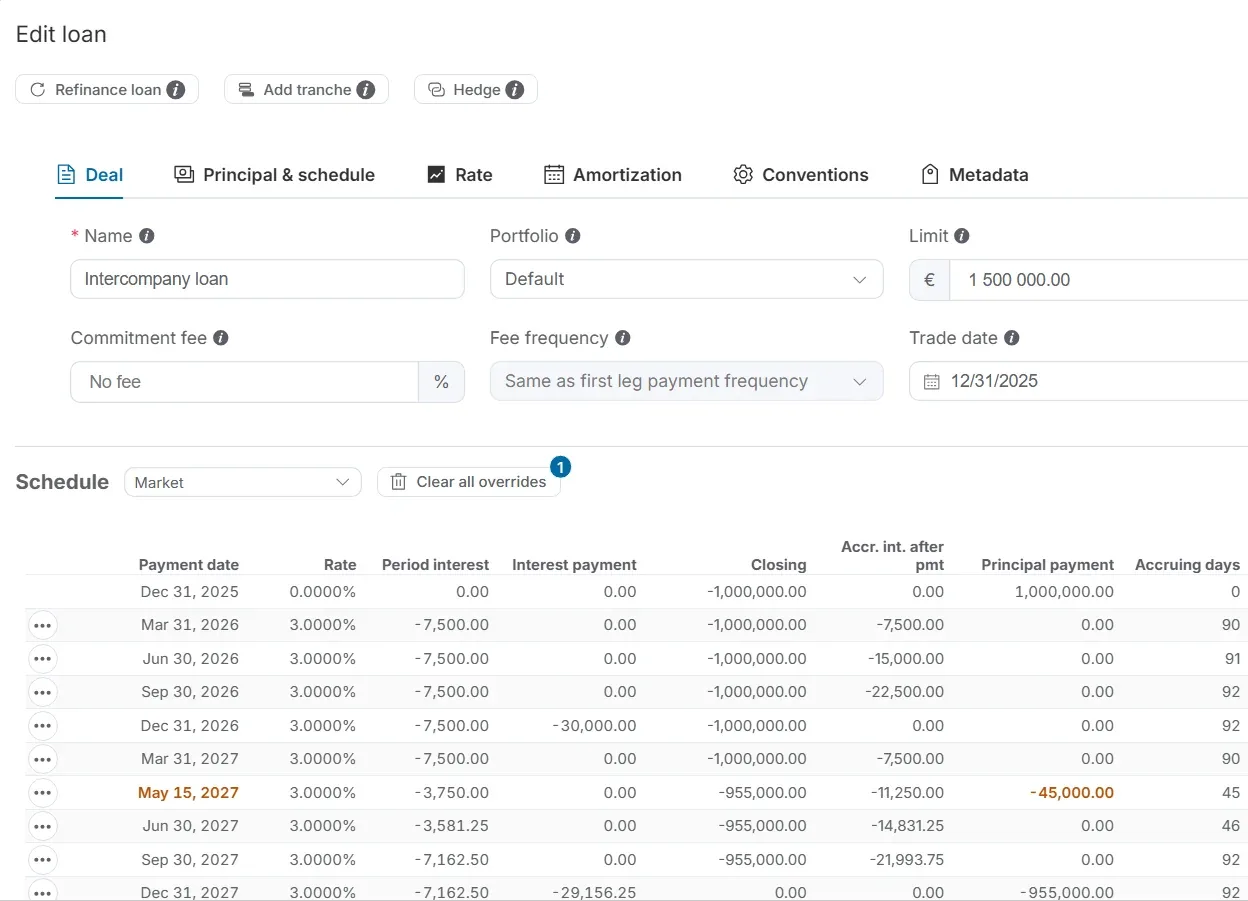
This demo adds one intercompany loan in TreasuryView and shows it in the Interest cost report.
- Add an intercompany loan. An intercompany loan is entered in the loan form under its own label. You set the rate, day count and compounding, and TreasuryView previews the schedule before saving.
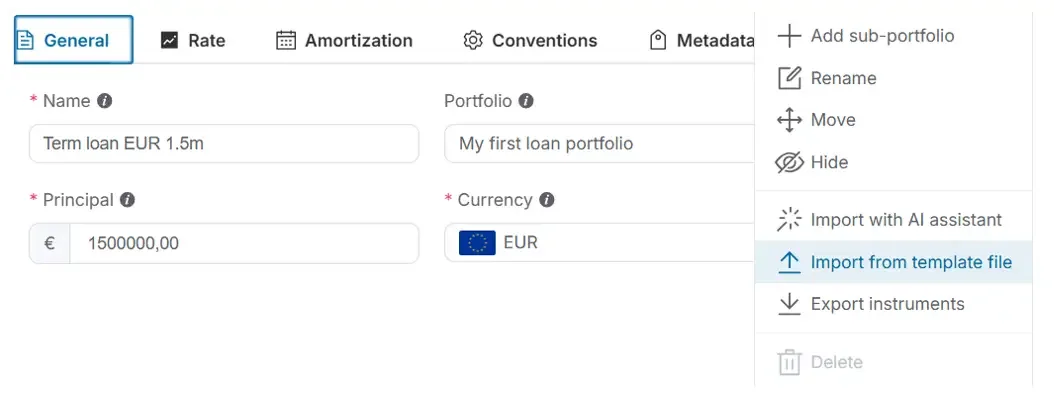
- Intercompany loan is its own loan type. Select it to open the loan form.
- Enter the loan terms. Name the loan and choose its portfolio. The other tabs hold principal and schedule, rate, amortization and conventions, and TreasuryView previews the schedule below the form.
- Set the payment logic of the agreement. Principal and schedule hold the amount, currency, dates, holiday calendar and payment frequency. The interest payment frequency is set separately, so the schedule follows your loan agreement.
- Check the schedule, then save. With interest paid annually, the schedule accrues interest month by month and pays it once a year. Select Save to add the loan.
- See the loan in the Interest cost report as of any reporting date. The new loan appears in the Interest cost report with its own interest for the selected period, calculated with market data as of the report date. The report exports to Excel, and the REST API sends the same results to accounting software.
Software trusted by finance and treasury teams





Ready to use after free sign-up.
- freed weekly
- 6h+
- Based on TreasuryView user averages
- of users see results from day 1
- 80%
- From client personal feedback
- automated data input
- 90%
- Internal TreasuryView user analyses
- to get started
- <1 day
- 80% of trial users see results from day 1
Why Excel falls short for automating intercompany funding
Managing intercompany loans manually is harder than it should be. Spreadsheets slow you down, loan terms get lost and reporting never quite matches. Here is what causes the pain.
-
Scattered data
Intercompany loan data is spread across many spreadsheets.
-
No group visibility
There is no real overview across group entities.
-
Terms hard to track
Loan agreements and terms are difficult to find and follow.
-
Diverging interest figures
Interest calculations differ between lender and borrower.
One hospitality group in Germany we worked with tracked over 100 internal loans in Excel just to monitor monthly interest payments. The data showed balances but gave no forward-looking view of future interest costs or funding exposure. They turned to TreasuryView to get one tracking system for their intercompany loans.
The month-end close for intercompany loans, hour by hour
With TreasuryView, intercompany loan positions are confirmed before the close instead of during it, so consolidation starts from confirmed figures. TreasuryView calculates interest, accruals and balances for every intercompany loan and every reporting date, and exports the results to your accounting software. The timeline follows a finance manager with six companies and loans in three currencies. Times and figures are illustrative.
| Time | Today in spreadsheets | Source | With TreasuryView |
|---|---|---|---|
| 08:30 | Compare repayment schedules with bank statements | Repayment schedules per loan in the system, with a change history | |
| 09:15 | Carry rate changes into the spreadsheets | Excel | New terms are applied automatically from the change date |
| 11:15 | Copy the reference rate after publication | Bank portal | Reference rate for the reporting date taken over automatically from the market data hub |
| 12:00 | Recalculate interest per loan | Excel | Interest calculated automatically from rate, margin and day count convention, for any date |
| 14:00 | Work out accruals at the reporting date | Excel | Interest accruals per loan and company calculated automatically for every reporting date |
| 15:30 | Prepare intercompany interest by subsidiary for accounting | Accounting software | Interest and balances per company and counterparty prepared automatically, exported to Excel or CSV or via REST API. Booking stays in your accounting software |
| 16:30 | Build the overview for management | PowerPoint | Reports by entity, country and currency created automatically |
Most reference rates are published as live fixings only after 11:00 CET, which is why that step comes after that time. Before then only delayed data is available: the fixing of the previous day is still under embargo at 08:30, so the latest fixing you can use at that time in the morning is from two days earlier. As of November 2026.
See how this compares with spreadsheets in detail: TreasuryView compared with spreadsheets.
TreasuryView automates your internal financing between entities, from deal capture to automated interest calculations and monthly reports
-
Record internal loans once
Both lender and borrower positions stay synchronized.
-
Automated interest and FX calculations
The system calculates day counts, compounding and floating benchmarks.
-
Central intercompany funding dashboard
See balances, maturities, repayments and interest across entities.
-
Audit-ready reporting
Export monthly interest reports and loan balances for finance teams.
TreasuryView main features for automating intercompany loans
- Centralized intercompany funding and balance tracking
- Automated interest, amortization and repayment schedules
- Multi-currency and multi-entity consolidation
- Audit-ready reporting and compliance documentation
- Scenario modeling for new intercompany funding structures
- FX exposure tracking for multi-currency loans
- Dual-entry mirroring to keep group entities in sync
- Dashboards for consolidated group positions
See step by step how to automate intercompany loans after spreadsheets.
Try TreasuryView free for 30 days
Problems you face and what TreasuryView does
-
Term sheets buried in emails and folders
Centralized loan hub: a single workspace for all intercompany loan transactions.
-
Manually entering transactions on both lender and borrower side
Synchronized entries: record once. TreasuryView updates both the lending and the borrowing side, keeping intercompany balances aligned.
-
Complex interest spreadsheets with circular references
Automated interest schedules: accruals, rate resets and compounding are handled using the day-count and rate conventions you set.
-
Interest calculations depend on fragile Excel formulas
Audit trail: logs of updates and user actions.
-
FX revaluations and local currencies create reporting chaos
Multi-currency handling: TreasuryView applies market FX rates, runs revaluations and consolidates reporting into a single base currency.
-
No clear record of approvals or changes
Change history: rate updates, repayments and changes are logged with user name, timestamp and status.
-
Each subsidiary uses its own rate or template
Policy consistency on one platform: use standardized templates (or customize them), interest rules and rate sources across all entities.
-
Reconciliations between entities never match perfectly
Counterparty matching: the system checks that lender and borrower positions agree and flags mismatches.
-
Hard to track repayment dates or rate resets
Dashboards: view upcoming payments, maturities and reset dates.
-
IT demands high security standards
Data protection: single sign-on and EU-based cloud hosting.
Set up, see and report on every intercompany loan
-
Set up any loan, in seconds
Term, revolver or one-off funding loan. TreasuryView handles them all.
-
Net liability overviews
See all internal loans and debt investments in one clear view.
-
Group and single-entity reporting
View totals or dig into details, then export to Excel or share the views.
From intercompany loan setup to reporting
-
Ease of setting up and managing loans
Flexible loan types: term, fixed, floating or free-flow ad-hoc funding, customizable. Templates and custom fields speed up deal creation and standardize entry. Import and export deals with ease, with no rework.
-
Mirror, update and stay compliant
Mirrored trades: post once and the deal is recorded on both sides for daily reporting. Live oversight: track counterparty limits and make mid-loan changes with audit logs.
-
Track interest and report with confidence
Accruals report: automate interest and fee schedules for monthly closings. Deal snapshots: view all deals as of any date. Custom dashboards: track rates, limits or exposure in one visual view. Cash flow forecasting: see future payments and plan ahead.
Why mid-market treasury teams switch to cloud software for intercompany loan management
-
Spreadsheet errors cost money
For example, a 0.5% interest formula mistake on a €10M loan costs €50,000 a year. Rollovers get missed, formulas break, and it is hard to spot the error before month-end.
-
Auditors and tax teams expect clean records
Missing approvals or rate change documentation make audits harder. Tax teams need proof, not spreadsheets full of comments.
-
Manual tracking burns time
Finance teams typically spend 10–20 hours a month reconciling intercompany balances. TreasuryView matches both sides, which frees time for analysis.
Your data is stored securely in Germany and the EU.
Our clients entrust us with sensitive company data. IT security and data protection have therefore been our top priority right from the start. Your data is stored in an ISO 27001-certified data center in Western Europe and managed according to German and EU data security regulations. Furthermore, we have appointed an external data security officer to oversee and improve our data protection procedures.
Audited by LocateRisk IT security monitoring: 10.12.2024. Security and IT information
How TreasuryView fits next to other platforms for intercompany loans
Ripple Treasury (formerly GTreasury), Kyriba, SAP and BlackLine are platforms often compared with TreasuryView for intercompany loans. For a detailed comparison, see TreasuryView vs. Ripple Treasury.
Which setup fits your team? Does your team have dedicated people at each stage of the intercompany loan lifecycle (deal capture, credit review, authorization), or do one or two finance managers run the full process? The answer determines which architecture fits. TreasuryView is built for the finance manager or treasurer who runs the intercompany process independently: self-service setup, no IT project, no bank connectivity required before getting value, subscription pricing from €250/month and a 30-day free trial with your own loan portfolio.
Kyriba and SAP. Both handle intercompany loans inside a wider in-house banking setup: Kyriba within its treasury management system, SAP through SAP In-House Cash in S/4HANA. They suit groups that want to centralize payments, netting and liquidity across a global bank landscape. TreasuryView suits groups that need the loans themselves managed precisely, without a TMS implementation project.
BlackLine. BlackLine's Intercompany Financial Management focuses on intercompany accounting: transaction creation, reconciliation, netting and settlement for the close. TreasuryView focuses on the loan itself: terms, interest schedules, FX revaluation and lender/borrower balances. The two can work side by side, with BlackLine running the close process and TreasuryView as the system of record for intercompany loans.
FAQ: TreasuryView for intercompany loan management
More questions? See the FAQ or contact us.
What is intercompany loan automation?
Intercompany loan automation is the process of automatically tracking, calculating and reporting loans between entities within the same corporate group. Instead of maintaining manual Excel files, automation centralizes intercompany loan data and handles tasks like principal tracking, interest accruals and repayment schedules in a structured system. This reduces errors and supports consistent reporting across entities.
Key benefits of intercompany loan automation:
- Automatic interest and amortization calculations
- Visibility across subsidiaries
- Audit-ready documentation for compliance
See also how to automate intercompany loan tracking in TreasuryView.
What is the difference between intercompany loans and intercompany netting?
Intercompany loans and intercompany netting serve different purposes in internal treasury management: loans move capital between entities, while netting offsets payables and receivables to reduce payments.
An intercompany loan is a formal lending agreement between two entities within the same corporate group, used to fund operations or manage liquidity internally. Intercompany netting, by contrast, is a settlement process that offsets multiple internal invoices so that only the net balance is paid.
Key differences:
- Loans create debt and interest obligations
- Netting reduces payment flows between entities
- Loans impact funding and FX exposure; netting improves cash efficiency
TreasuryView is made for intercompany loan automation, but not for intercompany netting.
Can TreasuryView manage intercompany loans?
Yes, TreasuryView can manage intercompany loans. It supports tracking of principal, interest schedules, currency exposure and internal repayment terms, helping finance teams replace Excel-based tracking with a structured, audit-ready system. This reduces the risk of errors and simplifies compliance for cross-entity lending.
Benefits for intercompany loan management include:
- Centralized tracking of intercompany balances
- Support for multiple currencies and custom terms
- Reporting for internal and external stakeholders
- TreasuryView is specialized in commercial debt portfolio management
Is my intercompany funding audit-ready?
Intercompany funding is audit-ready when three things hold together: the interest rate is supported by a transfer pricing analysis, the loan was approved under a documented policy, and the books show the loan ran exactly as agreed. Tax advisers cover the first and the board or CFO the second. TreasuryView covers the third: loan terms, schedules, interest and accruals for any reporting date, with a change history that logs who changed what and when. It does not set or certify an arm's length rate.
What do tax auditors ask for on intercompany loans?
Auditors typically ask for the signed agreement, the business rationale, evidence that the borrower can service the debt, the rating and benchmark behind the interest rate, the approval, and proof that interest and repayments followed the agreement. Transfer pricing advisers prepare the pricing evidence. TreasuryView supplies the last item: schedules, interest and accruals per loan, balances for any date and the change history of every amended term.
What is the difference between transfer pricing and intercompany loan management?
Transfer pricing decides what interest rate related companies should charge each other at arm's length. Intercompany loan management runs the loan after that decision: schedule, interest, accruals, rate resets and reporting. The first is a tax discipline, the second a finance operations task. TreasuryView is built for the second and does not replace a transfer pricing analysis.
How do I show that an intercompany loan followed its written agreement?
Compare the agreement with what was charged and paid. In TreasuryView you enter the agreed terms once, including rate, margin, day count convention and payment frequency, and the schedule, interest and accruals follow from them for every reporting date. If a rate or margin changes, TreasuryView calculates with the new terms from the change date and logs the change with user and timestamp. Reports export to Excel, so the figures in the books can be checked against the contract.
Who approves an intercompany loan, and where is the approval recorded?
Approval follows the company's articles, the jurisdiction and the group financing policy, so legal and tax advisers confirm who signs. The approval itself belongs in the company's governance records. In TreasuryView you store the agreement date and the approval reference as user defined fields on the loan, next to the terms, and later changes to the loan are logged with user and timestamp.
How often should intercompany loan interest rates be reviewed?
The financing policy and tax advice set the review cycle. Common triggers are rate reset dates, large moves in market rates and a change in the borrower's credit standing. Loans priced when rates were near zero can draw questions in an audit. TreasuryView shows upcoming rate reset dates and maturities in one view and reports by entity and country, so the loans due for review are easy to find.
Do I need any special knowledge to start using TreasuryView?
No special knowledge is needed to start using TreasuryView. It is built for users from finance teams, not IT experts. If you are familiar with Excel, you will feel right at home. TreasuryView is easy to set up, with no IT project, consultants or steep learning curves. Most users are up and running in a day.
- No treasury background required
- Helpful (human) support always available
- Book a call with our team to get started or ask questions
Fun fact: around 20% of TreasuryView users are interns or junior finance staff, using it with ease from day one. See TreasuryView vs. spreadsheets.
What counts as an intercompany loan?
An intercompany loan is a loan made between two legal entities within the same corporate group. These loans are used to move capital internally, often for funding operations, managing liquidity or optimizing tax positions. While they are not external liabilities, they still carry risk and must be tracked for compliance, especially across borders.
Common intercompany loan scenarios:
- Parent company lends to a subsidiary
- One business unit funds another
- Temporary liquidity support across entities
TreasuryView helps finance teams track intercompany loan balances, interest accruals and maturity dates in one place, reducing Excel risk and errors and improving audit readiness.
Can TreasuryView manage both lending and borrowing in one place?
Yes. TreasuryView holds each intercompany loan once and shows it as booked in your portfolio, as a loan from the borrower's side or as an investment from the lender's side. You see balances, maturities and rate resets for every entity in one workspace, and results go to your accounting or consolidation software by Excel export or REST API. TreasuryView does not post entries in the accounting software.
Built for group-wide clarity:
- One shared workspace across entities
- Balances, maturities and rate resets for every entity in one view
- Results exported by Excel or REST API
Explore TreasuryView's automated reporting for more.
Can TreasuryView calculate intercompany interest automatically?
Yes. TreasuryView calculates interest and accruals for every intercompany loan from your rate, margin and day count convention, and applies rate resets and rate changes from the change date. Results are available for any reporting date and leave the system by Excel export or REST API. TreasuryView does not create journal entries in your accounting software.
Included in automation:
- Daily interest accruals
- Upcoming rate reset dates shown ahead
- Latest market data pre-integrated in the system
Do I need to involve my IT team to set TreasuryView up?
No, you do not need your IT team to set up TreasuryView. It is ready to use without any technical setup. Built for finance professionals, TreasuryView runs in your browser with no installation, no accounting software integration and no internal IT involvement required.
- Web-based, cloud-hosted TMS and secure
- Easy onboarding with free human support
- Start your free 30-day trial and explore it today
- Book a call with an expert in case of questions or setup
Fast to set up, easy to use from day one.
Is my data secured in TreasuryView?
Yes, your data is stored and managed under strict EU data protection standards. Client data is hosted in Germany, within an ISO 27001-certified data center, and handled according to German and EU regulations. TreasuryView also appoints an external data security officer to oversee practices.
- Data encrypted in transit and at rest
- Audited by LocateRisk, audit of 10.12.2024
- GDPR compliant by design
Learn more about TreasuryView's data security.
How does TreasuryView handle multiple currencies in intercompany loans?
TreasuryView handles multiple currencies in intercompany loans through multi-currency tracking and FX exposure management. The platform centralizes intercompany lending data, covering principal, interest and FX movements, so that each transaction is valued and converted using current market data. This supports consistency across entities and replaces manual exchange rate updates in spreadsheets.
Key benefits:
- FX rate application and exposure tracking
- Visibility of currency-denominated balances
- Audit-ready reporting across entities and currencies
Does your intercompany loan module support any currency, or only a few specific currencies?
TreasuryView supports multi-currency intercompany loans. You can manage loans in major currencies, including AUD, CAD, CHF, CZK, DKK, EUR, GBP, JPY, NOK, NZD, PLN, SEK, TRY and USD. The module calculates interest, repayments and FX exposures across entities, which suits companies with international structures.
Key benefits:
- Visibility of FX exposures
- Automated interest calculations in any supported currency
- Consolidated reporting across entities and currencies
What makes TreasuryView suitable for intercompany loan automation?
TreasuryView suits intercompany loan automation because it centralizes cross-entity lending data and removes manual spreadsheet work. It tracks principal balances, interest accruals, amortization schedules and FX exposures in one structured, audit-ready system.
Key advantages:
- Visibility across all entities
- Automated calculations for every entity
- Audit-ready compliance reporting
- Multi-currency support for international groups
TreasuryView is a natural next step after spreadsheets. See TreasuryView vs. spreadsheets.
How does TreasuryView support audit and compliance for intercompany loans?
TreasuryView supports audit and compliance for intercompany loans through audit trails, centralized data and standardized reporting. Transactions such as loan entries, edits and reports are logged with time-stamped records, which helps internal and external auditors trace changes.
Key compliance features:
- Centralized loan data across entities
- Audit-ready reporting
- Secure data storage (GDPR and ISO 27001-certified data center)
- Traceability for internal controls and external audits
How do I get a consolidated debt view across multiple legal entities?
TreasuryView provides a single, consolidated view of all group loans and funding across entities. Record every bank facility and intercompany loan in one system instead of one file per entity. TreasuryView then shows all of them in one consolidated view, converted into your reporting currency. It centralizes intercompany and bank loans, hedges and related exposures in one dashboard, replacing scattered spreadsheets and manual consolidation. This gives finance teams visibility and control over group-level funding.
Key advantages:
- Unified portfolio view across all entities and currencies
- Automated data updates and reporting
- Access to balances, maturities and interest positions
How do I account for intercompany loans?
Intercompany loans are accounted for as internal financing arrangements between entities of the same corporate group. Each entity records its own side of the loan, one as lender and the other as borrower, with interest accruals, repayments and FX effects applied consistently to each.
TreasuryView calculates principal, interest and accruals per loan, and booking stays in the accounting system:
- Principal and interest are tracked
- Multi-currency and repayment terms are standardized
- Reports show balances and accruals by entity and counterparty for any date
Are intercompany loans considered debt?
Yes, intercompany loans are considered debt within a corporate group. They create a payable on the borrowing entity's books and a receivable on the lending entity's books, even though the transaction occurs internally. This classification supports accurate financial reporting and interest recognition in both entities.
TreasuryView focuses on debt management and FX management and simplifies this by tracking principal, interest and FX effects across entities in one place.
What is a good way to manage intercompany loans across a group without spreadsheets?
A system that holds every intercompany loan once, with terms, schedule, interest and accruals for any date, instead of a separate spreadsheet per entity. TreasuryView replaces spreadsheets for intercompany loan management with one record per loan, and calculates interest accruals, FX effects and repayments without manual work.
- Each loan is entered once and every entity reads from the same record
- Interest, FX effects and repayments are calculated without manual work
- One consolidated view of group funding instead of scattered files per entity
How do I track interest accruals and debt across multiple entities without Excel?
TreasuryView automates intercompany interest accrual and debt tracking across entities, so nothing depends on an Excel model. Interest is calculated automatically, rate resets update on schedule and every entity's position rolls up into one consolidated debt view.
- Automated intercompany interest accrual, no spreadsheet formulas to maintain
- Rate resets and maturities update on schedule across facilities
- One consolidated debt view across all entities
Does TreasuryView handle intercompany loans, or only bank debt?
TreasuryView handles both. Intercompany loans are treated as a core debt category alongside external facilities and term debt, not as a bolt-on feature. Each intercompany loan is entered once, and interest accruals, FX effects and repayments are calculated without manual entry.
- Works alongside external facilities and interest rate derivatives in the same system, so group-wide debt reporting does not require reconciling three different sources
- Relevant for groups with multi-currency intercompany funding, where FX effects are calculated per loan and entity
Which tool helps with intercompany loan reconciliation at month-end close?
If the mismatches come from intercompany loans, TreasuryView can help: it records each loan once and calculates interest and FX the same way for every entity. It shows balances and accruals for any date, by entity and counterparty, so each side can be checked against the same figures. For intercompany invoices and recharges, a ledger reconciliation tool is the right choice. Many groups use both.
Can TreasuryView prepare intercompany loan balances for consolidation and elimination?
Yes. TreasuryView shows every intercompany loan balance and accrual as of any date, by entity and counterparty, in local and reporting currency. TreasuryView exports that output to your consolidation tool or to Excel for the elimination entries. TreasuryView does not post elimination journals in your accounting software itself.
How is TreasuryView different from handling intercompany loans in SAP?
SAP consolidation eliminates intercompany balances once they are booked, but it does not manage the loan itself: terms, rate resets, day-count conventions and accruals. TreasuryView manages the loan and produces the aligned balances that go into SAP. TreasuryView is listed on the SAP Store; see integrations for what is supported.
Related resources
-
Debt portfolio management software
Read moreBank loans, intercompany funding and hedges in one view.
-
Explore TreasuryView's functionality
Read moreWhat TreasuryView does and who it is for.
-
FX risk management for multi-entity groups
Read moreTrack currency exposures across entities.
-
Commercial real estate debt management
Read moreDebt management for commercial real estate.
-
Track remaining debt at reset and renegotiation dates
Read the guideA step-by-step guide.
Get started with software that eases your intercompany loans
Keep your intercompany positions visible, always.