
TreasuryView compared with Kyriba
Kyriba vs. TreasuryView
Debt management for external facilities, intercompany loans, cash pools and derivatives
Kyriba and TreasuryView both manage debt, from different starting points. Kyriba is a full treasury management system (TMS) that starts with cash and liquidity, payments and bank connectivity, and covers in-house banking, risk and debt in the same platform, as a large-scale TMS implementation. TreasuryView starts with the debt itself: external facilities, intercompany loans, cash pool interest and interest rate derivatives with risk analytics. This page compares both side by side, using the public information each vendor provides.
Kyriba and TreasuryView: where each one starts
Kyriba describes its platform as treasury, risk management, payments, connectivity and working capital, with an AI layer called Trusted AI (TAI). According to its public pages, it covers cash and liquidity management with forecasting, connectivity to more than 10,000 banks, a payment hub, in-house banking and netting, FX, debt, investments and interest rate risk management, treasury accounting, supplier and receivables financing, and an AI assistant that answers treasury questions in plain language. Its Financial Transactions modules add deal workflows from trading desk to back office, with confirmations, settlement approvals and accounting entries. It serves enterprises and, with Kyriba Essentials for Mid-Market, mid-market companies. Kyriba does not publish prices and evaluation starts with a demo.
TreasuryView is a debt management platform for finance teams, covering external facilities, intercompany loans, cash pools, derivatives and interest rate risk. Its calculation engine calculates interest, schedules and valuations from loan terms and market rates, and it has been in production use since 2009. Pricing is published from €250 per month (net), with a 30-day free trial and a REST API in every plan. TreasuryView does not connect to banks or execute payments, so your bank connections can stay where they are today.
The fit question: Kyriba is the broader choice if you are planning a large-scale TMS implementation around global cash, payments and bank connectivity, with debt, investments, FX and in-house banking on the same platform. TreasuryView is the focused choice if your task is the debt book and its derivatives, meaning external facilities, intercompany loans, cash pool interest, swaps and interest rate risk, and the rest of your treasury stays where it is. Both manage debt, so the difference is scope, setup effort and how pricing works.
Take the interactive product tour
Read the demo as text: how to add loans and generate one loan report
Loan data often starts in spreadsheets: loan terms are retyped from PDFs, reference rates are looked up by hand and the same report is rebuilt every month. This interactive demo shows how TreasuryView replaces those steps.
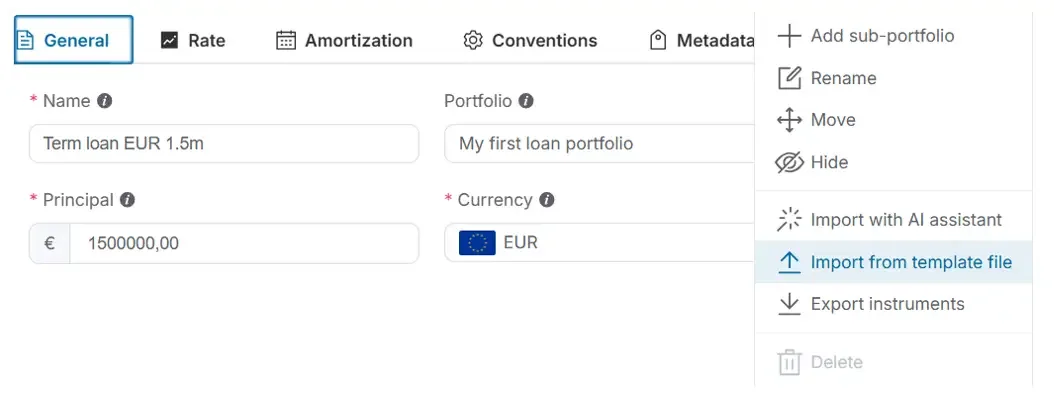
- TreasuryView offers three routes for adding a loan: the loan form, the Excel template and AI-assisted import (beta), which reads a spreadsheet you already have.
- The loan form is the route for a single loan. You enter the key terms, such as principal, dates, rate, payment frequency and conventions, and TreasuryView calculates the schedule. For a bespoke repayment schedule, the cash flows can be copied from Excel into the schedule.
- The Excel template is the route for many loans at once. You download the TreasuryView template, enter one row per loan and upload it.
- AI-assisted import (beta) is the route for a spreadsheet you already have. TreasuryView analyses the file and extracts the loan terms. Results depend on how structured the file is.
- The report is one view of bank loans and intercompany loans, calculated from the loan terms with market data as of the reporting date.
- The demo ends with an invitation to start with your own loans instead of rebuilding the report by hand.
Kyriba or TreasuryView: which one should you choose?
Kyriba and TreasuryView answer different questions. Kyriba is a full TMS for a large-scale implementation: cash and liquidity, payments, bank connectivity, in-house banking, risk and debt, with capabilities activated on the same platform as your needs evolve and an implementation project to set it up. TreasuryView is built around debt and derivatives tasks: external facilities, intercompany loans, cash pool interest, swaps and the interest rate risk analytics that go with them. It does not connect to banks, import bank statements or make payments, so it runs next to the cash platform or bank portals a finance team already uses.
Choose Kyriba if:
- You are planning a large-scale TMS implementation around global cash visibility, forecasting, bank connectivity and payments, with debt, investments and risk on the same platform
- You need deal workflows from trading desk to back office across investments, debt and derivatives, with confirmation letters, settlement approvals and accounting entries
- Your payments should run through one bank-agnostic hub across several accounting systems and banks, with approval workflows, sanctions screening, payee verification and fraud detection
- You need in-house banking with payments and receipts on behalf of group companies, multi-currency cash pools and multi-tier netting
- Your derivatives and exposures need FX, interest rate and commodity coverage, with CVA and DVA valuation and hedge accounting under IFRS 9 and US GAAP, in the same system as your cash
- You want an AI assistant in the platform that answers treasury questions in plain language and prepares actions for your approval
- You can plan an implementation project with bank and accounting system connectivity and agree a quoted contract, which Kyriba states is mostly a multi-year subscription
Choose TreasuryView if:
- Your task is the debt book and its derivatives rather than a treasury operating model, and your intercompany loans need the full agreement terms, with facilities, limits and commitment fees, drawdowns, fixed or floating rates, custom benchmark rates, tranches and repayment profiles
- Your cash pools need debit and credit interest calculated and reported, from balances or movements you enter or upload instead of an in-house bank set-up
- Your external facilities fund projects across the group and are planned as a portfolio, and you need interest rate swaps valued next to the loans they hedge, on a derivatives engine in production since 2009, with stress tests and scenarios for interest cost and value, on GROW and above
- You are moving loans and cash pool balances out of spreadsheets and want to start self-service, without an integration project, with a 30-day free trial without a payment method, a published monthly price and cancellation at any time
- Your cash and payments workflows stay where they are, and the REST API in every plan sends loan data, schedules and report results to your accounting or treasury systems when you are ready to automate
Strengths and limits of each
TreasuryView
- Strength: external facilities, calculation accuracy since 2009
- External facilities with broad coverage of non-standard terms: fixed and floating rate loans, revolving credit facilities, refinancings and multi-leg loans, with bullet, linear or annuity repayment, commitment limits and fees, and tranches, available from the START plan. Interest, schedules and accruals come from a calculation engine in production use since 2009. In the rare case a figure differs from your bank's confirmation, any row can be corrected.
- Strength: intercompany loans and cash pools
- Intercompany loans with facilities, limits and commitment fees, drawdowns, tranches and custom benchmark rates. Cash pool accounts with debit and credit interest, calculated and reported from the balances or movements you enter or upload.
- Strength: derivatives and interest rate risk analytics since 2009
- Derivatives valued next to the debt book since 2009: interest rate swaps with mark-to-market valuation, linked to the external facilities they hedge, plus interest rate stress tests (+/-100 bps, steepening, flattening), scenario analysis, BPV and duration sensitivities and comparison of hedging conditions with bank offers, on GROW and above. Cross-currency swaps, swaptions and hedge effectiveness testing are on ENTERPRISE. Caps and floors are modelled as loan terms on every plan.
- Strength: self-service start
- A 30-day free trial without a payment method. Move your loans and cash pool balances out of spreadsheets through the loan form or a spreadsheet upload, with no integration project.
- Strength: published pricing
- Monthly plans from €250 (net), cancel anytime, no setup or onboarding fees.
- Strength: API in every plan, from first call to full integration
- Generate a key in the app and send your first request from the interactive documentation, with no project and no extra fee. Automate at your own pace with report exports in XLSX or CSV, and bring in an integration project on ENTERPRISE when your systems need one.
- Strength: schedules you can correct to what happened
- Record what actually happened on a loan, cash pool or swap schedule, such as a moved payment date, an extra repayment or a new drawdown, and adjust upcoming rows to an agreed change. Later rows recalculate where a change carries forward. Available on every plan; swaps on GROW and above.
- Limit: no bank connectivity
- TreasuryView does not connect to banks, import bank statements or execute payments. Bank connections and payments stay in the systems you already use, and balances and movements are entered or uploaded.
- Limit: no cash management
- TreasuryView calculates interest on cash pool balances but does not run sweeps or netting, and does not provide daily cash positioning, payment approval chains or bank reconciliation.
Kyriba
- Strength: full treasury platform
- Cash and liquidity, forecasting, bank connectivity, payments, in-house banking, risk management, working capital and treasury accounting on one platform, with capabilities activated as treasury needs evolve, according to Kyriba's public pages.
- Strength: bank connectivity and payments
- Connectivity to more than 10,000 banks through SWIFT, bank APIs, host-to-host and EBICS, run by Kyriba as a managed service, and a bank-agnostic payment hub with approval workflows, sanctions screening, payee verification and fraud detection, according to Kyriba's public pages.
- Strength: debt, investments and interest rate derivatives
- A Debt module for short and long term borrowings (discount, interest-bearing, fixed, floating rate, amortising and lease contracts), an Investments module, and an Interest Rate Derivatives module for fixed-floating swaps, cross currency swaps, caps, floors and collars that also tracks credit facilities, with reports such as the Credit Facility Report and the Debt Maturities Ladder, according to Kyriba's Financial Transactions fact sheet.
- Strength: valuation, scenarios and hedge accounting
- Mark-to-market valuation with CVA and DVA support, scenario analysis for parallel or custom rate changes, FX, interest rate and commodity risk, deal confirmations and customisable approval workflows, and hedge accounting under IFRS 9 and US GAAP (ASC 815), according to Kyriba's public pages.
- Strength: in-house bank, netting and cash pools
- Internal accounts, payments and receipts on behalf of group companies, structured intercompany loans with accruals and amortisations posted to the ledger, multi-currency cash pools and multi-tier netting, according to Kyriba's In-House Banking fact sheet.
- Strength: Trusted AI (TAI)
- An AI assistant that answers treasury questions in plain language, with an embedded language model, no training on customer data and actions that need your approval, according to Kyriba's public pages.
- Strength: integrations and reach
- Open APIs with a developer portal, connectors to accounting and business systems such as SAP, Oracle, NetSuite, Workday and Microsoft Dynamics 365, and more than 3,000 customers, according to Kyriba.
- Consideration: implementation effort
- As a large-scale TMS, an implementation project with bank and accounting system connectivity is the usual route. Kyriba states a cost-controlled implementation with rapid go-live for mid-market companies, and Kyriba Essentials for Mid-Market is a curated starter package.
- Consideration: pricing and terms
- Pricing is not published and is quoted on scope. Kyriba states that costs scale with legal entities, bank accounts, modules, transaction volume and integration scope, and that most deals are multi-year subscriptions. No free trial is advertised.
- Consideration: debt modelling detail
- The fact sheet describes the Debt module's instrument types and valuation and names a Credit Facility Report and a Debt Maturities Ladder. It does not describe repayment schedule types, accruals, or commitment limits and fees, so ask for a demo with your own facility terms.
Looking for a Kyriba alternative for debt management?
If your main task is managing the debt book, meaning external facilities, intercompany loans, cash pools and interest rate derivatives, and your bank connections, payments and cash operation are already handled elsewhere, TreasuryView is built for that job. It offers published pricing from €250 per month, cancellation at any time and a REST API in every plan. If you are planning a large-scale TMS implementation for your whole treasury, from cash and payments to in-house banking, risk and debt, Kyriba covers more of it.
Kyriba vs. TreasuryView: debt management compared
| Feature | TreasuryView | Kyriba |
|---|---|---|
| Core job | External facilities, intercompany loans, cash pools, derivatives and interest rate risk management | Treasury platform: cash and liquidity with forecasting, bank connectivity, payments, in-house banking and netting, risk management for FX, debt, investments and interest rates, working capital, treasury accounting and an AI assistant (TAI) |
| External facilities | External facilities with broad coverage of non-standard terms: fixed and floating rate loans, revolving credit facilities, refinancings and multi-leg loans, with bullet, linear or annuity repayment, commitment limits and fees, and tranches, from the START plan. Calculation engine in production use since 2009; any row can be corrected to match a bank confirmation | Debt module for short and long term borrowings: discount, interest-bearing, fixed, floating rate, amortising and lease contracts; credit facilities are tracked in the Interest Rate Derivatives module, and a Credit Facility Report and a Debt Maturities Ladder are among its reports, according to Kyriba's fact sheet. Repayment schedule types, accruals, commitment limits and fees are not described there |
| Other instruments | Focused on external facilities, intercompany loans, cash pools and interest rate derivatives; FX risk management is an ENTERPRISE add-on | Investments module for money market funds and discount, interest-bearing, fixed, floating rate and amortising contracts; FX spot, forward, NDF, swap and option transactions; a commodities risk module, according to Kyriba |
| Intercompany loans | Intercompany loans shared with subsidiaries (borrower or lender view) on every plan, plus bilateral facilities with limits and commitment fees, drawdowns, fixed or floating rates, custom benchmark rates, bullet, linear, annuity or fixed repayment and tranches | Structured intercompany loans in the In-House Banking solution, with flexible principal and interest terms, scheduled loan events, and accruals and amortisations posted to the ledger, according to Kyriba |
| Cash pool interest | Cash pool accounts with debit and credit interest on every plan, calculated and reported from the balances or movements you enter or upload. TreasuryView does not import bank statements, run sweeps or net positions | Cash pooling with multi-currency pools and physical or notional structures; interest is calculated from market or internal schedules, with different rates per subsidiary and separate rates for debit and credit balances, according to Kyriba's In-House Banking fact sheet |
| In-house banking and netting | Not included. TreasuryView calculates and reports cash pool interest and does not run sweeps, netting or internal accounts | In-House Banking with internal accounts, payments and receipts on behalf of group companies, internal loans and interest, intercompany netting, multi-tier netting hierarchies and automatic settlements, according to Kyriba |
| Pricing | Published: START €250 per month, GROW €500 per month, ENTERPRISE on request. Net of VAT. Priced per team, not per user | Not published; quoted on scope. Kyriba states that costs scale with legal entities, bank accounts, modules, transaction volume and integration scope. Kyriba Essentials for Mid-Market is priced based on banking footprint |
| Free trial and contract | 30-day free trial with full access and no payment method. Monthly invoicing with no long-term contract, cancel any time, no cancellation fees, paid by bank transfer | No free trial advertised on the pages read; evaluation starts with a demo and a sales conversation, and Kyriba states that most deals are multi-year subscriptions |
| Setup and time to start | Sign up in under a minute and add loans through the loan form, a spreadsheet upload or AI-assisted import. No setup or onboarding fees | Large-scale TMS implementation project with bank and accounting system connectivity; Kyriba states a cost-controlled implementation with rapid go-live for mid-market companies and a 90% reduction in system integration time |
| API access | REST API with interactive documentation (OpenAPI) and developer portal access on every plan | Open API platform with a developer portal; registration is free and gives access to the API catalogue, documentation and samples; API connectors to accounting and business systems such as SAP, Oracle, NetSuite and Microsoft Dynamics 365, according to Kyriba |
| Debt-related API | Loan and cash pool lists, payment schedules, interest and accrual reports via the API; derivative data on GROW and above | No debt-related API found in the sections of the developer portal catalogue we read (Platform, Liquidity, Payments, Risk and Connectivity); Debt, Investments and Interest Rate Derivatives are described as product modules |
| Derivatives-related API | Interest rate swaps with payment cash flows, valuation and hedge reports, plus curves and scenario calculations via the API; swaps on GROW and above | A Hedge De-Designations API in the Risk category of the developer portal; no API for swaps, caps or valuations found in the other categories we read |
| Cash and bank data API | Not covered | Cash Balances, Bank Statement Balances, Cash Flows and Bank Accounts APIs in the developer portal |
| Payments API | Not covered | Transfers (status and deletion), Payment Files Status and Payment Transaction Summary APIs, a fraud detection API, and webhooks for batch and routing status |
| Loan capture | Loan form or spreadsheet upload, plus AI-assisted import below; the REST API sends results out | Deals are entered in the Debt module, with up to 13 currencies per deal, documents attached to transactions, confirmation letters and settlement instructions generated, and customisable workflows from trading desk to back office; spreadsheet upload of loans is not described on the pages read |
| Get debt data out (downstream) | Loan and cash pool lists, payment schedules, derivative data on GROW and above and report runs with XLSX or CSV export, via the API | Reports in PDF, Excel and HTML with automated e-mail delivery, hundreds of configurable reports, a CFO cockpit dashboard, ledger postings and open APIs for data exchange with accounting and other systems, according to Kyriba |
| Reference rates | Automated EUR reference rate fixings and pre-integrated curves on every plan; automated fixings in other currencies on ENTERPRISE; fixings and curves available via the API; custom benchmark rates are part of every loan's data model | Integrated market data; the Market Data option with SIX Telekurs supplies rates and curves, and rates can be imported from other market data vendors, according to Kyriba |
| Derivatives and valuation | Derivatives in production use since 2009: interest rate swaps with mark-to-market valuation, linked to the loans they hedge, on GROW; cross-currency swaps, swaptions, basis and amortising swaps and hedge effectiveness testing on ENTERPRISE; caps and floors as loan terms on every plan | Interest Rate Derivatives module for fixed-floating swaps, cross currency swaps, caps, floors and collars; FX module for spot, forward, NDF, swap, vanilla and barrier options; mark-to-market with CVA and DVA support; hedge accounting under IFRS 9 and US GAAP (ASC 815), according to Kyriba |
| Interest rate risk analytics | Interest rate stress tests (+/-100 bps, steepening, flattening), scenario analysis, sensitivities (BPV and duration) and comparison of hedging conditions with bank offers on GROW and above | Scenario analysis stores valuations for parallel or custom rate changes such as yield curve shifts; FX exposure management and policy-based hedging; interest rate and commodity risk are covered, according to Kyriba |
| Loan import with AI | AI-assisted import from term sheets, PDFs and spreadsheets (beta on START and GROW; included in ENTERPRISE) | AI import of loan agreements, term sheets or spreadsheets is not described on Kyriba's public pages (reviewed 5 November 2026) |
| Bank connection | Not included. Bank data stays in your bank portal, accounting or treasury system, or connectivity provider | Yes: connectivity to more than 10,000 banks through SWIFT, bank APIs, host-to-host and EBICS, run by Kyriba as a managed service, with intraday balances |
| Payments | Not included | Yes: bank-agnostic payment hub with rule-based approvals, sanctions screening, payee verification and fraud detection, ISO 20022 payment files and payment status tracking |
| Actual movements on the schedule | Recorded as schedule overrides on loans, cash pools and, on GROW and above, swaps, such as a moved payment date, an extra repayment or a new drawdown | Bank statements and balances come in for cash positions and reconciliation; how actual debt movements update a debt schedule is not described on the pages read |
| Debt interest posting to accounting | Interest, accruals and schedules go to your accounting system through the API. Integration projects with accounting systems are available on ENTERPRISE | GL entries are generated for all transaction types and posted to the ledger, can be approved before posting and are kept in a Kyriba sub-ledger, according to Kyriba's fact sheet |
| Audit trail | Unalterable audit trail of users and deals on GROW and ENTERPRISE; user activity log on START | Audit trail with every change to a deal, according to Kyriba's fact sheet |
| Single sign-on | Microsoft Entra ID on ENTERPRISE; passkey, e-mail code or federated sign-in on every plan | Not described on the pages read |
| Security and hosting | Client data hosted in Germany in an ISO 27001-certified data centre, designed to meet GDPR requirements; audit trail of user activity and deals | ISO/IEC 27001, SOC 1, SOC 2 Type 2 and TISAX, according to Kyriba's trust centre, and redundant disaster recovery, according to its fact sheet; the hosting location is not stated on the pages read |
| Support and implementation | Support by e-mail, chat, phone and video call on every plan, priority support on GROW and ENTERPRISE, integration projects on ENTERPRISE | Support and implementation terms are not detailed on the public pages read |
| Track record in debt management | Debt management and derivatives in production use since 2009 | More than 3,000 customers and two decades in the market, according to Kyriba; reference customers include Lockheed Martin, HelloFresh, Bolt, Nomura Research Institute and Eutelsat; no launch date for its Debt module is stated on its public pages |
Core job
TreasuryView
External facilities, intercompany loans, cash pools, derivatives and interest rate risk management
Kyriba
Treasury platform: cash and liquidity with forecasting, bank connectivity, payments, in-house banking and netting, risk management for FX, debt, investments and interest rates, working capital, treasury accounting and an AI assistant (TAI)
External facilities
TreasuryView
External facilities with broad coverage of non-standard terms: fixed and floating rate loans, revolving credit facilities, refinancings and multi-leg loans, with bullet, linear or annuity repayment, commitment limits and fees, and tranches, from the START plan. Calculation engine in production use since 2009; any row can be corrected to match a bank confirmation
Kyriba
Debt module for short and long term borrowings: discount, interest-bearing, fixed, floating rate, amortising and lease contracts; credit facilities are tracked in the Interest Rate Derivatives module, and a Credit Facility Report and a Debt Maturities Ladder are among its reports, according to Kyriba's fact sheet. Repayment schedule types, accruals, commitment limits and fees are not described there
Other instruments
TreasuryView
Focused on external facilities, intercompany loans, cash pools and interest rate derivatives; FX risk management is an ENTERPRISE add-on
Kyriba
Investments module for money market funds and discount, interest-bearing, fixed, floating rate and amortising contracts; FX spot, forward, NDF, swap and option transactions; a commodities risk module, according to Kyriba
Intercompany loans
TreasuryView
Intercompany loans shared with subsidiaries (borrower or lender view) on every plan, plus bilateral facilities with limits and commitment fees, drawdowns, fixed or floating rates, custom benchmark rates, bullet, linear, annuity or fixed repayment and tranches
Kyriba
Structured intercompany loans in the In-House Banking solution, with flexible principal and interest terms, scheduled loan events, and accruals and amortisations posted to the ledger, according to Kyriba
Cash pool interest
TreasuryView
Cash pool accounts with debit and credit interest on every plan, calculated and reported from the balances or movements you enter or upload. TreasuryView does not import bank statements, run sweeps or net positions
Kyriba
Cash pooling with multi-currency pools and physical or notional structures; interest is calculated from market or internal schedules, with different rates per subsidiary and separate rates for debit and credit balances, according to Kyriba's In-House Banking fact sheet
In-house banking and netting
TreasuryView
Not included. TreasuryView calculates and reports cash pool interest and does not run sweeps, netting or internal accounts
Kyriba
In-House Banking with internal accounts, payments and receipts on behalf of group companies, internal loans and interest, intercompany netting, multi-tier netting hierarchies and automatic settlements, according to Kyriba
Pricing
TreasuryView
Published: START €250 per month, GROW €500 per month, ENTERPRISE on request. Net of VAT. Priced per team, not per user
Kyriba
Not published; quoted on scope. Kyriba states that costs scale with legal entities, bank accounts, modules, transaction volume and integration scope. Kyriba Essentials for Mid-Market is priced based on banking footprint
Free trial and contract
TreasuryView
30-day free trial with full access and no payment method. Monthly invoicing with no long-term contract, cancel any time, no cancellation fees, paid by bank transfer
Kyriba
No free trial advertised on the pages read; evaluation starts with a demo and a sales conversation, and Kyriba states that most deals are multi-year subscriptions
Setup and time to start
TreasuryView
Sign up in under a minute and add loans through the loan form, a spreadsheet upload or AI-assisted import. No setup or onboarding fees
Kyriba
Large-scale TMS implementation project with bank and accounting system connectivity; Kyriba states a cost-controlled implementation with rapid go-live for mid-market companies and a 90% reduction in system integration time
API access
TreasuryView
REST API with interactive documentation (OpenAPI) and developer portal access on every plan
Kyriba
Open API platform with a developer portal; registration is free and gives access to the API catalogue, documentation and samples; API connectors to accounting and business systems such as SAP, Oracle, NetSuite and Microsoft Dynamics 365, according to Kyriba
Debt-related API
TreasuryView
Loan and cash pool lists, payment schedules, interest and accrual reports via the API; derivative data on GROW and above
Kyriba
No debt-related API found in the sections of the developer portal catalogue we read (Platform, Liquidity, Payments, Risk and Connectivity); Debt, Investments and Interest Rate Derivatives are described as product modules
Derivatives-related API
TreasuryView
Interest rate swaps with payment cash flows, valuation and hedge reports, plus curves and scenario calculations via the API; swaps on GROW and above
Kyriba
A Hedge De-Designations API in the Risk category of the developer portal; no API for swaps, caps or valuations found in the other categories we read
Cash and bank data API
TreasuryView
Not covered
Kyriba
Cash Balances, Bank Statement Balances, Cash Flows and Bank Accounts APIs in the developer portal
Payments API
TreasuryView
Not covered
Kyriba
Transfers (status and deletion), Payment Files Status and Payment Transaction Summary APIs, a fraud detection API, and webhooks for batch and routing status
Loan capture
TreasuryView
Loan form or spreadsheet upload, plus AI-assisted import below; the REST API sends results out
Kyriba
Deals are entered in the Debt module, with up to 13 currencies per deal, documents attached to transactions, confirmation letters and settlement instructions generated, and customisable workflows from trading desk to back office; spreadsheet upload of loans is not described on the pages read
Get debt data out (downstream)
TreasuryView
Loan and cash pool lists, payment schedules, derivative data on GROW and above and report runs with XLSX or CSV export, via the API
Kyriba
Reports in PDF, Excel and HTML with automated e-mail delivery, hundreds of configurable reports, a CFO cockpit dashboard, ledger postings and open APIs for data exchange with accounting and other systems, according to Kyriba
Reference rates
TreasuryView
Automated EUR reference rate fixings and pre-integrated curves on every plan; automated fixings in other currencies on ENTERPRISE; fixings and curves available via the API; custom benchmark rates are part of every loan's data model
Kyriba
Integrated market data; the Market Data option with SIX Telekurs supplies rates and curves, and rates can be imported from other market data vendors, according to Kyriba
Derivatives and valuation
TreasuryView
Derivatives in production use since 2009: interest rate swaps with mark-to-market valuation, linked to the loans they hedge, on GROW; cross-currency swaps, swaptions, basis and amortising swaps and hedge effectiveness testing on ENTERPRISE; caps and floors as loan terms on every plan
Kyriba
Interest Rate Derivatives module for fixed-floating swaps, cross currency swaps, caps, floors and collars; FX module for spot, forward, NDF, swap, vanilla and barrier options; mark-to-market with CVA and DVA support; hedge accounting under IFRS 9 and US GAAP (ASC 815), according to Kyriba
Interest rate risk analytics
TreasuryView
Interest rate stress tests (+/-100 bps, steepening, flattening), scenario analysis, sensitivities (BPV and duration) and comparison of hedging conditions with bank offers on GROW and above
Kyriba
Scenario analysis stores valuations for parallel or custom rate changes such as yield curve shifts; FX exposure management and policy-based hedging; interest rate and commodity risk are covered, according to Kyriba
Loan import with AI
TreasuryView
AI-assisted import from term sheets, PDFs and spreadsheets (beta on START and GROW; included in ENTERPRISE)
Kyriba
AI import of loan agreements, term sheets or spreadsheets is not described on Kyriba's public pages (reviewed 5 November 2026)
Bank connection
TreasuryView
Not included. Bank data stays in your bank portal, accounting or treasury system, or connectivity provider
Kyriba
Yes: connectivity to more than 10,000 banks through SWIFT, bank APIs, host-to-host and EBICS, run by Kyriba as a managed service, with intraday balances
Payments
TreasuryView
Not included
Kyriba
Yes: bank-agnostic payment hub with rule-based approvals, sanctions screening, payee verification and fraud detection, ISO 20022 payment files and payment status tracking
Actual movements on the schedule
TreasuryView
Recorded as schedule overrides on loans, cash pools and, on GROW and above, swaps, such as a moved payment date, an extra repayment or a new drawdown
Kyriba
Bank statements and balances come in for cash positions and reconciliation; how actual debt movements update a debt schedule is not described on the pages read
Debt interest posting to accounting
TreasuryView
Interest, accruals and schedules go to your accounting system through the API. Integration projects with accounting systems are available on ENTERPRISE
Kyriba
GL entries are generated for all transaction types and posted to the ledger, can be approved before posting and are kept in a Kyriba sub-ledger, according to Kyriba's fact sheet
Audit trail
TreasuryView
Unalterable audit trail of users and deals on GROW and ENTERPRISE; user activity log on START
Kyriba
Audit trail with every change to a deal, according to Kyriba's fact sheet
Single sign-on
TreasuryView
Microsoft Entra ID on ENTERPRISE; passkey, e-mail code or federated sign-in on every plan
Kyriba
Not described on the pages read
Security and hosting
TreasuryView
Client data hosted in Germany in an ISO 27001-certified data centre, designed to meet GDPR requirements; audit trail of user activity and deals
Kyriba
ISO/IEC 27001, SOC 1, SOC 2 Type 2 and TISAX, according to Kyriba's trust centre, and redundant disaster recovery, according to its fact sheet; the hosting location is not stated on the pages read
Support and implementation
TreasuryView
Support by e-mail, chat, phone and video call on every plan, priority support on GROW and ENTERPRISE, integration projects on ENTERPRISE
Kyriba
Support and implementation terms are not detailed on the public pages read
Track record in debt management
TreasuryView
Debt management and derivatives in production use since 2009
Kyriba
More than 3,000 customers and two decades in the market, according to Kyriba; reference customers include Lockheed Martin, HelloFresh, Bolt, Nomura Research Institute and Eutelsat; no launch date for its Debt module is stated on its public pages
Statements about Kyriba are based on its public website, product pages, fact sheets and trust centre, reviewed on 5 November 2026. 'Not described' means Kyriba's public pages describe no such feature on that date; it does not rule out features that exist but are not published. Additional currencies, or licensable reference rate or swap data, may require a separate market data licence, priced separately. Kyriba is a trademark of its owner, and this page is not affiliated with or endorsed by Kyriba. If you spot something outdated or inaccurate, please contact us and we will correct it.
Information about third-party products is based on publicly available sources and was last reviewed on 2026-11-05. TreasuryView is not affiliated with the vendors named. All product names and trademarks belong to their respective owners.
Derivatives and interest rate risk: what each platform covers today
Knowing where every loan and derivative stands is the first step. A treasurer also needs to know what happens when markets move. TreasuryView covers external facilities, intercompany loans, derivatives and interest rate risk in one platform, so positions and market impact sit together:
- Position: every external facility, intercompany loan and swap in one place, with schedules, accruals and valuations from the calculation engine.
- Impact: what a move of 100 basis points does to interest cost and cash flows, to the value of swaps and loans, and to the average cost of funds. Rate impact analysis is available on GROW.
- Growth: when the business adds a facility, a swap or a foreign-currency loan, it goes into the same platform instead of a new spreadsheet.
Derivatives and interest rate risk start with the GROW plan (€500 per month). START covers loans, intercompany loans and cash pools. FX rates, FX forward curves and FX history are available through the API. The FX risk management module (spot, forwards and options) is an ENTERPRISE add-on, available on request.
Kyriba lists an Interest Rate Derivatives module for fixed-floating swaps, cross currency swaps, caps, floors and collars, an FX module for spot, forwards, NDFs, swaps and options, mark-to-market valuation with CVA and DVA support, scenario analysis for parallel or custom rate changes, and hedge accounting under IFRS 9 and US GAAP, according to its public pages (reviewed 5 November 2026). Its range includes commodities and hedge accounting under US GAAP. TreasuryView's focus is interest rate derivatives valued next to the debt they hedge, in production use since 2009.
If your debt is only intercompany loans today, you may not need interest rate risk analytics yet. If external facilities or swaps are coming, starting on a platform that covers them avoids a second migration.
API and integration: link your debt data with the systems around it
Debt data is only useful if it reaches the systems that need it. TreasuryView's REST API is included in every plan, with API documentation and developer portal access, so you can build the workflow that fits your stack. Typical workflows:
- Upstream: loans enter through the loan form, a spreadsheet upload or AI-assisted import (beta), so you can start without an integration project.
- Downstream to accounting: pull accruals, schedules and reports into your accounting or treasury system, so figures are not retyped.
- Downstream to cash forecasting and BI: send interest and principal schedules to your forecasting tool or dashboards.
- Market data: pull curves, reference rate fixings and FX rates into your own models.
These are examples. The API documentation lists the endpoints available on your plan.
What each TreasuryView plan covers
- START (€250 per month): up to 50 loans, 1 company including subsidiaries, 5 internal users, multi-currency (EUR, USD, GBP, CHF and 20+ others), cash pools, intercompany loans, manual schedule overrides, integrated end-of-day market data and the REST API.
- GROW (€500 per month): up to 300 loans and interest rate derivatives, 15 internal users plus 10 guests, valuation and interest rate risk analytics, interest rate swaps, hedge coverage and priority support.
- ENTERPRISE (on request): cross-currency swaps, swaptions, hedge effectiveness testing, the FX risk management module (spot, forwards and options), automated fixings in other currencies, extended transaction volume and reports, single sign-on (Microsoft Entra ID), and integration projects with accounting systems, built for you.
Full functionality free for 30 days
Sign up in under a minute, no credit card. The trial ends automatically. Monthly plans from €250 (net), cancel anytime. Plan details are on the pricing page.
How to choose debt management software next to or instead of a treasury platform
If you answer "yes" to these questions, TreasuryView might be a good fit.
-
Still tracking external facilities, intercompany loans and cash pools in spreadsheets?
TreasuryView keeps external facilities, intercompany loans, cash pools and derivatives in one dashboard, with schedules and accruals calculated for you.
-
Do you need swaps valued and interest rate risk analysed next to your loans?
TreasuryView values interest rate swaps alongside your loans on GROW and above, with mark-to-market valuation, stress tests and interest rate scenarios. Caps and floors are modelled as loan terms.
-
Do you need a platform you can start with yourself, without an implementation project?
Sign up, add your loans through the loan form or a spreadsheet upload, and run reports. There are no setup fees.
-
Do you want published pricing before you commit budget?
Monthly plans are published from €250 (net), with a 30-day free trial.
-
Is bank connectivity already handled in your bank portal, your accounting or treasury system or by a provider?
TreasuryView works next to it and links through the API, so you keep that contract.
-
Do you need to send debt data to accounting, forecasting or BI tools?
The REST API, included in every plan, sends results out to the systems around TreasuryView.
-
Do you need payments, bank connectivity and daily cash positioning from the same tool?
Then Kyriba's platform may fit better. TreasuryView does not provide payments or daily cash management.
What the first 30 days look like
Within the 30-day free trial you can have your external facilities, intercompany loans and cash pools in one place, with reports and market data included.
-
Start in under a minute
Immediate access
Create a free accountSign up for free and explore the full functionality.
-
Day 1
Import your data
Data migrationUpload your loans with the Excel template or enter them directly, and preview each schedule before you save.
-
Week 1
Automate your work
Customise views and automate reporting.
-
Week 2
Make data-driven decisions
Evaluate interest rate risk and, on GROW, value swaps next to the loans they hedge.
“It [TreasuryView] is a very intuitive tool to use, with enough capabilities to get a clear understanding of your company's treasury status. I also really value the support I get from their team setting it up for my company.”
Other comparisons
- Agicap Alternative for Loan & Debt Management
- Atlar Alternative for Debt Management
- Chatham Onyx Alternative for Mid-Sized Companies
- ION Treasury Alternative for Mid-Sized Companies
- Nomentia Alternative for SMBs & Mid-Sized Companies
- Ripple Treasury (GTreasury) Alternative
- Salmon Treasury Alternative for Mid-Sized Companies
- Spreadsheet Alternative for Loan & Debt Management
- Enterprise TMS Alternative for Mid-Sized Companies
- ZenTreasury Alternative for Mid-Sized Companies
FAQ: choosing between TreasuryView and Kyriba
What is a Kyriba alternative for debt management?
TreasuryView is one option if managing the debt book is your main task. It manages external facilities, intercompany loans, cash pools and interest rate derivatives, calculates interest, schedules and valuations, and publishes its monthly pricing. Kyriba is a full TMS for a large-scale implementation covering cash, payments, bank connectivity, in-house banking and risk, so the better fit depends on whether cash and payments or debt and derivatives come first.
How much does Kyriba cost compared with TreasuryView?
Kyriba does not publish prices. It states that costs scale with legal entities, bank accounts, modules, transaction volume and integration scope, and that a formal quote follows a sales conversation. TreasuryView publishes its prices: START is €250 per month and GROW is €500 per month, both net of VAT, with ENTERPRISE on request. To compare total cost, compare the scope each one covers.
Is there a monthly plan, and can I cancel at any time?
Yes. TreasuryView plans are billed monthly, there is no long-term contract, and you can cancel any time in your account with no cancellation fee. Payment is by bank transfer. Kyriba does not publish its contract terms and states that most deals are multi-year subscriptions.
Is there a free trial, and do I need a credit card?
TreasuryView offers a 30-day free trial with full access and no payment method, and you can upload your own loans to see real reports. Kyriba does not advertise a free trial on the pages we read; you start with a demo.
Can I buy Kyriba's debt management on its own?
Kyriba presents debt management as part of its risk management product and states that capabilities can be activated on the same platform as treasury needs evolve. Whether the Debt module can be bought without other modules is agreed with Kyriba and is not stated on its public pages. TreasuryView is a standalone debt management platform that you can start yourself.
Can I use TreasuryView next to Kyriba?
Yes. TreasuryView does not replace a cash platform. Finance teams keep bank connections and payments where they are and use TreasuryView for external facilities, intercompany loans, cash pool interest and derivatives. The REST API sends schedules and report results to the systems around it.
Which debt instruments does each platform cover?
Kyriba lists borrowings (discount, interest-bearing, fixed, floating rate, amortising and lease contracts), credit facilities in its Interest Rate Derivatives module, investments in money market funds and securities, and FX, interest rate and commodity derivatives. TreasuryView covers external facilities, including revolving credit facilities, intercompany loans, cash pools and interest rate derivatives.
Does TreasuryView manage external facilities as well as intercompany loans?
Yes. External facilities, meaning bank loans and credit facilities, are available from the START plan, with broad coverage of non-standard terms: fixed and floating rate loans, revolving credit facilities, refinancings and multi-leg loans, with bullet, linear or annuity repayment, commitment limits and fees, and tranches. Interest, schedules and accruals come from a calculation engine in production use since 2009, and any row can be corrected to match a bank confirmation.
Can TreasuryView calculate interest on cash pool balances, and does it import bank statements?
TreasuryView calculates and reports debit and credit interest on cash pool accounts on every plan, from balances or movements you enter or upload. It does not import bank statements, run sweeps or net positions.
Does Kyriba calculate interest on intercompany loans and cash pools?
According to Kyriba's In-House Banking fact sheet, yes: structured intercompany loans with flexible principal and interest terms, interest calculated from market or internal schedules with separate rates for debit and credit balances, and accruals and amortisations posted to the ledger. TreasuryView calculates and reports debit and credit interest on cash pool accounts on every plan, from balances or movements you enter or upload.
Does Kyriba support interest rate derivatives and risk management?
According to Kyriba's public pages, yes. It lists fixed-floating swaps, cross currency swaps, caps, floors and collars, mark-to-market valuation with CVA and DVA support, scenario analysis for parallel or custom rate changes, and hedge accounting under IFRS 9 and US GAAP. TreasuryView values interest rate swaps next to the loans they hedge from GROW, with stress tests and scenarios, and its calculation engine has been in production use since 2009. Check both vendors' current documentation against your requirements and test with your own data.
Which TreasuryView plan do I need for derivatives and interest rate risk?
Derivatives and interest rate risk analytics start with GROW at €500 per month. START covers loans, intercompany loans and cash pools. Cross-currency swaps, swaptions, basis and amortising swaps and hedge effectiveness testing are on ENTERPRISE.
What happens to my loans and derivatives when rates move?
TreasuryView shows the impact of rate moves on interest cost, cash flows and the value of swaps and loans, with rate impact analysis on GROW.
Does Kyriba offer hedge accounting, and what does TreasuryView offer?
Kyriba lists hedge accounting under IFRS 9 and US GAAP (ASC 815) and posts accounting entries to the ledger. TreasuryView offers hedge relationships on GROW and above and, on ENTERPRISE, hedge effectiveness testing.
Does TreasuryView have an API, and is it included in every plan?
Yes. TreasuryView's REST API, with interactive documentation, is included in START, GROW and ENTERPRISE, and so is developer portal access. Kyriba offers an Open API platform with a developer portal, where registration is free, according to Kyriba.
How do I get my loans into TreasuryView?
Through the loan form, a spreadsheet upload or AI-assisted import (beta). The REST API then sends calculation results out to your accounting or treasury systems.
Can I send TreasuryView data to my accounting system, cash forecast or BI tool?
Yes. Instruments, exposure portfolio data and report content can be exported through the API.
Do I need bank connections to use TreasuryView?
No. TreasuryView does not connect to banks. Bank transactions and repayments stay in your bank portal, accounting or treasury system or connectivity provider, while loan terms, schedules and interest live in TreasuryView.
Can I keep my current bank connectivity provider?
Yes. TreasuryView sits beside your existing bank connectivity, whether that is your bank portal, your accounting or treasury system or a provider, and you keep that contract.
How long does setup take compared with Kyriba?
You can sign up in under a minute and upload loans from a spreadsheet on the first day, without involving your IT team. Kyriba describes an implementation project with bank and accounting system connectivity, states a cost-controlled implementation with rapid go-live for mid-market companies, and does not publish a typical go-live time.
Will I talk to a human if I get stuck during the trial?
Yes. If you get stuck or want a tour of the software, you can talk to one of our professionals. Full support is available during the trial, and you can book a demo call.
What if TreasuryView is not for me and I want to leave?
The free trial ends automatically and its data will be deleted. Monthly plans can be cancelled at any time.
Does TreasuryView support custom benchmark rates, such as an internal group funding rate?
Yes. Custom benchmark rates are part of every loan's data model and are always on, so a loan can reset on an internal rate as well as on market indices.
Is my data secured?
Client data is hosted in an ISO 27001-certified data centre in Germany and handled according to German and EU regulations. TreasuryView also appoints an external data security officer. Learn more about data security. Kyriba lists ISO/IEC 27001, SOC 1, SOC 2 Type 2 and TISAX in its trust centre.
Which alternatives to Kyriba exist?
That depends on your company's size, priorities and budget. Three examples, by focus:
- TreasuryView: for finance teams focused on debt management. It automates reporting, reduces Excel risks and improves visibility across external facilities, intercompany loans, cash pools and derivatives, for teams without internal IT support.
- Nomentia: a treasury suite covering bank connectivity, payments, cash and debt, with a vendor-led implementation. See TreasuryView vs. Nomentia.
- Atlar: cash, payments and debt management on live bank connections. See TreasuryView vs. Atlar.
Choose based on what matters most: debt management, global treasury control or bank and payment visibility.
Where can I find more answers?
See the general FAQ or contact us.
How we reviewed this page
Statements about Kyriba are based on its public website, product pages, fact sheets and trust centre, read on 5 November 2026, and on the Treasury Brief vendor profile reviewed on 2 November 2026. Kyriba facts are vendor-stated. TreasuryView facts are taken from its pricing page on the same date. "Not described" means the pages we read describe no such feature today; it does not mean something does not exist. Kyriba may have changed since. If you spot something out of date, please contact us and we will correct it.
Compare with your own loan data, free for 30 days
Import your own loan portfolio, check the results against your existing model and then decide.