
For finance teams with loan facilities split into tranches with different rates, currencies or maturities.
Tranched loan software: every tranche, rate and maturity in one record
A tranched loan splits one facility into parts with their own terms. This guide shows how a corporate borrower tracks each tranche, its interest and its maturity, and how TreasuryView holds them under one limit.
- Secure sign-up in under a minute. No payment method required.
- The trial ends automatically. Monthly SaaS plans from €250, cancel anytime. See pricing.
What a tranched loan is
A tranched loan is one loan agreement divided into tranches. Each tranche has its own amount and can have its own rate, currency, repayment profile and maturity. The word is French for "slice".
The term has three meanings, and search results mix them up:
- Facility tranches. A bank or syndicate lends under one agreement, split into parts such as a term loan and a revolving tranche. This is the case for corporate borrowers.
- Staged drawdowns. One loan is paid out in instalments, for example as a project proceeds.
- Securitisation tranches. A pool of loans is sliced into senior, mezzanine and junior classes with a payment waterfall. This is a structured finance topic.
This page covers the first two, from the borrower's side. TreasuryView does not model securitisation waterfalls.
Why companies split a facility into tranches
-
Match funding to the need
A term tranche for an investment, a revolving tranche for working capital. A term tranche is fully funded on day one, a revolver is drawn as needed (Reed Smith).
-
Mix fixed and floating
One tranche on a fixed rate, another on a floating rate, to balance rate risk across the facility.
-
Borrow in the currency you earn
A tranche in another currency for a subsidiary that earns in that currency.
-
Stagger maturities
Tranches that mature in different years avoid one large refinancing date.
Worked example: one facility, three tranches
A company agrees a facility of EUR 40m and USD 10m with its bank. The facility has three tranches, each with its own terms. The figures are illustrative.
| Tranche | Amount | Currency | Rate | Repayment | Maturity |
|---|---|---|---|---|---|
| A: term loan | 25m | EUR | 3-month EURIBOR + 1.80% (floating) | Linear, quarterly | 5 years |
| B: term loan | 15m | EUR | 4.10% (fixed) | Bullet | 7 years |
| C: term loan | 10m | USD | 5.20% (fixed) | Bullet | 5 years |
Three things then differ by tranche. Interest cost: A moves with EURIBOR, B and C do not. Maturity profile: A falls every quarter, B and C fall due in one amount, in different years. Hedge need: only the floating tranche A carries rate risk that a swap could cover, and only part of its balance if you hedge part of it. In a spreadsheet, this becomes three tabs that have to add up to one facility.
Where spreadsheets break on tranched loans
-
One tab per tranche
Each tranche has its own schedule. Group totals need links that break when a row is inserted.
-
Rates and day counts that differ
Fixed, floating and different day count conventions in one facility make interest hard to check against the bank statement.
-
Limit and drawn amounts out of sync
The facility limit, the drawn amounts and the undrawn part sit in different places, and so does the commitment fee on the undrawn part.
-
Hedges covering part of the facility
A swap that hedges one tranche, or part of one, is hard to see next to the exposure it covers.
How TreasuryView holds tranched loans
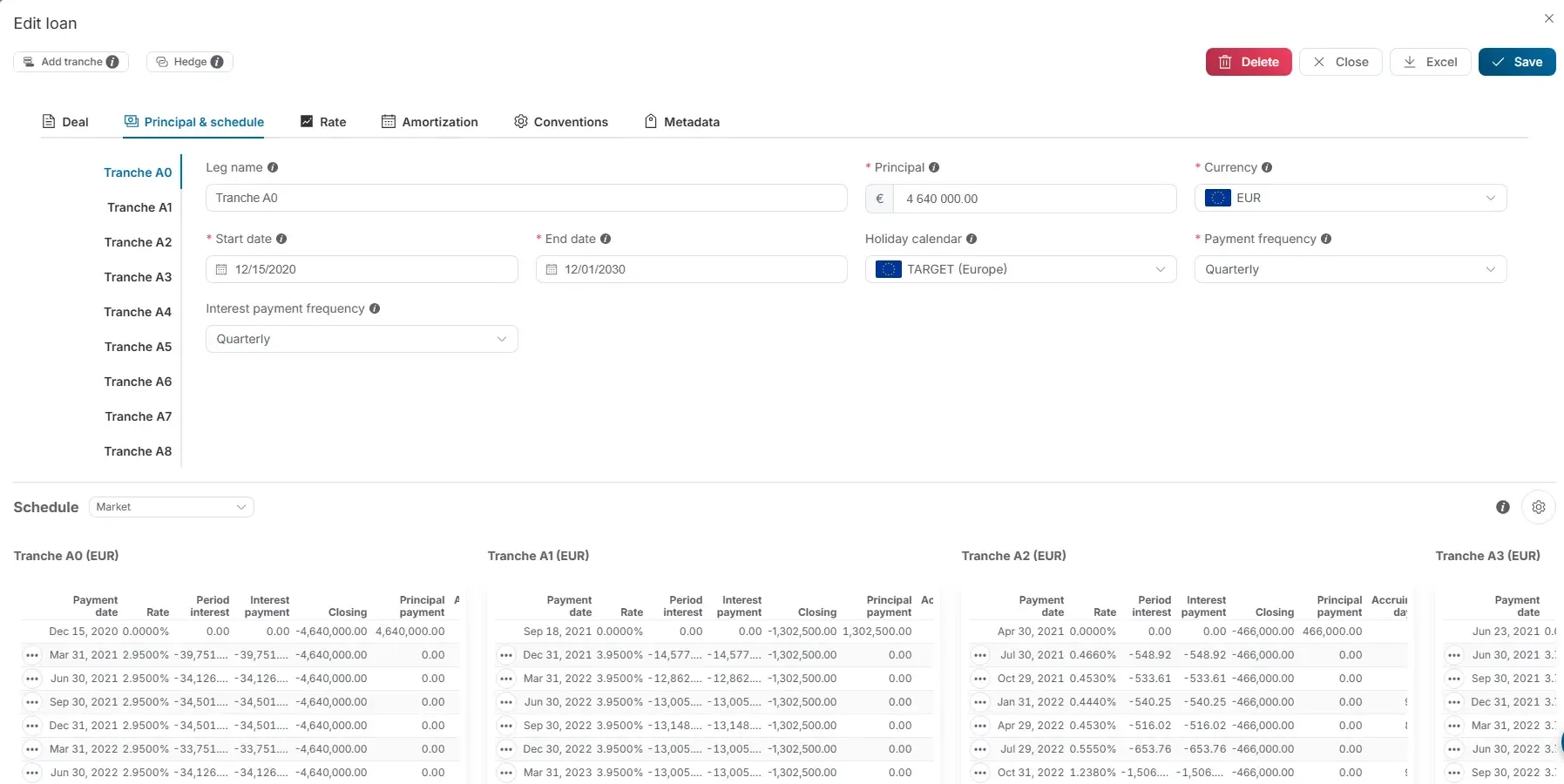
In TreasuryView, a tranched loan is one loan with several tranches. You add a tranche with one button, and each tranche has its own tab for principal and schedule, rate, amortization, conventions and metadata. In the upload file and the API, a tranche is called a leg.
| What you set | In TreasuryView |
|---|---|
| One facility | One loan with a limit; the tranches sit under it |
| Amount, currency, dates | Per tranche: principal, currency, start and end date, payment and interest frequency, holiday calendar |
| Interest rate | Per tranche: fixed or floating, reference rate and margin, cap and floor, day count convention |
| Repayment | Per tranche: bullet, linear, annuity and variants |
| Limit and commitment fee | Limit and commitment fee on the loan; undrawn amount and fee are calculated |
| Hedge | A swap can be linked to the loan; coverage and residual exposure are calculated |
| Schedule | Every tranche shown side by side with date, rate, interest, closing balance and principal payment |
| Reports | Interest cost and maturity profile by tranche, entity, country and currency, exported to Excel or CSV or via the REST API |
Enter tranches in the form, upload them from a spreadsheet with one row per tranche, or send them via API. For a step-by-step example, see how to create a loan facility agreement. For loans that change terms over time, see how to create a refinancing loan.
What TreasuryView does not do
TreasuryView is built for the borrower. It does not service loans for lenders, and it does not keep a lender register or run sell-downs or an agent role in a syndicate. It does not model securitisation tranches, waterfalls or onchain loans. See the feature overview for what TreasuryView includes and leaves out.
Five questions to ask any tranched loan software
Most software that comes up for "tranched loan software" is built for lenders and banks. A corporate borrower should check five things:
- Is it built for the borrower's view of the debt, or for lending and servicing?
- Can each tranche have its own rate, currency, repayment and maturity?
- Does it handle the facility limit, the drawn and undrawn amounts and the commitment fee?
- Can a hedge be linked to the loan, and does it show what remains unhedged?
- Do reports show interest and maturities by tranche and for the whole portfolio? See also debt portfolio management.
FAQ: tranched loan software
What is a tranched loan?
A tranched loan is one loan agreement divided into parts called tranches. Each tranche has its own amount and can have its own interest rate, currency, repayment profile and maturity. Borrowers use tranches to match funding to different needs under one facility.
What is the difference between a loan tranche and a securitisation tranche?
A loan tranche is a part of one loan facility that a borrower repays. A securitisation tranche is a class of securities, such as senior or junior, created from a pool of loans, with a payment waterfall that decides who is paid first. TreasuryView covers loan tranches, not securitisation tranches.
How do you track the tranches of a loan facility?
Record the facility once, with its limit, and add each tranche with its own amount, currency, rate, repayment and dates. Interest, balances and maturities are then calculated per tranche and for the whole facility. In TreasuryView this is one loan with a tab per tranche.
Can each tranche have its own interest rate, currency and maturity?
Yes. In TreasuryView each tranche has its own principal, currency, start and end date, rate type, margin, day count convention and repayment profile. One facility can hold fixed and floating tranches side by side.
How is the commitment fee calculated on the undrawn part?
The commitment fee is charged on the part of the limit that is not drawn, at the rate agreed with the bank. TreasuryView calculates the undrawn amount and the fee for each period, with limit step-downs.
Does TreasuryView support syndicated loans?
TreasuryView supports syndicated loans from the borrower's side, with tranches, a limit and a commitment fee. It does not keep a lender register or support sell-downs or an agent role.
Does TreasuryView handle securitisation tranches or waterfalls?
No. TreasuryView manages debt for corporate borrowers. It does not model securitisation structures or payment waterfalls.
Sources and further reading
Sources last checked on 11 November 2026. They are external and not written by TreasuryView.
- Term Loan Tranches by Reed Smith: how a term loan tranche differs from a revolving tranche in a syndicated facility
This page is for general information and does not replace tax or legal advice for your situation. As of November 2026.
Track every tranche without a tab per tranche
Enter your tranched loans in TreasuryView and see interest and maturities by tranche, hedge coverage per loan and the whole portfolio.