
How to check a bank's swap offer: mid-market rate, margin and alternatives
Last updated:
A bank's interest rate swap offer is fair when its fixed rate sits close to the mid-market swap rate for exactly the same terms, and the difference, the bank's margin, is visible and plausible. You check it in four steps: record the terms, find the mid-market rate for those terms, convert the difference into a margin in basis points and in euros, and test whether the hedge size and the instrument fit your loans.
This guide walks through the four steps with a worked example, compares a swap with a cap and a collar, and shows how finance teams prepare the check in TreasuryView before the conversation with the bank.
How do I check whether my bank's swap offer is at market rates?
1. Record the terms of the offer. Notional amount, start date (spot or forward start), maturity, amortisation profile, floating reference rate and its tenor, fixed rate, payment frequency and day count convention. The swap should mirror the loan it hedges: the same fixing dates, the same repayment profile and a notional that does not exceed the loan.
2. Find the mid-market swap rate for these terms. The mid-market rate is the fixed rate at which the swap has a market value of zero on the trade date, calculated from the current interest rate curve without any bank margin. For an amortising loan, the published standard swap rate for the maturity is not the right benchmark: the mid-market rate depends on the amortisation profile. Use market data from the same day as the offer, because curves move during the day.
3. Convert the difference into a margin. The difference between the offered fixed rate and the mid-market rate is the margin in basis points. Multiplied by the present value of one basis point on the fixed rate over the term (about €405 per basis point in the example below), it gives the margin as a present value in euros. Roughly the same amount shows up as a negative market value of the new swap on day one. A margin is normal: banks price in credit risk, capital costs and their own margin. What matters is that you know its size and can compare it across offers. Ask the bank to show the mid-market rate and the priced-in costs separately, and compare offers from more than one bank on the same day.
4. Check the hedge size and the instrument. How much of your floating rate debt does the swap hedge (the hedge ratio)? What happens if the loan is repaid or refinanced early? Would a cap or a collar give you the protection you need at a better balance of cost and flexibility? The comparison below helps with that question.
Example from TreasuryView: one swap at three fixed rates
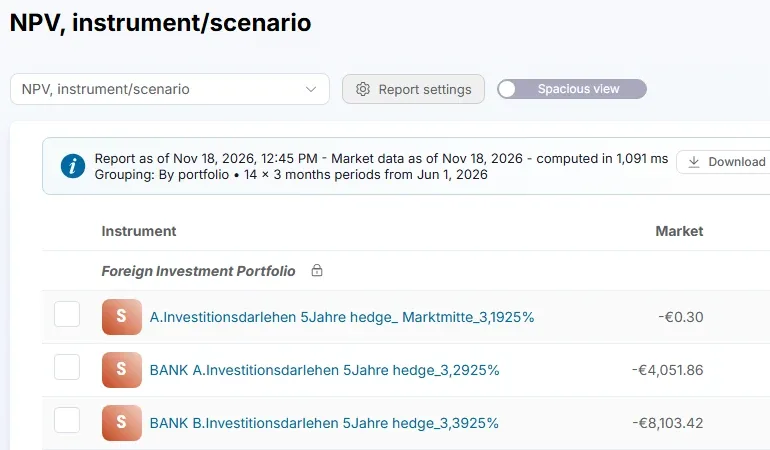
An interest rate swap of €1 million hedges the floating rate loan "Investitionsdarlehen 5Jahre" (hedge ratio 100%): you pay a fixed rate quarterly and receive the 3-month reference rate, maturity 31 December 2030, day count ACT/360. TreasuryView values the same swap at three fixed rates, with market data as of 18 November 2026:
| Version | Fixed rate | Spread over mid-market | Market value (present value) |
|---|---|---|---|
| Mid-market | 3.1925% | 0 bp | −€0.30 |
| Bank A | 3.2925% | +10 bp | −€4,051.86 |
| Bank B | 3.3925% | +20 bp | −€8,103.42 |
At the mid-market rate of 3.1925%, the swap is worth practically zero (−€0.30). Each basis point of spread costs about €405 in present value: bank A prices in about €4,050 with 10 basis points, bank B about €8,100 with 20 basis points. On €1 million, bank B's offer costs 0.20% a year more over the remaining term, about €2,000 a year. With these figures you compare offers and discuss the margin with the bank. Bank A and bank B are example offers.
Should we hedge floating rate loans with an interest rate swap or a cap, and how do I compare them?
A swap fixes your interest rate; a cap sets an upper limit and leaves you the benefit of falling rates, in exchange for a premium. A collar combines a bought cap with a sold floor, which lowers or offsets the premium but limits the benefit of falling rates to the floor.
| Criterion | Interest rate swap (pay fixed) | Interest rate cap | Collar |
|---|---|---|---|
| Effect | Fixed rate | Upper limit on the rate | Upper and lower limit |
| Cost at the start | No premium; the margin is in the fixed rate | Premium, usually paid upfront | Lower or no premium, as the sold floor funds the cap |
| Falling rates | No benefit | Full benefit, less the premium | Benefit down to the floor |
| Planning certainty | Highest | Maximum rate known | Rate range known |
| Early repayment of the loan | Swap is closed out at its market value, positive or negative | Cap can expire or be sold; the most you lose is the premium paid | Closed out at its market value |
| Market value for you | Moves in both directions | Never negative for the buyer | Moves in both directions |
How to compare them: calculate your total interest cost for each option (loan interest plus swap payments, or loan interest plus the cap premium spread over the term) under the same scenarios: rates unchanged, rates along the forward curve, +100 and −100 basis points, and a steeper or flatter curve. As a rule of thumb, the cap is cheaper than the swap if the reference rate stays on average below the swap rate minus the annual cost of the cap premium. Other factors decide as well: your view on rates, the budget for a premium, the likelihood of an early repayment or refinancing, any hedging requirement in the loan agreement, and how the hedge is accounted for.
Read more: hedging a floating rate loan with an interest rate swap, hedging strategies and creating a cap, floor or collar in TreasuryView.
How to prepare the check in TreasuryView
From the GROW plan: valuation of swaps, scenario analysis and comparison of hedging conditions with bank offers.
-
Capture the loan
Enter the floating rate loan with its repayment profile through the loan form or a spreadsheet upload, or use the loan already in TreasuryView.
-
Enter the bank offer as a swap or cap
Enter the offered terms. TreasuryView values the instrument with daily updated market data, so the market value on the trade date shows the margin priced into the offer.
-
Compare scenarios
Run the same rate scenarios (+/-100 basis points, steepening, flattening) for swap, cap and collar and see the interest cost with and without the hedge, plus the hedge ratio before and after.
-
Take the result to the bank
Share the report with your CFO or management. You agree the trade directly with your bank, as before; TreasuryView provides the independent check beforehand, not the execution.
FAQ: checking a bank swap offer
What is the mid-market swap rate?
The mid-market swap rate is the fixed rate at which an interest rate swap has a market value of zero on the trade date, calculated from the current interest rate curve without bank margin, credit or capital costs. It is the neutral benchmark for checking a bank's offer with the same terms.
Why does a new swap have a negative market value on day one?
The bank prices its margin, credit risk and capital costs into the fixed rate. Valued at mid-market rates, the swap is therefore worth less than zero from your side on the trade date. That negative amount is roughly the margin as a present value, and it is a useful figure for comparing offers.
How large is the margin of a swap offer in euros?
Multiply the spread in basis points by the present value of one basis point on the fixed rate over the term. In the TreasuryView example (swap of €1 million to the end of 2030, market data as of 18 November 2026) that is about €405 per basis point, so a spread of 10 basis points means a margin of about €4,050 and 20 basis points about €8,100 as a present value. Simpler still: enter the offer in TreasuryView, and the market value on the trade date shows the margin directly.
Which software helps the CFO prepare refinancing and interest rate hedging before talking to the bank?
TreasuryView is debt and treasury management software for finance teams. From the GROW plan, it values interest rate swaps with daily updated market data, models caps and collars, compares hedging conditions with bank offers and calculates interest cost scenarios (+/-100 basis points, steepening, flattening) for the whole debt portfolio, so the CFO goes into the bank meeting with figures on margin, hedge ratio and the cost of each alternative.
Does TreasuryView execute the swap?
No. You agree interest rate swaps directly with your bank, as before. TreasuryView prepares the decision, values the swap after the trade and links it to the loan it hedges.
Check your next swap offer with your own data
Capture your loans and the bank offer, and see the margin and the scenarios before you agree the trade.
Free for 30 days with full functionality. No payment method required, no software to install, cancel anytime.