
TreasuryView compared with Trinity TMS
Trinity TMS vs. TreasuryView
Debt management for external facilities, intercompany loans, cash pools and derivatives
Trinity TMS and TreasuryView both manage debt, from different starting points. Trinity TMS is a modular treasury management system (TMS) from Frankfurt that starts with liquidity planning, cash management and payments, and covers financing, credit facilities, guarantees, risk management and an in-house bank in the same system, introduced as a TMS implementation. TreasuryView starts with the debt itself: external facilities, intercompany loans, cash pool interest and interest rate derivatives with risk analytics. This page compares both side by side, using the public information each vendor provides.
Trinity TMS and TreasuryView: where each one starts
Trinity TMS is the treasury management system of Trinity Management Systems GmbH in Frankfurt am Main. According to its public pages, it covers liquidity planning with simulations and predictive analytics, cash management with cash pooling and payments, financing and investment, credit facilities and limits, guarantee management, currency, interest rate and commodity risk, an in-house bank with internal accounts and multilateral netting, automated posting and reporting. Trinity states 28 years of treasury experience, ISO 27001:2022 certification and operation on premises or in its German Private Cloud in Frankfurt, and names clients from mid-market to enterprise, such as Schaeffler, LEDVANCE, CECONOMY and Telefónica Germany. Prices are quoted individually and evaluation starts with a demo.
TreasuryView is debt and treasury management software for finance teams, covering external facilities, intercompany loans, cash pools, derivatives and interest rate risk. Its calculation engine calculates interest, schedules and valuations from loan terms and market rates, and it has been in production use since 2009. Pricing is published from €250 per month (net), with a 30-day free trial and a REST API in every plan. TreasuryView does not connect to banks or execute payments, so your bank connections can stay where they are today.
The fit question: Trinity TMS is the broader choice if you are planning a TMS implementation around liquidity planning, cash management, payments and an in-house bank, with financing, guarantees and risk management on the same system. TreasuryView is the focused choice if your task is the debt book and its derivatives, meaning external facilities, intercompany loans, cash pool interest, swaps and interest rate risk, and the rest of your treasury stays where it is. Both manage debt, so the difference is scope, setup effort and how pricing works.
Take the interactive product tour
Read the demo as text: how to add loans and generate one loan report
Loan data often starts in spreadsheets: loan terms are retyped from PDFs, reference rates are looked up by hand and the same report is rebuilt every month. This interactive demo shows how TreasuryView replaces those steps.
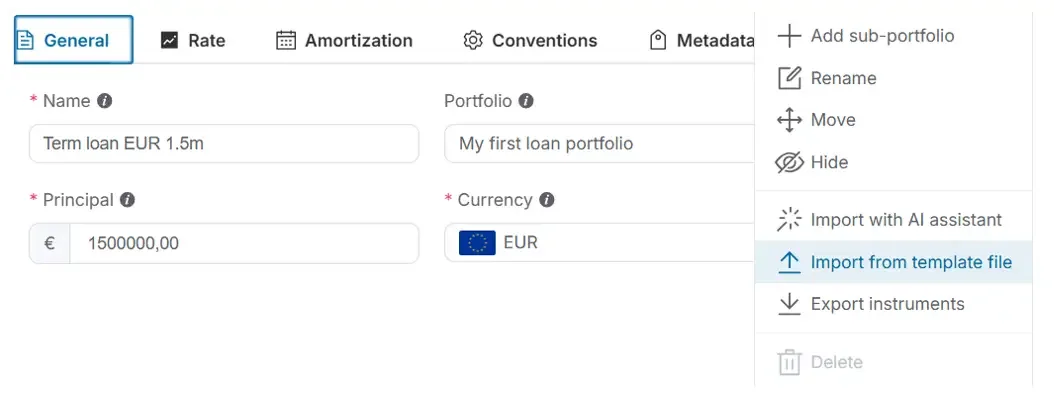
- TreasuryView offers three routes for adding a loan: the loan form, the Excel template and AI-assisted import (beta), which reads a spreadsheet you already have.
- The loan form is the route for a single loan. You enter the key terms, such as principal, dates, rate, payment frequency and conventions, and TreasuryView calculates the schedule. For a bespoke repayment schedule, the cash flows can be copied from Excel into the schedule.
- The Excel template is the route for many loans at once. You download the TreasuryView template, enter one row per loan and upload it.
- AI-assisted import (beta) is the route for a spreadsheet you already have. TreasuryView analyses the file and extracts the loan terms. Results depend on how structured the file is.
- The report is one view of bank loans and intercompany loans, calculated from the loan terms with market data as of the reporting date.
- The demo ends with an invitation to start with your own loans instead of rebuilding the report by hand.
Trinity TMS or TreasuryView: which one should you choose?
Trinity TMS and TreasuryView answer different questions. Trinity TMS is a modular TMS for the treasury operation: liquidity planning, cash management and payments, financing and credit facilities, guarantees, risk management and an in-house bank, introduced in phases from requirements analysis to go-live. TreasuryView is built around debt and derivatives tasks: external facilities, intercompany loans, cash pool interest, swaps and the interest rate risk analytics that go with them. It does not connect to banks, import bank statements or make payments, so it runs next to the cash platform or bank portals a finance team already uses.
Choose Trinity TMS if:
- You are planning a TMS implementation around liquidity planning and cash management, with financing, credit facilities, guarantees and risk management in the same system
- You want daily cash positioning, cash pooling, payments and bank connectivity through EBICS or SWIFT, plus an in-house bank with internal accounts and multilateral netting
- You manage guarantees and surety bonds and want to apply for them digitally through EBICS or the Guarantee Vault platform of Digital Vault Services
- Your hedges cover FX, interest rate and commodity risk, with limits per trader, separation of front, middle and back office and a four-eyes principle
- You need operation on premises or in a German private cloud, with standard interfaces to SAP, Oracle and Microsoft Dynamics
- You can plan an implementation project with requirements analysis, configuration, data migration, training and go-live, and agree an individually quoted licence
Choose TreasuryView if:
- Your task is the debt book and its derivatives rather than a treasury operating model, and your intercompany loans need the full agreement terms, with facilities, limits and commitment fees, drawdowns, fixed or floating rates, custom benchmark rates, tranches and repayment profiles
- Your cash pools need debit and credit interest calculated and reported, from balances or movements you enter or upload instead of an in-house bank set-up
- Your external facilities fund projects across the group and are planned as a portfolio, and you need interest rate swaps valued next to the loans they hedge, on a derivatives engine in production since 2009, with stress tests and scenarios for interest cost and value, on GROW and above
- You are moving loans and cash pool balances out of spreadsheets and want to start self-service, without an integration project, with a 30-day free trial without a payment method, a published monthly price and cancellation at any time
- Your cash and payments workflows stay where they are, and the REST API in every plan sends loan data, schedules and report results to your accounting or treasury systems when you are ready to automate
Strengths and limits of each
TreasuryView
- Strength: external facilities, calculation accuracy since 2009
- External facilities with broad coverage of non-standard terms: fixed and floating rate loans, revolving credit facilities, refinancings and multi-leg loans, with bullet, linear or annuity repayment, commitment limits and fees, and tranches, available from the START plan. Interest, schedules and accruals come from a calculation engine in production use since 2009. In the rare case a figure differs from your bank's confirmation, any row can be corrected.
- Strength: intercompany loans and cash pools
- Intercompany loans with facilities, limits and commitment fees, drawdowns, tranches and custom benchmark rates. Cash pool accounts with debit and credit interest, calculated and reported from the balances or movements you enter or upload.
- Strength: derivatives and interest rate risk analytics since 2009
- Derivatives valued next to the debt book since 2009: interest rate swaps with mark-to-market valuation, linked to the external facilities they hedge, plus interest rate stress tests (+/-100 bps, steepening, flattening), scenario analysis, BPV and duration sensitivities and comparison of hedging conditions with bank offers, on GROW and above. Cross-currency swaps, swaptions and hedge effectiveness testing are on ENTERPRISE. Caps and floors are modelled as loan terms on every plan.
- Strength: self-service start
- A 30-day free trial without a payment method. Move your loans and cash pool balances out of spreadsheets through the loan form or a spreadsheet upload, with no integration project.
- Strength: published pricing
- Monthly plans from €250 (net), cancel anytime, no setup or onboarding fees.
- Strength: API in every plan, from first call to full integration
- Generate a key in the app and send your first request from the interactive documentation, with no project and no extra fee. Automate at your own pace with report exports in XLSX or CSV, and bring in an integration project on ENTERPRISE when your systems need one.
- Strength: schedules you can correct to what happened
- Record what actually happened on a loan, cash pool or swap schedule, such as a moved payment date, an extra repayment or a new drawdown, and adjust upcoming rows to an agreed change. Later rows recalculate where a change carries forward. Available on every plan; swaps on GROW and above.
- Limit: no bank connectivity
- TreasuryView does not connect to banks, import bank statements or execute payments. Bank connections and payments stay in the systems you already use, and balances and movements are entered or uploaded.
- Limit: no cash management
- TreasuryView calculates interest on cash pool balances but does not run sweeps or netting, and does not provide daily cash positioning, payment approval chains or bank reconciliation.
Trinity TMS
- Strength: modular treasury management system
- Liquidity planning, cash management, financing and investment, credit facilities and limits, guarantee management, risk management, in-house bank, automated posting and reporting in one modular system that can be tailored to individual requirements, according to Trinity.
- Strength: financing instruments and credit facilities
- Money market loans, commercial paper, bullet, instalment and annuity loans, promissory note loans (Schuldscheindarlehen), capital market financing, bonds and leasing, with external and intercompany counterparties, automatic interest and repayment schedules, syndicated loans, collateral management and a maturity radar; credit facilities including revolving and syndicated facilities with fee and commission calculation, according to Trinity.
- Strength: interest rate derivatives and valuation
- Swaps, caps, floors, forward rate agreements, swaptions and cross currency swaps, valued with credit and debit value adjustments (CVA/DVA) on automatically imported interest rates and yield curves, with effectiveness analysis and simulation of interest rate developments, according to Trinity.
- Strength: cash, in-house bank and guarantees
- Daily cash positioning, cash pooling with automatic interest calculation for all pool participants, payments, interest-bearing intercompany accounts, multilateral netting and guarantee management with digital guarantee applications through EBICS and a REST API to the Guarantee Vault platform, according to Trinity.
- Strength: German private cloud and controls
- Operation on premises or in the German Private Cloud in ISO-certified data centres in Frankfurt, ISO 27001:2022 certification, GDPR compliance, audit trails, front, middle and back office user profiles and a four-eyes principle, according to Trinity.
- Consideration: implementation effort
- Trinity describes an implementation in phases: requirements analysis, configuration, data migration, training and go-live, accompanied by its team. A typical duration is not stated on the pages read.
- Consideration: pricing and trial
- Pricing depends on the scope of functions and the operating model and is quoted individually. No free trial is advertised on the pages read; evaluation starts with a demo.
Looking for a Trinity TMS alternative for debt management?
If your main task is managing the debt book, meaning external facilities, intercompany loans, cash pools and interest rate derivatives, and your bank connections, payments and cash operation are already handled elsewhere, TreasuryView is built for that job. It offers published pricing from €250 per month, cancellation at any time and a REST API in every plan. If you are planning a TMS implementation for your whole treasury, from liquidity planning and payments to an in-house bank, guarantees and risk management, Trinity TMS covers more of it.
Trinity TMS vs. TreasuryView: debt management compared
| Feature | TreasuryView | Trinity TMS |
|---|---|---|
| Core job | External facilities, intercompany loans, cash pools, derivatives and interest rate risk management | Modular treasury management system: liquidity planning, cash management and payments, financing and investment, credit facilities and limits, guarantee management, currency, interest rate and commodity risk, in-house bank, automated posting and reporting, according to Trinity |
| External facilities | External facilities with broad coverage of non-standard terms: fixed and floating rate loans, revolving credit facilities, refinancings and multi-leg loans, with bullet, linear or annuity repayment, commitment limits and fees, and tranches, from the START plan. Calculation engine in production use since 2009; any row can be corrected to match a bank confirmation | Money market loans, commercial paper, bullet, instalment and annuity loans, promissory note loans (Schuldscheindarlehen), capital market financing and leasing, with fixed and variable rates, various interest calculation methods, business day conventions, syndicated loans, collateral management and automatic interest and repayment schedules; credit facilities, including revolving and syndicated facilities, with utilisation, fees and commissions, according to Trinity |
| Other instruments | Focused on external facilities, intercompany loans, cash pools and interest rate derivatives; FX risk management is an ENTERPRISE add-on | Investments (overnight and fixed-term deposits, commercial paper, bonds, equities and fund units), guarantees, surety bonds and letters of comfort, FX transactions (spot, forward, NDF, options) and commodity derivatives, according to Trinity |
| Intercompany loans | Intercompany loans shared with subsidiaries (borrower or lender view) on every plan, plus bilateral facilities with limits and commitment fees, drawdowns, fixed or floating rates, custom benchmark rates, bullet, linear, annuity or fixed repayment and tranches | Intercompany loans and shareholder loans through the in-house bank, with interest-bearing intercompany accounts, internal credit lines and limits, market-based interest linked to official reference rates, individual margins by counterparty credit standing, and calculation and posting of interest and accruals, according to Trinity |
| Cash pool interest | Cash pool accounts with debit and credit interest on every plan, calculated and reported from the balances or movements you enter or upload. TreasuryView does not import bank statements, run sweeps or net positions | Yes: bank-side cash pools replicated with interest control, or cash pool structures run in Trinity TMS (zero or target balancing). Internal accounts record each movement, and debit and credit interest for all participants is calculated automatically and provided as reports, posting files or MT940 statements, according to Trinity |
| In-house banking and netting | Not included. TreasuryView calculates and reports cash pool interest and does not run sweeps, netting or internal accounts | Yes: in-house bank with interest-bearing intercompany accounts, interest and accrual calculation, internal credit lines and limits, electronic statements (MT940) for intercompany accounts, intercompany clearing and periodic multilateral netting, according to Trinity |
| Pricing | Published: START €250 per month, GROW €500 per month, ENTERPRISE on request. Net of VAT. Priced per team, not per user | Not published. Trinity's FAQ states that pricing depends on the scope of functions and the operating model and is quoted individually |
| Free trial and contract | 30-day free trial with full access and no payment method. Monthly invoicing with no long-term contract, cancel any time, no cancellation fees, paid by bank transfer | No free trial advertised on the pages read; evaluation starts with a demo. Contract terms are not published |
| Setup and time to start | Sign up in under a minute and add loans through the loan form, a spreadsheet upload or AI-assisted import. No setup or onboarding fees | Implementation in phases: requirements analysis, configuration, data migration, training and go-live, accompanied by Trinity's team. A typical overall duration is not stated on the pages read |
| API access | REST API with interactive documentation (OpenAPI) and developer portal access on every plan | Interfaces and web services for data exchange, a REST API to the Guarantee Vault platform, and standard interfaces to SAP, Oracle and Microsoft Dynamics plus individual connectors, according to Trinity. Public API documentation or a developer portal was not found on the pages read |
| Debt-related API | Loan and cash pool lists, payment schedules, interest and accrual reports via the API; derivative data on GROW and above | Not described; no endpoints are published on the pages read |
| Derivatives-related API | Interest rate swaps with payment cash flows, valuation and hedge reports, plus curves and scenario calculations via the API; swaps on GROW and above | Not described; no endpoints are published on the pages read |
| Cash and bank data API | Not covered | Not described as endpoints. Bank data comes in through EBICS, SWIFT and electronic banking, including intraday advices, according to Trinity |
| Payments API | Not covered | Not described as endpoints. Payments run through Trinity's payments module and electronic banking, according to Trinity |
| Loan capture | Loan form or spreadsheet upload, plus AI-assisted import below; the REST API sends results out | Financing instruments are set up in the system with audit-compliant, multi-stage workflows; loan agreements can be attached or generated from the system, according to Trinity. Spreadsheet upload of loans is not described on the pages read |
| Get debt data out (downstream) | Loan and cash pool lists, payment schedules, derivative data on GROW and above and report runs with XLSX or CSV export, via the API | Ready-to-use reports, flexible multi-level pivot analysis, a maturity radar, and automated posting through the accounting module, according to Trinity |
| Reference rates | Automated EUR reference rate fixings and pre-integrated curves on every plan; automated fixings in other currencies on ENTERPRISE; fixings and curves available via the API; custom benchmark rates are part of every loan's data model | Automatically imported and historised interest rates and yield curves, through feeds from market data providers or bank files via EBICS, according to Trinity |
| Derivatives and valuation | Derivatives in production use since 2009: interest rate swaps with mark-to-market valuation, linked to the loans they hedge, on GROW; cross-currency swaps, swaptions, basis and amortising swaps and hedge effectiveness testing on ENTERPRISE; caps and floors as loan terms on every plan | Swaps, caps, floors, forward rate agreements, swaptions and cross currency swaps, valued with credit and debit value adjustments (CVA/DVA); hedging instruments are recorded, valued and monitored, and their effectiveness is analysed, according to Trinity |
| Interest rate risk analytics | Interest rate stress tests (+/-100 bps, steepening, flattening), scenario analysis, sensitivities (BPV and duration) and comparison of hedging conditions with bank offers on GROW and above | Company-wide view of interest rate deals and hedges, simulation of various interest rate developments, and limits per trader, currency and maximum loss, according to Trinity. Basis point stress tests and sensitivities such as BPV are not described on the pages read |
| Loan import with AI | AI-assisted import from term sheets, PDFs and spreadsheets (beta on START and GROW; included in ENTERPRISE) | AI and predictive analytics are described for liquidity planning. AI import of loan agreements, term sheets or spreadsheets is not described on the pages read (reviewed 18 November 2026) |
| Bank connection | Not included. Bank data stays in your bank portal, accounting or treasury system, or connectivity provider | Yes: EBICS, SWIFT and electronic banking, plus connections to online FX trading platforms, according to Trinity |
| Payments | Not included | Yes: payments module, standing settlement instructions and support for common payment formats worldwide, according to Trinity |
| Actual movements on the schedule | Recorded as schedule overrides on loans, cash pools and, on GROW and above, swaps, such as a moved payment date, an extra repayment or a new drawdown | Bank statements feed cash positioning and a rule-based reconciliation with planning data; how actual debt movements update a loan schedule is not described on the pages read |
| Debt interest posting to accounting | Interest, accruals and schedules go to your accounting system through the API. Integration projects with accounting systems are available on ENTERPRISE | Accounting module with automatic account assignment and posting of cash flows, interest accruals and valuations to the accounting system, according to Trinity |
| Audit trail | Unalterable audit trail of users and deals on GROW and ENTERPRISE; user activity log on START | Audit trails, historisation of transaction and market data, and rule-based workflows with dual control (four-eyes principle), according to Trinity |
| Single sign-on | Microsoft Entra ID on ENTERPRISE; passkey, e-mail code or federated sign-in on every plan | Not described on the pages read |
| Security and hosting | Client data hosted in Germany in an ISO 27001-certified data centre, designed to meet GDPR requirements; audit trail of user activity and deals | ISO 27001:2022 certified and GDPR compliant, with data centres in Germany (Frankfurt), regular audits and penetration tests; operation on premises, in the German Private Cloud or hybrid, according to Trinity |
| Support and implementation | Support by e-mail, chat, phone and video call on every plan, priority support on GROW and ENTERPRISE, integration projects on ENTERPRISE | Support by phone, Microsoft Teams or e-mail, user and administrator training and individual workshops; Trinity states a response time of under 30 minutes |
| Track record in debt management | Debt management and derivatives in production use since 2009 | 28 years of treasury experience, according to Trinity; clients named on its site include Schaeffler, LEDVANCE, CECONOMY, Telefónica Germany, ALPLA, TMD Friction and SCIO Automation, described as mid-market to enterprise |
Core job
TreasuryView
External facilities, intercompany loans, cash pools, derivatives and interest rate risk management
Trinity TMS
Modular treasury management system: liquidity planning, cash management and payments, financing and investment, credit facilities and limits, guarantee management, currency, interest rate and commodity risk, in-house bank, automated posting and reporting, according to Trinity
External facilities
TreasuryView
External facilities with broad coverage of non-standard terms: fixed and floating rate loans, revolving credit facilities, refinancings and multi-leg loans, with bullet, linear or annuity repayment, commitment limits and fees, and tranches, from the START plan. Calculation engine in production use since 2009; any row can be corrected to match a bank confirmation
Trinity TMS
Money market loans, commercial paper, bullet, instalment and annuity loans, promissory note loans (Schuldscheindarlehen), capital market financing and leasing, with fixed and variable rates, various interest calculation methods, business day conventions, syndicated loans, collateral management and automatic interest and repayment schedules; credit facilities, including revolving and syndicated facilities, with utilisation, fees and commissions, according to Trinity
Other instruments
TreasuryView
Focused on external facilities, intercompany loans, cash pools and interest rate derivatives; FX risk management is an ENTERPRISE add-on
Trinity TMS
Investments (overnight and fixed-term deposits, commercial paper, bonds, equities and fund units), guarantees, surety bonds and letters of comfort, FX transactions (spot, forward, NDF, options) and commodity derivatives, according to Trinity
Intercompany loans
TreasuryView
Intercompany loans shared with subsidiaries (borrower or lender view) on every plan, plus bilateral facilities with limits and commitment fees, drawdowns, fixed or floating rates, custom benchmark rates, bullet, linear, annuity or fixed repayment and tranches
Trinity TMS
Intercompany loans and shareholder loans through the in-house bank, with interest-bearing intercompany accounts, internal credit lines and limits, market-based interest linked to official reference rates, individual margins by counterparty credit standing, and calculation and posting of interest and accruals, according to Trinity
Cash pool interest
TreasuryView
Cash pool accounts with debit and credit interest on every plan, calculated and reported from the balances or movements you enter or upload. TreasuryView does not import bank statements, run sweeps or net positions
Trinity TMS
Yes: bank-side cash pools replicated with interest control, or cash pool structures run in Trinity TMS (zero or target balancing). Internal accounts record each movement, and debit and credit interest for all participants is calculated automatically and provided as reports, posting files or MT940 statements, according to Trinity
In-house banking and netting
TreasuryView
Not included. TreasuryView calculates and reports cash pool interest and does not run sweeps, netting or internal accounts
Trinity TMS
Yes: in-house bank with interest-bearing intercompany accounts, interest and accrual calculation, internal credit lines and limits, electronic statements (MT940) for intercompany accounts, intercompany clearing and periodic multilateral netting, according to Trinity
Pricing
TreasuryView
Published: START €250 per month, GROW €500 per month, ENTERPRISE on request. Net of VAT. Priced per team, not per user
Trinity TMS
Not published. Trinity's FAQ states that pricing depends on the scope of functions and the operating model and is quoted individually
Free trial and contract
TreasuryView
30-day free trial with full access and no payment method. Monthly invoicing with no long-term contract, cancel any time, no cancellation fees, paid by bank transfer
Trinity TMS
No free trial advertised on the pages read; evaluation starts with a demo. Contract terms are not published
Setup and time to start
TreasuryView
Sign up in under a minute and add loans through the loan form, a spreadsheet upload or AI-assisted import. No setup or onboarding fees
Trinity TMS
Implementation in phases: requirements analysis, configuration, data migration, training and go-live, accompanied by Trinity's team. A typical overall duration is not stated on the pages read
API access
TreasuryView
REST API with interactive documentation (OpenAPI) and developer portal access on every plan
Trinity TMS
Interfaces and web services for data exchange, a REST API to the Guarantee Vault platform, and standard interfaces to SAP, Oracle and Microsoft Dynamics plus individual connectors, according to Trinity. Public API documentation or a developer portal was not found on the pages read
Debt-related API
TreasuryView
Loan and cash pool lists, payment schedules, interest and accrual reports via the API; derivative data on GROW and above
Trinity TMS
Not described; no endpoints are published on the pages read
Derivatives-related API
TreasuryView
Interest rate swaps with payment cash flows, valuation and hedge reports, plus curves and scenario calculations via the API; swaps on GROW and above
Trinity TMS
Not described; no endpoints are published on the pages read
Cash and bank data API
TreasuryView
Not covered
Trinity TMS
Not described as endpoints. Bank data comes in through EBICS, SWIFT and electronic banking, including intraday advices, according to Trinity
Payments API
TreasuryView
Not covered
Trinity TMS
Not described as endpoints. Payments run through Trinity's payments module and electronic banking, according to Trinity
Loan capture
TreasuryView
Loan form or spreadsheet upload, plus AI-assisted import below; the REST API sends results out
Trinity TMS
Financing instruments are set up in the system with audit-compliant, multi-stage workflows; loan agreements can be attached or generated from the system, according to Trinity. Spreadsheet upload of loans is not described on the pages read
Get debt data out (downstream)
TreasuryView
Loan and cash pool lists, payment schedules, derivative data on GROW and above and report runs with XLSX or CSV export, via the API
Trinity TMS
Ready-to-use reports, flexible multi-level pivot analysis, a maturity radar, and automated posting through the accounting module, according to Trinity
Reference rates
TreasuryView
Automated EUR reference rate fixings and pre-integrated curves on every plan; automated fixings in other currencies on ENTERPRISE; fixings and curves available via the API; custom benchmark rates are part of every loan's data model
Trinity TMS
Automatically imported and historised interest rates and yield curves, through feeds from market data providers or bank files via EBICS, according to Trinity
Derivatives and valuation
TreasuryView
Derivatives in production use since 2009: interest rate swaps with mark-to-market valuation, linked to the loans they hedge, on GROW; cross-currency swaps, swaptions, basis and amortising swaps and hedge effectiveness testing on ENTERPRISE; caps and floors as loan terms on every plan
Trinity TMS
Swaps, caps, floors, forward rate agreements, swaptions and cross currency swaps, valued with credit and debit value adjustments (CVA/DVA); hedging instruments are recorded, valued and monitored, and their effectiveness is analysed, according to Trinity
Interest rate risk analytics
TreasuryView
Interest rate stress tests (+/-100 bps, steepening, flattening), scenario analysis, sensitivities (BPV and duration) and comparison of hedging conditions with bank offers on GROW and above
Trinity TMS
Company-wide view of interest rate deals and hedges, simulation of various interest rate developments, and limits per trader, currency and maximum loss, according to Trinity. Basis point stress tests and sensitivities such as BPV are not described on the pages read
Loan import with AI
TreasuryView
AI-assisted import from term sheets, PDFs and spreadsheets (beta on START and GROW; included in ENTERPRISE)
Trinity TMS
AI and predictive analytics are described for liquidity planning. AI import of loan agreements, term sheets or spreadsheets is not described on the pages read (reviewed 18 November 2026)
Bank connection
TreasuryView
Not included. Bank data stays in your bank portal, accounting or treasury system, or connectivity provider
Trinity TMS
Yes: EBICS, SWIFT and electronic banking, plus connections to online FX trading platforms, according to Trinity
Payments
TreasuryView
Not included
Trinity TMS
Yes: payments module, standing settlement instructions and support for common payment formats worldwide, according to Trinity
Actual movements on the schedule
TreasuryView
Recorded as schedule overrides on loans, cash pools and, on GROW and above, swaps, such as a moved payment date, an extra repayment or a new drawdown
Trinity TMS
Bank statements feed cash positioning and a rule-based reconciliation with planning data; how actual debt movements update a loan schedule is not described on the pages read
Debt interest posting to accounting
TreasuryView
Interest, accruals and schedules go to your accounting system through the API. Integration projects with accounting systems are available on ENTERPRISE
Trinity TMS
Accounting module with automatic account assignment and posting of cash flows, interest accruals and valuations to the accounting system, according to Trinity
Audit trail
TreasuryView
Unalterable audit trail of users and deals on GROW and ENTERPRISE; user activity log on START
Trinity TMS
Audit trails, historisation of transaction and market data, and rule-based workflows with dual control (four-eyes principle), according to Trinity
Single sign-on
TreasuryView
Microsoft Entra ID on ENTERPRISE; passkey, e-mail code or federated sign-in on every plan
Trinity TMS
Not described on the pages read
Security and hosting
TreasuryView
Client data hosted in Germany in an ISO 27001-certified data centre, designed to meet GDPR requirements; audit trail of user activity and deals
Trinity TMS
ISO 27001:2022 certified and GDPR compliant, with data centres in Germany (Frankfurt), regular audits and penetration tests; operation on premises, in the German Private Cloud or hybrid, according to Trinity
Support and implementation
TreasuryView
Support by e-mail, chat, phone and video call on every plan, priority support on GROW and ENTERPRISE, integration projects on ENTERPRISE
Trinity TMS
Support by phone, Microsoft Teams or e-mail, user and administrator training and individual workshops; Trinity states a response time of under 30 minutes
Track record in debt management
TreasuryView
Debt management and derivatives in production use since 2009
Trinity TMS
28 years of treasury experience, according to Trinity; clients named on its site include Schaeffler, LEDVANCE, CECONOMY, Telefónica Germany, ALPLA, TMD Friction and SCIO Automation, described as mid-market to enterprise
Statements about Trinity TMS are based on its public website (home page, treasury, cash management, in-house bank and risk management pages, FAQ and best-practice articles), read on 18 November 2026. 'Not described' means Trinity's public pages describe no such feature on that date; it does not rule out features that exist but are not published. Additional currencies, or licensable reference rate or swap data, may require a separate market data licence, priced separately. Trinity TMS is a trademark of its owner, and this page is not affiliated with or endorsed by Trinity Management Systems GmbH. If you spot something outdated or inaccurate, please contact us and we will correct it.
Information about third-party products is based on publicly available sources and was last reviewed on 2026-11-18. TreasuryView is not affiliated with the vendors named. All product names and trademarks belong to their respective owners.
Derivatives and interest rate risk: what each platform covers today
Knowing where every loan and derivative stands is the first step. A treasurer also needs to know what happens when markets move. TreasuryView covers external facilities, intercompany loans, derivatives and interest rate risk in one platform, so positions and market impact sit together:
- Position: every external facility, intercompany loan and swap in one place, with schedules, accruals and valuations from the calculation engine.
- Impact: what a move of 100 basis points does to interest cost and cash flows, to the value of swaps and loans, and to the average cost of funds. Rate impact analysis is available on GROW.
- Growth: when the business adds a facility, a swap or a foreign-currency loan, it goes into the same platform instead of a new spreadsheet.
Derivatives and interest rate risk start with the GROW plan (€500 per month). START covers loans, intercompany loans and cash pools. FX rates, FX forward curves and FX history are available through the API. The FX risk management module (spot, forwards and options) is an ENTERPRISE add-on, available on request.
Trinity TMS lists swaps, caps, floors, forward rate agreements, swaptions and cross currency swaps, valuations with CVA and DVA on automatically imported interest rates and yield curves, simulation of interest rate developments and effectiveness analysis of hedging instruments, according to its public pages (reviewed 18 November 2026). Its range also includes FX and commodity hedging. TreasuryView's focus is interest rate derivatives valued next to the debt they hedge, in production use since 2009.
If your debt is only intercompany loans today, you may not need interest rate risk analytics yet. If external facilities or swaps are coming, starting on a platform that covers them avoids a second migration.
API and integration: link your debt data with the systems around it
Debt data is only useful if it reaches the systems that need it. TreasuryView's REST API is included in every plan, with API documentation and developer portal access, so you can build the workflow that fits your stack. Typical workflows:
- Upstream: loans enter through the loan form, a spreadsheet upload or AI-assisted import (beta), so you can start without an integration project.
- Downstream to accounting: pull accruals, schedules and reports into your accounting or treasury system, so figures are not retyped.
- Downstream to cash forecasting and BI: send interest and principal schedules to your forecasting tool or dashboards.
- Market data: pull curves, reference rate fixings and FX rates into your own models.
These are examples. The API documentation lists the endpoints available on your plan.
What each TreasuryView plan covers
- START (€250 per month): up to 50 loans, 1 company including subsidiaries, 5 internal users, multi-currency (EUR, USD, GBP, CHF and 20+ others), cash pools, intercompany loans, manual schedule overrides, integrated end-of-day market data and the REST API.
- GROW (€500 per month): up to 300 loans and interest rate derivatives, 15 internal users plus 10 guests, valuation and interest rate risk analytics, interest rate swaps, hedge coverage and priority support.
- ENTERPRISE (on request): cross-currency swaps, swaptions, hedge effectiveness testing, the FX risk management module (spot, forwards and options), automated fixings in other currencies, extended transaction volume and reports, single sign-on (Microsoft Entra ID), and integration projects with accounting systems, built for you.
Full functionality free for 30 days
Sign up in under a minute, no credit card. The trial ends automatically. Monthly plans from €250 (net), cancel anytime. Plan details are on the pricing page.
How to choose debt management software next to or instead of a treasury platform
If you answer "yes" to these questions, TreasuryView might be a good fit.
-
Still tracking external facilities, intercompany loans and cash pools in spreadsheets?
TreasuryView keeps external facilities, intercompany loans, cash pools and derivatives in one dashboard, with schedules and accruals calculated for you.
-
Do you need swaps valued and interest rate risk analysed next to your loans?
TreasuryView values interest rate swaps alongside your loans on GROW and above, with mark-to-market valuation, stress tests and interest rate scenarios. Caps and floors are modelled as loan terms.
-
Do you need a platform you can start with yourself, without an implementation project?
Sign up, add your loans through the loan form or a spreadsheet upload, and run reports. There are no setup fees.
-
Do you want published pricing before you commit budget?
Monthly plans are published from €250 (net), with a 30-day free trial.
-
Is bank connectivity already handled in your bank portal, your accounting or treasury system or by a provider?
TreasuryView works next to it and links through the API, so you keep that contract.
-
Do you need to send debt data to accounting, forecasting or BI tools?
The REST API, included in every plan, sends results out to the systems around TreasuryView.
-
Do you need payments, bank connectivity and daily cash positioning from the same tool?
Then Trinity TMS may fit better. TreasuryView does not provide payments or daily cash management.
What the first 30 days look like
Within the 30-day free trial you can have your external facilities, intercompany loans and cash pools in one place, with reports and market data included.
-
Start in under a minute
Immediate access
Create a free accountSign up for free and explore the full functionality.
-
Day 1
Import your data
Data migrationUpload your loans with the Excel template or enter them directly, and preview each schedule before you save.
-
Week 1
Automate your work
Customise views and automate reporting.
-
Week 2
Make data-driven decisions
Evaluate interest rate risk and, on GROW, value swaps next to the loans they hedge.
“It [TreasuryView] is a very intuitive tool to use, with enough capabilities to get a clear understanding of your company's treasury status. I also really value the support I get from their team setting it up for my company.”
Other comparisons
- Agicap Alternative for Loan & Debt Management
- Atlar Alternative for Debt Management
- Chatham Onyx Alternative for Mid-Sized Companies
- Embat Alternative for Mid-Sized Companies
- ION Treasury Alternative for Debt Management
- Kyriba Alternative for Mid-Sized Companies
- Nomentia Alternative for SMBs & Mid-Sized Companies
- Ripple Treasury (GTreasury) Alternative
- Salmon Treasury Alternative for Mid-Sized Companies
- Spreadsheet Alternative for Loan & Debt Management
- Enterprise TMS Alternative for Mid-Sized Companies
- Trovata Alternative for Debt Management
- ZenTreasury Alternative for Mid-Sized Companies
FAQ: choosing between TreasuryView and Trinity TMS
What is a Trinity TMS alternative for debt management?
TreasuryView is one option if managing the debt book is your main task. It manages external facilities, intercompany loans, cash pools and interest rate derivatives, calculates interest, schedules and valuations, and publishes its monthly pricing. Trinity TMS is a modular TMS covering liquidity planning, cash management, payments, guarantees, risk management and an in-house bank, so the better fit depends on whether the whole treasury operation or the debt and derivatives portfolio comes first.
How much does Trinity TMS cost compared with TreasuryView?
Trinity does not publish prices. Its FAQ states that pricing depends on the scope of functions and the operating model, and that it prepares an individual quote. TreasuryView publishes its prices: START is €250 per month and GROW is €500 per month, both net of VAT, with ENTERPRISE on request. To compare total cost, compare the scope each one covers.
Is there a monthly plan, and can I cancel at any time?
Yes. TreasuryView plans are billed monthly, there is no long-term contract, and you can cancel any time in your account with no cancellation fee. Payment is by bank transfer. Trinity does not publish its contract terms.
Is there a free trial, and do I need a credit card?
TreasuryView offers a 30-day free trial with full access and no payment method, and you can upload your own loans to see real reports. Trinity does not advertise a free trial on the pages we read; you start with a demo.
Can I buy Trinity's financing module on its own?
Trinity describes a modular system that can be tailored to individual requirements. Which modules can be licensed on their own is agreed with Trinity and is not stated on its public pages. TreasuryView is standalone debt and treasury management software that you can start yourself.
Can I use TreasuryView next to Trinity TMS?
Yes. TreasuryView does not replace a cash platform. Finance teams keep bank connections and payments where they are and use TreasuryView for external facilities, intercompany loans, cash pool interest and derivatives. The REST API sends schedules and report results to the systems around it.
Which debt instruments does each platform cover?
Trinity lists money market loans, commercial paper, bullet, instalment and annuity loans, promissory note loans (Schuldscheindarlehen), capital market financing, bonds and leasing, credit facilities including revolving and syndicated facilities, investments, guarantees, and FX, interest rate and commodity derivatives. TreasuryView covers external facilities, including revolving credit facilities, intercompany loans, cash pools and interest rate derivatives.
Does TreasuryView manage external facilities as well as intercompany loans?
Yes. External facilities, meaning bank loans and credit facilities, are available from the START plan, with broad coverage of non-standard terms: fixed and floating rate loans, revolving credit facilities, refinancings and multi-leg loans, with bullet, linear or annuity repayment, commitment limits and fees, and tranches. Interest, schedules and accruals come from a calculation engine in production use since 2009, and any row can be corrected to match a bank confirmation.
Can TreasuryView calculate interest on cash pool balances, and does it import bank statements?
TreasuryView calculates and reports debit and credit interest on cash pool accounts on every plan, from balances or movements you enter or upload. It does not import bank statements, run sweeps or net positions.
Does Trinity TMS calculate interest on intercompany loans and cash pools?
According to Trinity's public pages, yes. Its in-house bank manages intercompany loans and shareholder loans on interest-bearing intercompany accounts, with market-based interest linked to official reference rates and margins by counterparty credit standing, and calculates and posts interest and accruals. For cash pools, Trinity replicates bank-side pools or runs pool structures itself and calculates debit and credit interest for all participants automatically. TreasuryView calculates and reports debit and credit interest on cash pool accounts on every plan, from balances or movements you enter or upload, and manages intercompany loans with facilities, limits, drawdowns and custom benchmark rates.
Does Trinity TMS support interest rate derivatives and risk management?
According to Trinity's public pages, yes. It lists swaps, caps, floors, forward rate agreements, swaptions and cross currency swaps, valuations with CVA and DVA, simulation of interest rate developments and effectiveness analysis of hedges. TreasuryView values interest rate swaps next to the loans they hedge from GROW, with stress tests, scenarios and BPV and duration sensitivities, and its calculation engine has been in production use since 2009. Check both vendors' current documentation against your requirements and test with your own data.
Which TreasuryView plan do I need for derivatives and interest rate risk?
Derivatives and interest rate risk analytics start with GROW at €500 per month. START covers loans, intercompany loans and cash pools. Cross-currency swaps, swaptions, basis and amortising swaps and hedge effectiveness testing are on ENTERPRISE.
What happens to my loans and derivatives when rates move?
TreasuryView shows the impact of rate moves on interest cost, cash flows and the value of swaps and loans, with rate impact analysis on GROW.
Does Trinity TMS analyse hedge effectiveness, and what does TreasuryView offer?
According to its public pages, Trinity records, values and monitors interest rate hedging instruments, analyses their effectiveness and posts cash flows and valuations to accounting. TreasuryView offers hedge relationships on GROW and above and, on ENTERPRISE, hedge effectiveness testing.
Does TreasuryView have an API, and is it included in every plan?
Yes. TreasuryView's REST API, with interactive documentation, is included in START, GROW and ENTERPRISE, and so is developer portal access. Trinity describes interfaces and web services and standard interfaces to SAP, Oracle and Microsoft Dynamics; public API documentation was not found on the pages we read.
How do I get my loans into TreasuryView?
Through the loan form, a spreadsheet upload or AI-assisted import (beta). The REST API then sends calculation results out to your accounting or treasury systems.
Can I send TreasuryView data to my accounting system, cash forecast or BI tool?
Yes. Instruments, exposure portfolio data and report content can be exported through the API.
Do I need bank connections to use TreasuryView?
No. TreasuryView does not connect to banks. Bank transactions and repayments stay in your bank portal, accounting or treasury system or connectivity provider, while loan terms, schedules and interest live in TreasuryView.
Can I keep my current bank connectivity provider?
Yes. TreasuryView sits beside your existing bank connectivity, whether that is your bank portal, your accounting or treasury system or a provider, and you keep that contract.
How long does setup take compared with Trinity TMS?
You can sign up in under a minute and upload loans from a spreadsheet on the first day, without involving your IT team. Trinity describes an implementation in phases, from requirements analysis and configuration to data migration, training and go-live, and does not publish a typical duration on the pages we read.
How do I move my debt book from Trinity TMS to TreasuryView?
TreasuryView is debt and treasury management software that covers the debt part of a TMS: external facilities, intercompany loans, cash pool interest and, on the GROW plan, interest rate derivatives. To move your debt book, take the loan terms from your current records and add them through the loan form, the Excel template or AI-assisted import (beta). Sign-up takes under a minute and loans can be uploaded on the first day. TreasuryView has no bank connectivity or payments, so teams that need those keep Trinity TMS or their provider for cash and payments and run TreasuryView next to it. See the migration guide.
Will I talk to a human if I get stuck during the trial?
Yes. If you get stuck or want a tour of the software, you can talk to one of our professionals. Full support is available during the trial, and you can book a demo call.
What if TreasuryView is not for me and I want to leave?
The free trial ends automatically and its data will be deleted. Monthly plans can be cancelled at any time.
Does TreasuryView support custom benchmark rates, such as an internal group funding rate?
Yes. Custom benchmark rates are part of every loan's data model and are always on, so a loan can reset on an internal rate as well as on market indices.
Is my data secured?
Client data is hosted in an ISO 27001-certified data centre in Germany and handled according to German and EU regulations. TreasuryView also appoints an external data security officer. Learn more about data security. Trinity states ISO 27001:2022 certification, GDPR compliance and data centres in Frankfurt, with operation on premises or in its German Private Cloud.
Trinity TMS and TreasuryView are both hosted in Germany. What is the difference?
Both keep client data in German data centres. The difference is scope and how you start. Trinity TMS is a modular TMS for liquidity, cash, payments, guarantees, risk and an in-house bank, introduced through an implementation project with an individual quote. TreasuryView is debt and treasury management software for external facilities, intercompany loans, cash pools and interest rate derivatives, which you start yourself with a 30-day free trial and published monthly pricing.
Which alternatives to Trinity TMS exist?
That depends on your company's size, priorities and budget. Three examples, by focus:
- TreasuryView: for finance teams focused on debt management. It automates reporting, reduces Excel risks and improves visibility across external facilities, intercompany loans, cash pools and derivatives, for teams without internal IT support.
- Kyriba: a full treasury platform covering cash, payments, bank connectivity, in-house banking and risk. See TreasuryView vs. Kyriba.
- Nomentia: a treasury suite covering bank connectivity, payments, cash and debt, with a vendor-led implementation. See TreasuryView vs. Nomentia.
Choose based on what matters most: debt management, global treasury control or bank and payment visibility.
Where can I find more answers?
See the general FAQ or contact us.
How we reviewed this page
Statements about Trinity TMS are based on its public website, read on 18 November 2026: the home page, the treasury page (financing and investment, credit facilities and limits, guarantee management), the cash management, in-house bank and risk management pages, the FAQ and best-practice articles dated June and August 2026. Trinity facts are vendor-stated. TreasuryView facts are taken from its pricing page on the same date. "Not described" means the pages we read describe no such feature today; it does not mean something does not exist. Trinity may have changed since. If you spot something out of date, please contact us and we will correct it.
Compare with your own loan data, free for 30 days
Import your own loan portfolio, check the results against your existing model and then decide.